

This article is part of our AI Agent Guides. See how models compare this week on the AI Agent Leaderboard, a ranking of rankings refreshed every week.
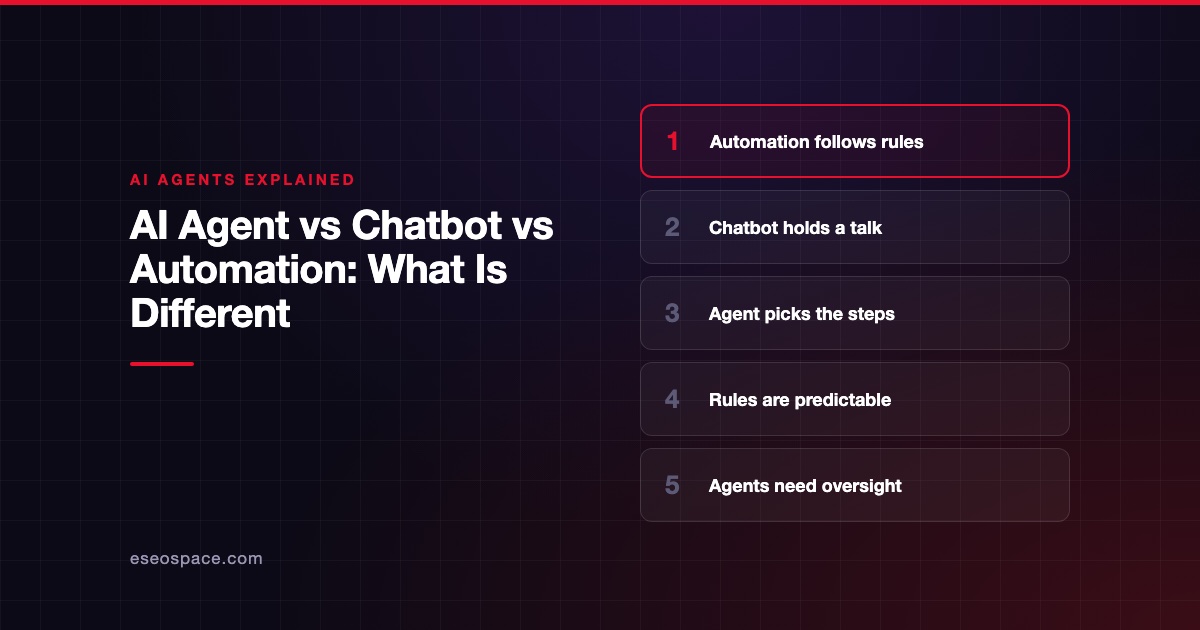
The difference comes down to who decides the steps. In automation, you decide in advance. In a chatbot, the conversation drives each reply, and in an agent, the AI decides.
That one question predicts cost, risk and how much supervision you need.
Most businesses need all three at different times. The mistake is paying for an agent when a simple rule would do, or trusting a rule with a job that keeps changing.
Key Takeaways
- Automation runs fixed steps when a trigger fires. It is predictable and only as smart as the rules you wrote.
- Chatbots answer people in conversation. Traditional ones follow scripts, while AI ones generate replies.
- Agents work toward a goal, choose tools and adjust as they go. They handle messy work and can make messier mistakes.
- The labels now overlap. Ask what the product does, not what it is called.
- Start with the simplest option that does the job, and move up only when it falls short.
The three side by side
| Automation (Zapier-style) | Chatbot | AI agent | |
|---|---|---|---|
| Who decides the steps | You, in advance | A script or the model, one reply at a time | The AI, as it goes |
| What starts it | An event, such as a new form entry | A person's message | A goal or a request |
| Same input, same result? | Yes, if the steps have no AI in them | Scripted bots yes, AI bots not always | Not always |
| Main strength | Reliability at volume | Instant answers | Handling work with unknown steps |
| Typical failure | Breaks on an unexpected input | Wrong or unhelpful answer | Wrong action taken with confidence |
| Oversight needed | Check it when it fails | Sample the transcripts | Review actions and set limits |
The "not always" entries matter more than they look. Zapier's own agents page lists a frequently asked question on why you do not get the same outcome from AI every time. Build your process with that in mind.
What automation does
Automation is a recipe. Zapier's help center defines a Zap as a workflow with a trigger, which starts it, and one or more actions, which it performs afterward. A new form entry arrives, a contact gets created, and a message goes to your sales channel.
Nothing is being reasoned about, and that is the appeal. If your steps do not change, a rule runs the same way each time, and you can read exactly what it will do. When it fails, it usually fails in a way you can trace.
The limit is inputs you did not plan for. If a customer writes "cancel the second one, not the first", a rule has no way to work out what that means. You either send it to a person or build a much larger set of rules.
What a chatbot does
A chatbot is software that talks. IBM describes a chatbot as an application that communicates with people through text or voice to answer questions and help them complete tasks.
There are two kinds, and IBM separates them clearly. Traditional chatbots follow predefined rules, decision trees and scripted flows. AI chatbots use large language models to understand intent and produce more natural replies.
Chatbots are often the right answer for support questions and basic intake. Our guide to building AI chatbots for customer support covers that path. Their limit appears when a person needs something done, not just explained.
What an AI agent does
An agent takes a goal and works out how to reach it. IBM's definition is a system that autonomously performs tasks by designing workflows with available tools. We explain the mechanics in what is an AI agent.
Anthropic's guide to building effective agents gives a useful dividing line. Workflows follow predefined code paths, while agents direct their own process and tool use. It recommends agents for open-ended problems where you cannot predict the number of steps.
Take the "cancel the second one" message again. An agent could look up the customer's orders, identify the second, check your cancellation policy and draft the refund. That is useful, and it is also why the agent needs limits on what it may do without asking.
Why the lines are blurring
The categories are no longer neat, so product names will not settle this for you. Three overlaps cause most of the confusion.
Chatbots are gaining tools. IBM says many AI chatbots now connect to business applications and databases so they can retrieve information and complete transactions. Its agent guide separates nonagentic chatbots, with no tools, memory or reasoning, from agentic ones that can plan subtasks.
Automation platforms are adding agents. Zapier now sells Agents alongside Zaps. It describes them as working across more than 9,000 apps (checked on 2 November 2026). The same vendor can sell you both, so ask which one a given feature uses.
Agents often run inside workflows. Anthropic's guide calls all these variations "agentic systems" but keeps the workflow and agent distinction. In practice, one rule-based step can hand a messy decision to an AI step and take back control.
How to choose
Ask these questions in order, and stop at the first clear answer.
- Are the steps the same every time? Use automation. Do not pay for reasoning you do not need.
- Does the person just need information? Use a chatbot grounded in your documents.
- Do the steps depend on what turns up? Consider an agent.
- Could a wrong action cost money or trust? Keep an approval step, whichever you choose.
- Is it legal, medical, tax or financial? A qualified professional must review the output, in every option.
Anthropic's advice here is worth repeating: find the simplest solution possible, because agentic systems often trade latency and cost for better performance. If a Zap solves it, you are finished.
Three examples
| Job | Good first choice | Why |
|---|---|---|
| Copy new leads into your CRM and alert sales | Automation | Same steps every time |
| Answer "what are your hours and do you take my insurance?" | Chatbot | Information from known documents |
| Research 40 prospects and draft tailored notes for review | Agent | Steps vary by prospect, and a person checks the drafts |
Mixing them is normal. A form can trigger an automation, which hands an unusual request to an agent, which then asks a person to approve. For connecting these pieces, see our MCP guide and our Composio vs Zapier MCP comparison.
If you do choose an agent
Not all agents work equally well, and the model inside makes a real difference. Independent benchmarks test this on realistic tasks.
Our AI Agent Leaderboard averages several of those benchmarks and refreshes weekly, so it can stay current in a way this article cannot. If you care most about behavior, look at the reliability board. It uses signals from real sessions, such as whether shell commands succeeded and whether the agent followed corrections.
Then run your own trial. A strong benchmark result shows a model can handle agent work, but it does not show it can handle your exceptions.
Frequently asked questions
Is an AI chatbot the same as an AI agent?
No, though one product can be both. A chatbot's job is to reply, while an agent's job is to reach a goal, which may include acting in other software. If it can only talk, it is a chatbot.
Is Zapier an AI agent?
A standard Zap is automation, because you define the trigger and actions in advance. Zapier also offers a separate Agents product. Check which one you are looking at before you compare prices or plan oversight.
Are agents always better than automation?
No. For fixed steps, automation is usually cheaper and more predictable. Agents earn their cost when the path changes from one case to the next, and a person cannot reasonably write every rule.
Can I start with a chatbot and add agent features later?
Yes, and it is a sensible order. Get answers right first, then add one tool at a time, starting with read-only access. Add approval steps before the agent can change anything for a customer.









