This article is part of our Agentic Commerce hub. Want help applying it? Talk to eSEOspace.
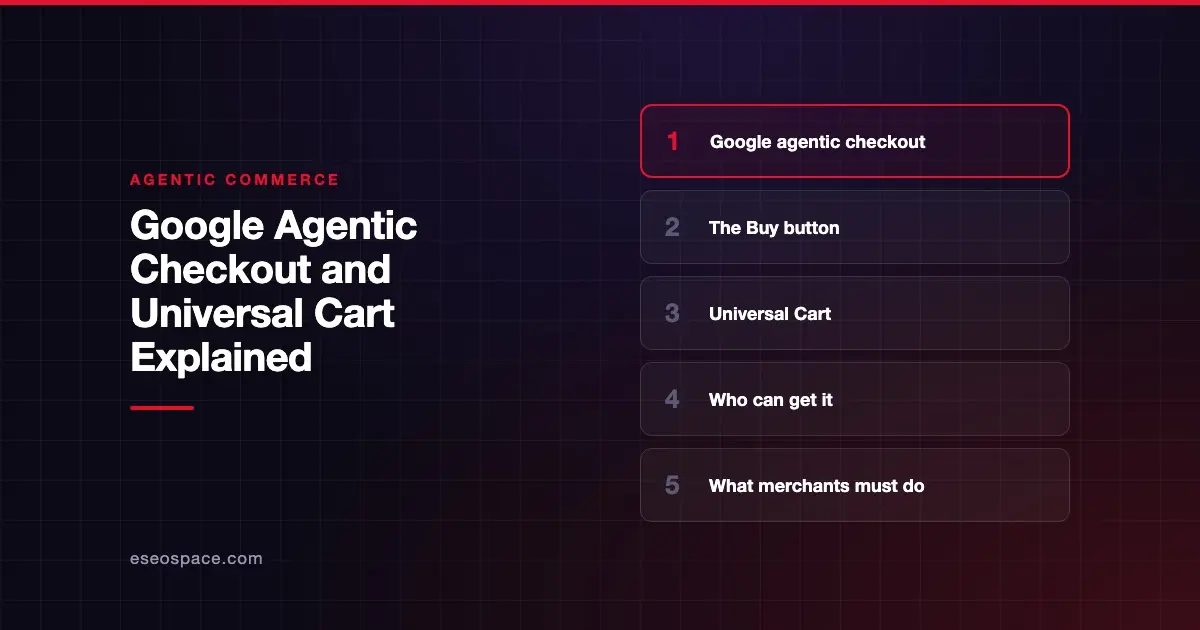
Google agentic checkout lets Google buy an item for a shopper on the merchant's own site, after the shopper confirms it. The Buy button and Universal Cart are separate features, and access to the Buy button is limited to selected merchants.
This guide separates those three names. It is part of our Agentic Commerce hub, and was checked against Google's documentation on 9 November 2026. Rollouts here change often.
Key Takeaways
- Agentic checkout, the UCP-powered Buy button and Universal Cart are three different features.
- Google's help page says UCP-powered checkout is available to select merchants, and its developer guide says integrations need Google's approval.
- Only listings with the
native_commerce(checkout_eligibility)attribute show the Buy button. - Google says you remain the seller of record.
- Subscriptions, personalized goods, pre-orders and age-restricted items are among the products that cannot use checkout.
- Google said direct checkout began expanding to Canadian shoppers on 4 November 2026.
Three features, three jobs
| Feature | What it does | Where the purchase happens |
|---|---|---|
| Agentic checkout | Google buys a tracked item for the shopper after they confirm | On the merchant's site |
| UCP-powered checkout (Buy button) | The shopper checks out on Google's surface | On Google, with Google Pay |
| Universal Cart | One cart across merchants and Google services | Google Pay, or transferred to the merchant's site |
UCP stands for Universal Commerce Protocol, an open standard for AI agents and commerce systems. See our UCP explainer for the background.
Agentic checkout
Google announced agentic checkout on 13 November 2025. It is tied to price tracking.
A shopper tracks an item with a size, color and budget. When the price fits, Google can offer to buy it on the merchant's site using Google Pay. Google says "We'll always ask for your permission first, and only buy after you've confirmed the purchase and shipping details."
At launch it rolled out on Search, including AI Mode, from eligible US merchants. Google named Wayfair, Chewy, Quince and select Shopify merchants.
Google's UCP help page draws the line this way. "Google's agentic checkout feature buys things on the customer's behalf directly on a merchant's website at the customer's direction."
The UCP-powered Buy button
Google launched UCP on 11 January 2026 and said it would soon power a checkout feature on eligible listings in AI Mode and the Gemini app.
Here the sale happens on Google. The help page says "With the new checkout experience enabled, the checkout happens directly on Google's surfaces while keeping you the merchant of record."
Shoppers pay with Google Pay, using details saved in Google Wallet. Google's help page says the feature currently uses standard card numbers stored in Google Wallet, and that more payment forms may come later.
Universal Cart
Google introduced Universal Cart at I/O on 19 May 2026. Google says it works across merchants and across services.
Shoppers can add items while using Search, Gemini, YouTube or Gmail. At checkout, Google says they can use Google Pay or move their items to the merchant's site.
The May post said "Universal Cart is rolling out across Search and the Gemini app in the U.S. this summer, with YouTube and Gmail to follow." We could not confirm how far that rollout has reached, so check your own account.
Who can get the Buy button
Access is limited. The help page says "The checkout feature enabled by UCP is available for select merchants at this time."
Google's UCP developer guide describes the direct route. You prepare your Merchant Center account, join a waitlist, and build the integration. It adds "Your integration must be approved by Google before you can go live on AI Mode in Google Search and Gemini."
There's also a hub route. Google's Merchant Center onboarding page describes the hub. "The Merchant Center integration is gradually rolling out in the U.S., with Australia and Canada to follow next year." Merchants are notified when selected.
Where it is available to shoppers
Google's 4 November 2026 post covers Canada. "Rolling out starting today, direct checkout, powered by UCP, is expanding to Canadian shoppers on AI Mode in Google Search and the Gemini app." It names lululemon, select Shopify merchants, Shoppers Drug Mart and Simons.
The May post said checkout would come to Canada and Australia, and later the UK. We did not confirm a shopper launch in Australia or the UK.
What a merchant has to set up
Google's Merchant Center requirements start with an account in good standing and products approved for free listings.
The page then lists these settings:
- Return policy. Required, including return cost, return window and a link to the full policy.
- Customer support. At least one contact method: a website URL, an email address or a phone number.
- Checkout eligibility. The
native_commerce(checkout_eligibility)attribute must be true for each product. Missing means false. - Consumer notices. Required for items with regulatory warnings, such as California Proposition 65.
- Product ID match. Your feed ID must match the ID your checkout expects.
One detail can break a working feed. Google warns "The native_commerce attribute group is fully overwritten with each upload and does not support incremental updates." Include every flag each time, or missing flags are erased.
Google also strongly recommends variant data, because gaps can suppress the checkout button.
Products that can't use checkout
Google's requirements page lists categories that are ineligible for checkout. They include:
- Subscriptions and installment plans.
- Personalized goods, such as engraved items.
- Used, refurbished or final sale items.
- Pre-orders.
- Items needing special shipping, such as freight.
- Age-restricted items, such as alcohol and tobacco.
- Prohibited content, including healthcare and pharmaceuticals.
- Services, rentals and virtual items.
If you sell these, the Buy button is not your route. Cart transfer may still apply, so check its rules.
Two paths: native checkout or cart transfer
Google's developer guide offers two paths. The native checkout path handles the full purchase on Google. The cart path transfers a shopper's cart to your website.
The two behave differently by default. Checkout is opt-in per product.
Cart transfer works the other way. Google says "Cart transfer operates on an opt-out model, meaning eligible products are included by default unless explicitly excluded."
That default applies once you've declared the cart capability in your UCP profile. Products approved for free listings then become eligible.
If you're on Shopify
Shopify has its own route to these features. Its help page says Google AI Mode and Gemini are rolling out to eligible stores. It adds "Direct checkout is also rolling out to Google users and might not yet be available in your store."
See Shopify Catalog explained for how Shopify's data routes differ by channel.
Do you need special markup?
Not for appearing in Google's AI features. Google's AI features guide says "You don't need to create new machine readable files, AI text files, or markup to appear in these features."
The checkout attributes above are a separate matter. They are feed data for checkout, not markup for AI features.
Next step
Start with Merchant Center. Google's help page says the best preparation is keeping your product feeds and brand assets as robust and up to date as possible.
If your feed and product pages need work, see our ecommerce SEO services. We can't promise access to these features, or any rankings or sales from them.
Frequently asked questions
Is agentic checkout the same as the Buy button?
No. Agentic checkout buys on the merchant's site after a shopper confirms. The UCP-powered Buy button lets the shopper check out on Google's surface.
Am I still the seller?
Google says you remain the seller of record for UCP-powered checkout, and that the brand stays the merchant of record with Universal Cart.
Can any merchant get the Buy button?
No. Google says it's available for select merchants, and your integration must be approved before it goes live.
What payment methods can shoppers use?
Google says shoppers use Google Pay with details saved in Google Wallet, and that PayPal was planned. Check the current help page.
Do I need to add schema to qualify?
Google says no new markup or AI text files are needed to appear in its AI features. Checkout needs specific attributes in your product feed instead.