This article is part of our Agentic Commerce hub. Want help applying it? Talk to eSEOspace.
ChatGPT shopping lets a person find and compare products in the chat, then buy on the merchant's own site or app. The product details come from integrated catalogs or approved product feeds.
Shopping is live for ChatGPT users in the U.S., according to OpenAI's merchant page. This guide follows one purchase from start to finish. It is part of our Agentic Commerce guide, and was checked against OpenAI's documentation on 9 November 2026.
Key Takeaways
- A shopper asks in plain language, and ChatGPT suggests products based on preferences, context and product data.
- Shopify and Etsy catalogs are already integrated, according to OpenAI, while other merchants apply and join a waitlist.
- OpenAI says purchases are completed on merchant-owned websites or apps.
- OpenAI says there are no fees on purchases that start in ChatGPT.
- Being eligible does not guarantee a product will be shown.
The path from question to purchase
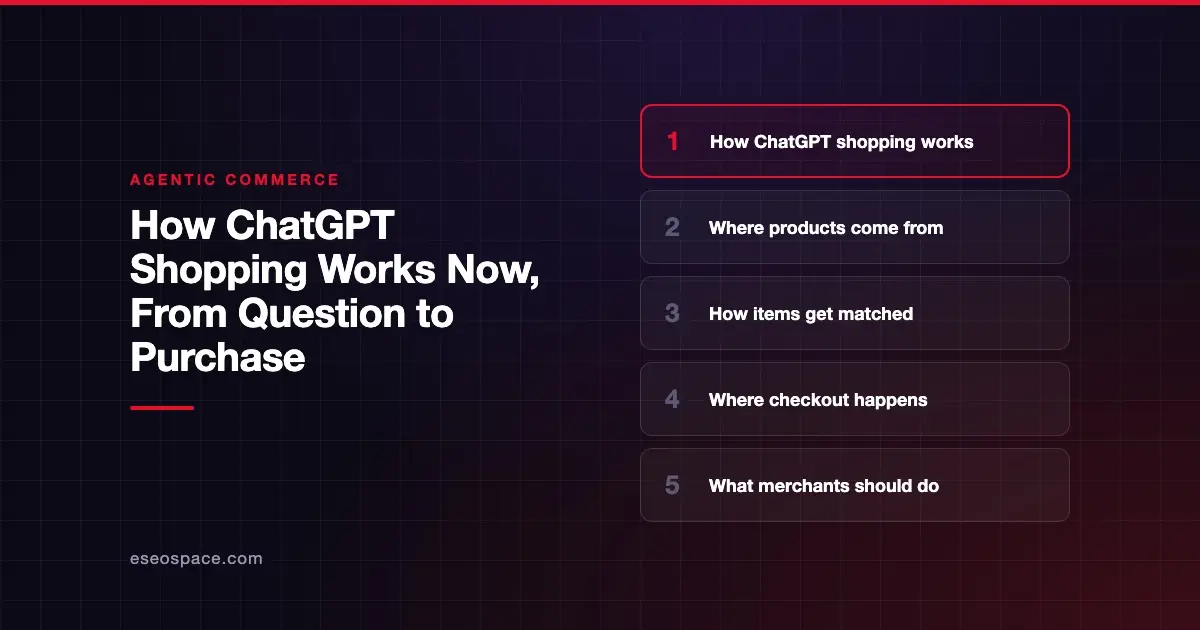
Here is how a typical purchase runs today, based on OpenAI's and Shopify's own descriptions.
- A shopper describes what they want in ChatGPT.
- ChatGPT shows products drawn from merchant data.
- The shopper compares options in the conversation.
- The shopper chooses a product and moves to the merchant's site or app.
- The merchant takes the order, the payment and the customer service work.
OpenAI is direct about the last two steps. It says "Users can discover and evaluate products in ChatGPT, but purchases are completed on merchant-owned websites or apps."
This is a change from the earlier Instant Checkout idea. Read what happened to ChatGPT Instant Checkout for what is and isn't confirmed about that.
Where the product information comes from
ChatGPT needs structured data about your products. There are two main routes in, depending on where you sell.
Integrated catalogs
OpenAI's merchant page says: "If you sell through Shopify or Etsy, your catalog is already integrated, and no additional setup or application is required."
Shopify's agentic storefronts help page adds that the feature is "active by default for eligible stores." ChatGPT is one of the channels it names.
Applying with a product feed
Other merchants can apply on OpenAI's merchant page. The developer guide says "Onboarding product feeds in ChatGPT is currently available to approved partners."
OpenAI's page says applicants are placed on a waitlist. It also says a self-serve merchant portal is planned for "later this year," with no specific date given.
What a product feed has to include
A feed is a structured file listing your products. OpenAI's feed specification lists nine fields that are required for a useful discovery feed.
| Field | What it holds |
|---|---|
item_id | Your unique product ID |
title | The product name |
description | What the product is |
url | The product page on your site |
brand | The brand name |
seller_name | Who is selling it |
image_url | The product image |
availability | Whether it can be bought |
price | The current price |
OpenAI recommends "uploading a full snapshot at least once a day." Its guide describes uploading over SFTP, a standard way to transfer files. The merchant page also mentions APIs and leading commerce platforms and feed providers.
The specification says "Search defaults to enabled and checkout to disabled." It also warns that "Checkout requires a separately enabled integration."
How ChatGPT chooses which products to show
OpenAI does not publish a ranking formula. Its merchant page gives only a general description.
It says "Products are tailored to each shopper based on preferences, context, and product data." It also says "Richer data helps your products surface with more accurate information when shoppers compare options."
Two limits matter here. OpenAI's feed specification says "Eligibility does not guarantee display," and results are tailored to each shopper. So two people can see different products for the same question.
Crawlers and ChatGPT search
OpenAI also runs a crawler called OAI-SearchBot. Its bot documentation says "Sites that are opted out of OAI-SearchBot will not be shown in ChatGPT search answers, though can still appear as navigational links."
That statement is about search answers, and OpenAI does not say how it applies to product results. Still, it is a good reason to check that you are not blocking this bot. Our guide to AI crawlers and robots.txt explains how those rules work.
What about ads?
OpenAI's merchant page does not say whether advertising affects shopping results. We make no claim either way.
The feed specification does include a separate ads setting. It says "Ads defaults to disabled unless your feed has an Ads default configured." If ads are part of your plan, see our page on ChatGPT ads.
Where checkout happens
For most stores, checkout happens on your own website or app. On Shopify, the help page says "ChatGPT users complete their purchase on your online store checkout in a ChatGPT in-app browser."
OpenAI's monetization guide describes this as external checkout. Payment, billing, taxes, refunds and compliance are handled on your domain.
One narrower path exists. The same guide describes "Checkout with the ChatGPT payment sheet (private beta)." It says that path "is limited to select marketplaces today and is not available to all users."
What it costs merchants
OpenAI's merchant page says "There are no fees on purchases that start in ChatGPT." You still pay your own payment processor, your platform and your shipping costs.
Apps are an extra option, not a requirement. OpenAI says "Apps are optional and are best suited for larger merchants who want more control over the shopping and purchase experience."
What this means for your store
The work is mostly about accurate data and a smooth checkout. None of these steps promises that your products will be shown.
- Confirm whether you are on Shopify or Etsy, or need to apply.
- Check titles, descriptions, images, prices and stock against your live site.
- Refresh product data at least daily if you run a feed.
- Make sure your robots.txt does not block OAI-SearchBot by accident.
- Test checkout on a phone, including inside an in-app browser if you can.
- Recheck OpenAI's page monthly, because shopping is expanding and rules can change.
You can read more about what stores should do in our Agentic Commerce hub.
Next step
Good product data helps in every search channel, not just ChatGPT. Our AI SEO services cover structured data and AI visibility work, without promising placement in any AI product.
Frequently asked questions
Is ChatGPT shopping available outside the U.S.?
OpenAI's merchant page says shopping is currently live for ChatGPT users in the U.S. It says OpenAI plans to expand to more merchants and regions over time. No dates are given.
Do I need to do anything if I use Shopify?
OpenAI says Shopify catalogs are already integrated, with no application required. Shopify says agentic storefronts are active by default for eligible stores. Check your Shopify admin to confirm your store's status.
Can I pay to appear in ChatGPT shopping results?
OpenAI's merchant page does not address whether ads affect shopping results. The feed specification has a separate ads setting that is off by default. Check OpenAI's current terms before you plan around it.
Does the purchase happen inside ChatGPT?
For most stores, no. OpenAI says purchases are completed on merchant-owned websites or apps. A private beta for in-chat payment is limited to select marketplaces.
How often should I update my product feed?
OpenAI recommends uploading a full snapshot at least once a day. Stale prices or stock can give shoppers wrong information. Update more often if your inventory changes quickly.
Will a complete feed get my products shown?
There is no guarantee. OpenAI's specification says "Eligibility does not guarantee display." Results are tailored to each shopper, so your products may appear for some people and not others.