This guide is part of AI agent protocols, within The MCP Guide. Want your website ready for AI agents? See WebMCP development.
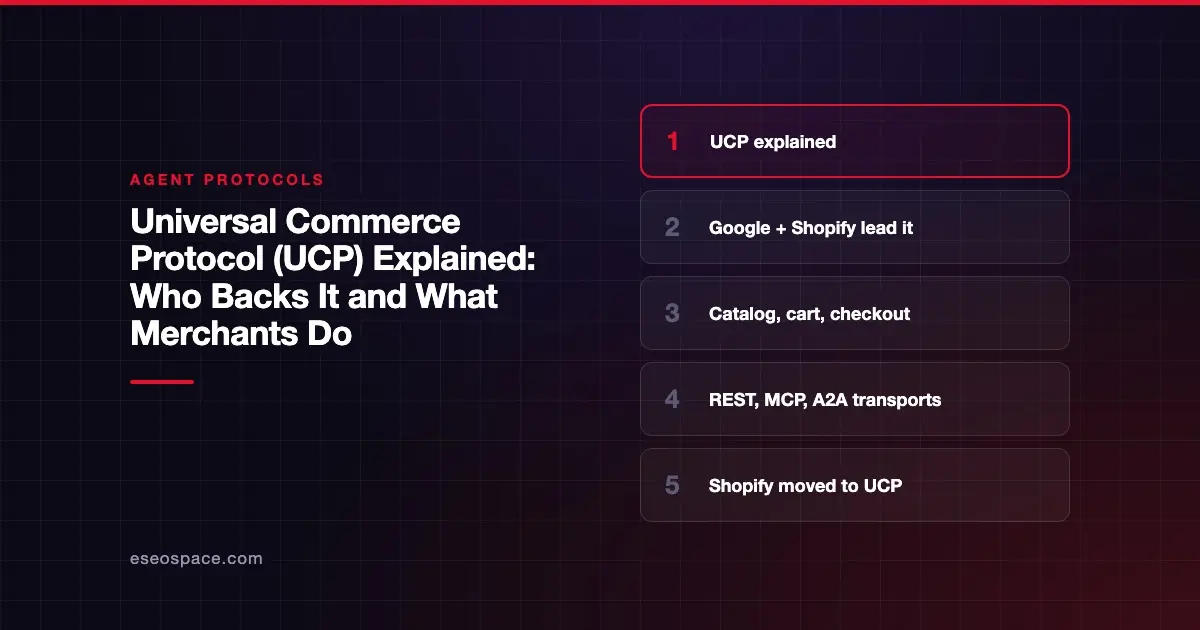
The Universal Commerce Protocol (UCP) is an open standard that lets AI agents and platforms search a store's catalog, build carts, check out and track orders in one common format. Google and Shopify are its founding organizations, and it powers checkout in Google's AI Mode and Gemini.
UCP launched on 11 January 2026 and has shipped dated releases since, the latest being 2026-08-25. For merchants, the main questions are who controls it, what it covers and whether you need to do anything. This guide answers each, checked on 6 November 2026.
Key Takeaways
- Google's launch post says UCP "is developed by Google in collaboration with industry leaders including Shopify, Etsy, Wayfair, Target, and Walmart."
- Governance sits with a five-seat Governing Council; Google and Shopify hold permanent seats, and Google holds proxy votes for open seats until December 2028.
- UCP covers catalog search and lookup, cart building, identity linking, checkout and order management, and can run over REST, MCP, A2A or embedded checkout.
- Shopify removed catalog and cart tools from
/api/mcp; they now live at/api/ucp/mcp, and every request needs an agent profile. - Google's merchant docs list UCP checkout on AI Mode in Search and Gemini web, with onboarding through Merchant Center.
What UCP is
The UCP site describes it as "The common language for platforms, agents, and businesses." The UCP GitHub repository calls it "An open standard enabling interoperability between various commerce entities." It is Apache 2.0 licensed.
Without a shared standard, every AI app would need a custom integration with every store. UCP gives them one format for the whole journey. Google's technical launch post, dated 11 January 2026, says it "standardizes the full commerce journey - from discovery and consideration to purchase and order management."
Who backs UCP
Founders and co-developers
Google lists Shopify, Etsy, Wayfair, Target and Walmart as collaborators.
The UCP site now lists a longer set of co-developers by vertical. For shopping it names Google, Shopify, Etsy, Wayfair, Target, Walmart, Amazon, Microsoft, Meta, Salesforce and Stripe. It also lists lodging co-developers (such as Booking.com, Expedia Group, Hilton and Marriott) and food co-developers (DoorDash, Square, Toast, Uber Eats). Separate endorsers include Adyen, Mastercard, PayPal and Visa.
Governance
The project's governance document sets out how decisions are made:
- A Governing Council of five. Google and Shopify, as founding organizations, each hold one permanent seat. Three seats are elected.
- "Google acts as the custodian of the UCP.dev domain."
- "Google holds proxy vote for all open seats until Dec 2028."
- Domain Tech Councils for Shopping, Food, Lodging and Payments. The Shopping council has 16 members, four permanent from each of Google and Shopify.
- The Payments council's permanent members include Google, Shopify, Adyen, Ant International, Coinbase, Global Payments, PayPal and Stripe.
There is no independent foundation behind UCP today. That is a real difference from MCP and A2A, which sit in the Linux Foundation's Agentic AI Foundation.
What UCP covers
The UCP site lists "Catalog Search and Lookup, Cart Building, Identity Linking, Checkout, and Order Management." The repository also mentions extensions such as discounts and fulfillment.
| Capability | What it lets an agent do |
|---|---|
| Catalog | Search products and look up live details such as variants, stock and price |
| Cart | Add several items from one store before checkout |
| Checkout | Create and complete a checkout, with tax and payment |
| Identity linking | Use OAuth 2.0 so a shopper gets member pricing or perks |
| Order | Receive webhook updates for shipped, delivered and returned |
| Payment token exchange | Pass payment credentials safely between providers |
How it connects
UCP is "transport agnostic." The repository says businesses can offer capabilities via "REST APIs, MCP (Model Context Protocol), or A2A." Google's launch post describes the same three routes: "APIs, Agent2Agent (A2A), and the Model Context Protocol (MCP)."
For payments, Google's post says UCP "is compatible with Agent Payments Protocol (AP2)." Our AP2 explainer covers those.
Release history
UCP uses dated versions. The releases page lists:
- v2026-01-11 and v2026-01-23: the launch versions, including docs on capability maturity levels.
- v2026-04-08: added Cart, Catalog search and lookup, OAuth 2.0 identity linking, and request and response signing.
- v2026-08-25 (latest as of 6 November 2026): groundwork for Food and Lodging, grocery features, and payment additions such as 3DS2, payment schedules and split payments. It also restructured the fulfillment schema, a breaking change.
The UCP site says a "Lodging draft specification now available" and lists food as "coming soon."
Where UCP is used
Google's UCP merchant docs name "AI Mode in Google Search and Gemini web (app coming soon)." Merchants can "Use your existing Merchant Center account shopping feeds." Native checkout is the default; embedded checkout is "An additional optional path for specific, approved merchants." The docs invite lodging and food businesses to join a waitlist.
In May 2026, Google said UCP checkout would roll out in Canada and Australia "in the coming months, and later to the U.K." Google said on 4 November 2026 that direct checkout, powered by UCP, "is expanding to Canadian shoppers on AI Mode in Google Search and the Gemini app."
Shopify
Shopify's agents docs say "Shopify's MCP tools implement UCP at every step of the buyer journey." Agents must "Define a profile so Shopify can verify your agent," and "Higher trust tiers unlock broader access, including direct checkout completion."
Stripe
Stripe's UCP docs say Stripe "is a member of the UCP Tech Council" and offer a Stripe Payments handler for card and Apple Pay credentials in UCP checkouts.
Shopify's Storefront MCP moved to UCP
If you or a developer built on Shopify's Storefront MCP endpoint, this matters. Shopify's Storefront MCP page says "The catalog and cart tools on https://{shop}/api/mcp were removed." It adds: "UCP now provides these capabilities at https://{shop}/api/ucp/mcp."
The replacements are:
- Catalog:
search_catalog,lookup_catalogandget_product - Cart:
create_cart,get_cart,update_cartandcancel_cart - Policies and FAQs:
ask_business - Checkout URLs: from Checkout MCP
Two gotchas. Shopify says to "Include an agent profile in every request to /api/ucp/mcp." And "Each update_cart request replaces the full cart," so send every line item you want to keep. Customer Accounts MCP is unchanged. Our Shopify MCP server guide has the full tool list.
What merchants should do
- Shopify merchants: you mostly get UCP through Shopify. Review Agentic Storefronts in your admin and keep your catalog clean. If you have custom agent code, move it to
/api/ucp/mcp. See Shopify agentic commerce. - Google Merchant Center users: check Merchant Center for UCP checkout onboarding as it rolls out in your country.
- Custom platforms: read the spec and samples, and decide which capabilities to support.
- Everyone: make product data complete and accurate, and decide your policy for agent-placed orders.
Comparing with OpenAI's approach? Read UCP vs ACP.
Next step
eSEOspace designs and builds stores through our Shopify website design and ecommerce services, and we can review how your catalog and checkout look to AI agents. Projects are quoted individually, and we cannot promise placement in Google or any AI channel. Explore related standards on the agent protocols hub.
More in the MCP Guide
Latest research: State of MCP: October 2026
Frequently asked questions
Who owns UCP?
No single owner is named in the license; the copyright reads "UCP Authors." In practice, the governance document gives Google and Shopify permanent Governing Council seats, and Google holds proxy votes for open seats until December 2028.
Is UCP the same as MCP?
No. UCP defines commerce actions such as catalog, cart and checkout. MCP is one of the transports UCP can run over, alongside REST, A2A and embedded checkout.
Does UCP handle payments?
It defines how payment credentials are exchanged through payment handlers, and it is compatible with AP2 for proof of user approval. Money still moves through providers such as Stripe or Google Pay.
Is UCP finished?
It is in active development with dated releases; the latest is 2026-08-25. Lodging is a draft, and food specifications are "coming soon," per the UCP site.
My Shopify agent code broke. Why?
Shopify removed catalog and cart tools from /api/mcp. They now live at /api/ucp/mcp, and each request must include an agent profile.