This guide is part of AI agent protocols, within The MCP Guide. Want your website ready for AI agents? See WebMCP development.
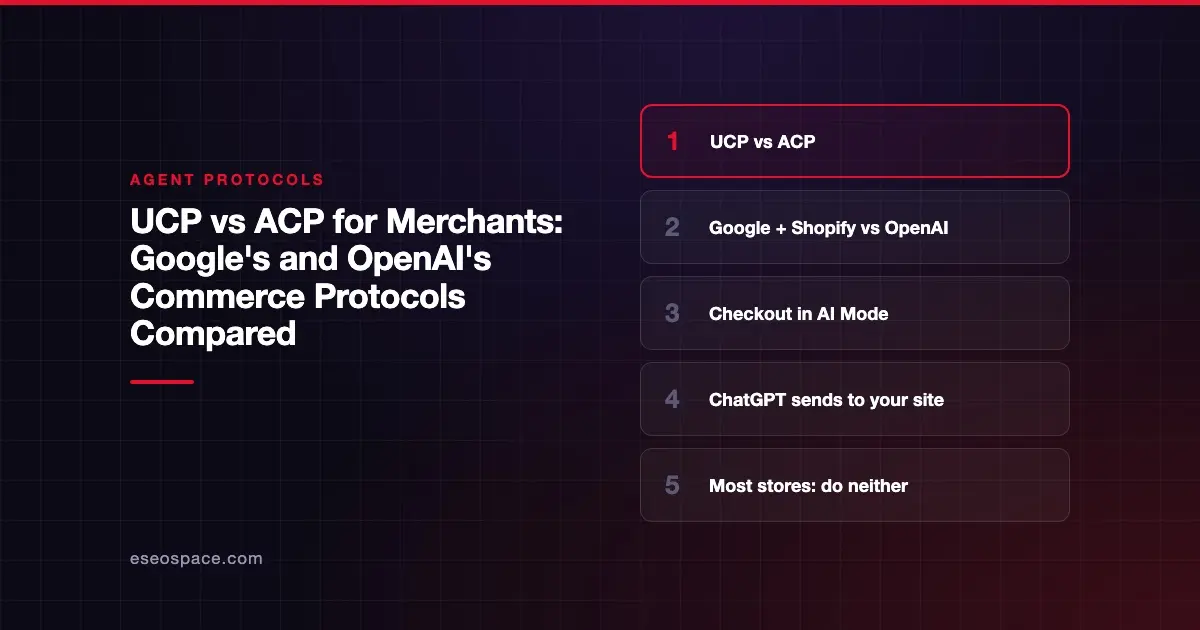
UCP and ACP are two open standards for letting AI agents shop and check out with your store. UCP (Universal Commerce Protocol) is led by Google and Shopify and powers checkout in Google's AI Mode and Gemini. ACP (Agentic Commerce Protocol) comes from OpenAI and Stripe and underpins commerce in ChatGPT.
For most merchants, the honest answer is that you will not implement either yourself. Your platform and your product feeds do the work. This guide compares the two so you know what each channel needs from you, checked on 6 November 2026.
Key Takeaways
- UCP was launched by Google on 11 January 2026 with Shopify, Etsy, Wayfair, Target and Walmart; Google and Shopify hold permanent seats on its Governing Council.
- ACP was developed by OpenAI and Stripe; its spec "is currently in beta," and its maintainers file lists OpenAI, Stripe and Meta.
- UCP covers catalog, cart, checkout, identity linking and orders, over REST, MCP, A2A or embedded checkout. ACP covers checkout and delegated payment, and since 2026-04-17 carts, a Feed API, orders and an MCP binding.
- Google's UCP checkout runs in AI Mode in Search and Gemini web. ChatGPT now completes purchases "on merchant-owned websites or apps."
- Neither standard is under a neutral foundation today, unlike MCP and A2A.
Side-by-side comparison
| UCP | ACP | |
|---|---|---|
| Full name | Universal Commerce Protocol | Agentic Commerce Protocol |
| Led by | Google and Shopify (founding organizations) | OpenAI and Stripe (Founding Maintainers); Meta also a lead maintainer |
| Launched | 11 January 2026 | First spec version 2025-09-29 |
| Latest version (Nov 2026) | v2026-08-25 | 2026-04-17 (latest stable); spec in beta |
| Scope | Catalog, cart, checkout, identity linking, orders, payment token exchange | Checkout, delegated payment; carts, feeds, orders added 2026-04-17 |
| Transports | REST, MCP, A2A, embedded | REST; MCP binding since 2026-04-17 |
| Payments | Payment handlers; compatible with AP2 | Delegated payment tokens (e.g., Stripe Shared Payment Token) |
| Main AI surfaces | Google AI Mode, Gemini; Shopify agent channels | ChatGPT |
| License | Apache 2.0 | Apache 2.0 |
Who backs each one
UCP
Google's launch post says UCP "is developed by Google in collaboration with industry leaders including Shopify, Etsy, Wayfair, Target, and Walmart." The UCP governance document gives Google and Shopify permanent seats on a five-member Governing Council and says "Google holds proxy vote for all open seats until Dec 2028."
ACP
The ACP repository says it is "jointly governed by OpenAI and Stripe as Founding Maintainers" and that the spec "is currently in beta." Its maintainers file lists OpenAI, Stripe and Meta as lead maintainers.
Both are company-led. That is worth knowing if you care about who sets the rules. MCP and A2A, by contrast, sit in the Linux Foundation's Agentic AI Foundation. See our AI agent protocols comparison.
What each one covers
UCP scope
Google's launch post says UCP "standardizes the full commerce journey - from discovery and consideration to purchase and order management." Its latest release, v2026-08-25, added groundwork for food and lodging, grocery features and payment options such as installments and split payments. UCP is broader: it aims to cover shopping, lodging and food ordering.
ACP scope
ACP started with two specs: Agentic Checkout and Delegated Payment. The 2026-04-17 changelog added carts, an "unreleased Feed API surface," native orders, delegated 3DS2 authentication and an "MCP transport binding for ACP checkout operations."
So the scopes are converging. Both now cover catalog-like data, carts, checkout and orders.
Where each one runs
UCP: Google and Shopify
Google's UCP merchant docs name "AI Mode in Google Search and Gemini web (app coming soon)." Merchants use their "existing Merchant Center account shopping feeds." Google's May 2026 post says UCP checkout will reach Canada and Australia "in the coming months, and later to the U.K.," with the retailer remaining "the merchant of record." Google said on 4 November 2026 that direct checkout, powered by UCP, "is expanding to Canadian shoppers on AI Mode in Google Search and the Gemini app."
Shopify's MCP tools for agents implement UCP; see our UCP explainer for Shopify's /api/ucp/mcp endpoint.
ACP: ChatGPT
The ChatGPT merchants page says "We're moving away from a standalone Instant Checkout experience in ChatGPT" and "purchases are completed on merchant-owned websites or apps." It still calls ACP "the open infrastructure for AI-native commerce in ChatGPT." Shopping in ChatGPT is "currently live in the U.S." OpenAI's developer guide says product feed onboarding "is currently available to approved partners."
This is the biggest practical difference in November 2026. On Google's UCP path, an agent can complete checkout inside AI Mode or Gemini. In ChatGPT, the shopper finishes on your own checkout.
Payments and trust
UCP uses payment handlers, and Google's launch post says it "is compatible with Agent Payments Protocol (AP2)" for signed proof of user approval. Shopify adds agent profiles and trust tiers.
ACP uses delegated payment tokens, such as Stripe's Shared Payment Token, so the agent never sees the card. The 2026-04-17 release also made idempotency keys mandatory and added webhook signing.
If you use Stripe, you can support both. Stripe's agentic commerce docs link Shared Payment Tokens, a catalog feed and UCP support from one place.
What should a merchant implement?
| Your setup | What to do |
|---|---|
| Shopify store | Use Shopify's Agentic Storefronts and catalog; no direct UCP or ACP build. See Shopify agentic commerce |
| Google Merchant Center seller | Watch Merchant Center for UCP checkout onboarding in your country |
| U.S. seller wanting ChatGPT visibility | Apply for ChatGPT product feeds; make your checkout fast |
| Custom or headless platform | Pick the channel that matters most; build that protocol from the spec |
| Large retailer | Consider both, plus a ChatGPT app for deeper integration |
| Small store on any platform | Focus on product data quality first |
A practical order of work
- Product data. Both channels depend on complete, accurate feeds.
- Your platform's agent settings. Turn on what Shopify, Salesforce or your platform provides.
- Your own checkout. ChatGPT shoppers finish their purchase there.
- Direct protocol work. Only if you run a custom stack and a channel requires it.
What could change
Both standards are moving fast. UCP shipped four dated releases between January and August 2026. ACP is still in beta. OpenAI has already changed its ChatGPT checkout model once. Plan for change and avoid building deep custom integrations you cannot maintain.
Next step
eSEOspace builds stores through our ecommerce services and Shopify website design, and builds ChatGPT apps through our ChatGPT app development service. We quote each project and cannot promise placement in Google or ChatGPT. Read the single-protocol guides on UCP and ACP, or browse the agent protocols hub.
More in the MCP Guide
Latest research: State of MCP: October 2026
Frequently asked questions
Are UCP and ACP competitors?
They overlap. Both define how agents shop and check out, and their scopes are converging. But each mainly serves a different channel: UCP for Google surfaces and Shopify, ACP for ChatGPT.
Can I support both?
Yes. Payment providers such as Stripe support both, and platforms may handle both for you. Most merchants support them indirectly through their platform and feeds.
Which one is more mature?
Neither is final. UCP has dated releases, the latest v2026-08-25, with lodging still a draft. ACP's spec is labelled beta, with 2026-04-17 the latest stable version.
Does ChatGPT still check out inside the chat?
OpenAI says purchases now finish on merchant-owned sites or apps. Google's UCP path still offers native checkout in AI Mode and Gemini web.
Do either of them use MCP?
Both can. UCP lists MCP as a transport, and Shopify serves UCP tools over MCP. ACP added an MCP transport binding in its 2026-04-17 release.