This guide is part of AI agent protocols, within The MCP Guide. Want your website ready for AI agents? See WebMCP development.
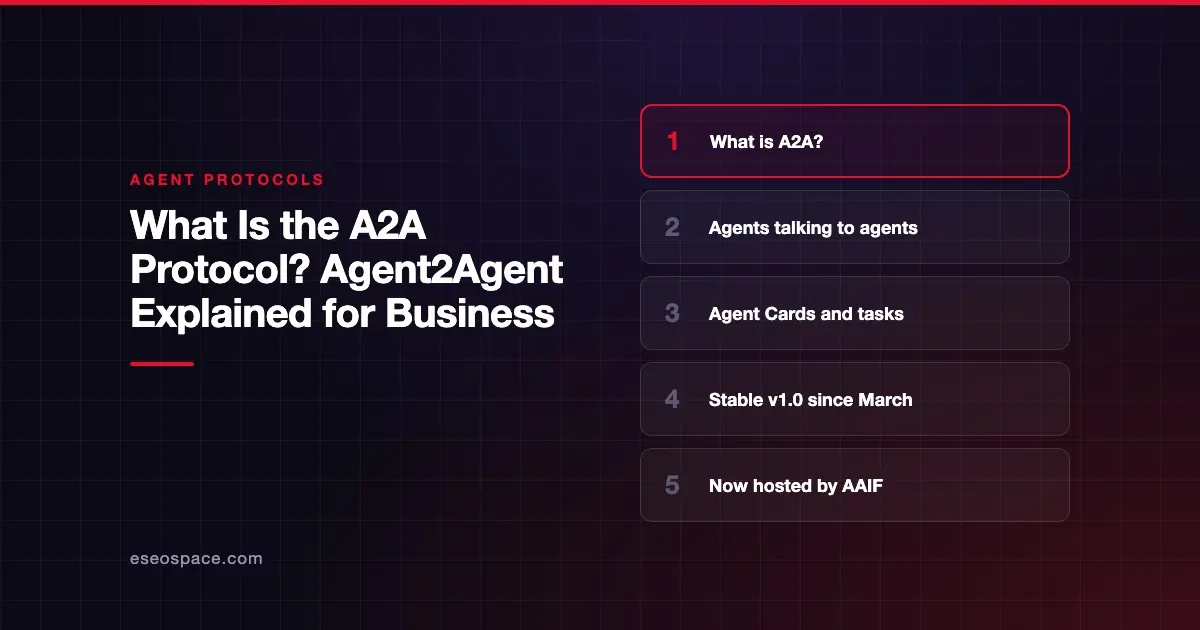
A2A (Agent2Agent) is an open protocol that lets AI agents built by different teams or companies find each other, share work and report progress. Where MCP connects one agent to its tools, A2A connects one agent to another agent.
Google launched A2A in April 2025 and handed it to the Linux Foundation. It reached its first stable version, v1.0, in March 2026, and in August 2026 it joined the Agentic AI Foundation, the same foundation that hosts MCP. This guide explains how it works and whether your business needs it, checked on 6 November 2026.
Key Takeaways
- A2A is an open standard for communication between AI agents, maintained under the Linux Foundation and licensed Apache 2.0.
- Google launched it in April 2025; the Linux Foundation launched the A2A project on 23 June 2025.
- A2A v1.0, its first stable spec, shipped in March 2026. The latest release on GitHub is v1.0.1 (28 May 2026).
- On 17 August 2026, A2A joined the Agentic AI Foundation (AAIF) as a hosted project, alongside MCP.
- Each agent publishes an Agent Card, a JSON file that describes its skills, endpoint and sign-in needs. Work is tracked as tasks with defined states.
What A2A does
The A2A project site calls it "an open standard for seamless communication and collaboration between AI agents." It is a communication layer, not a framework for building agents. Your agent can be built with any tool and still speak A2A.
A simple picture: an employee (your agent) uses tools at their desk through MCP. When they need help from another department or another company, they send a request to a colleague (another agent) through A2A. They do not need to know how the colleague works inside, only what the colleague agrees to do.
The A2A docs describe remote agents as a "black box," with internals hidden. That suits work with vendors and partners, where you would never expose your systems directly.
Who created A2A and who runs it now
Origin
The Agentic AI Foundation's announcement, dated 17 August 2026, says "Google launched A2A in April 2025 and donated it to the Linux Foundation."
The Linux Foundation press release of 23 June 2025 announced the A2A project at Open Source Summit North America in Denver, citing "growing support from more than 100 leading technology companies."
Governance today
The A2A site says the protocol is maintained by a Technical Steering Committee with representatives from AWS, Cisco, Google, IBM Research, Microsoft, Salesforce, SAP and ServiceNow. Its footer reads "Copyright 2026 The Linux Foundation."
In August 2026, A2A joined AAIF "as a hosted project." AAIF is the foundation that also hosts MCP. The AAIF post says A2A is "backed by over 150 organizations." Our page on who owns MCP explains the foundation.
What happened to IBM's ACP
IBM Research had its own Agent Communication Protocol (ACP). Its project page now says "ACP is now part of A2A under the Linux Foundation!" and the ACP GitHub repository was archived on 27 August 2025. Do not confuse that ACP with the Agentic Commerce Protocol from OpenAI and Stripe, covered in our ACP explainer.
How A2A works
The A2A key concepts page defines a small set of parts.
The actors
- User: "The end user, which can be a human operator or an automated service."
- A2A client: an app or agent "that acts on behalf of the user" and starts the conversation.
- A2A server (remote agent): "An AI agent or agentic system that exposes an HTTP endpoint implementing the A2A protocol."
Agent Cards
An Agent Card "acts as a digital business card." It is a JSON document listing the agent's identity, endpoint URL, capabilities, authentication requirements and skills. The agent discovery page says the standard location is /.well-known/agent-card.json on the agent's domain. Agents can also be found through curated registries or direct configuration. A more detailed "authenticated extended" card can be shown only to signed-in clients.
Tasks, messages, parts and artifacts
- Task: "A stateful unit of work initiated by an agent, with a unique ID and defined lifecycle."
- Message: "A single turn of communication between a client and an agent," with a role of user or agent.
- Part: the content container. Each part holds text, a file, inline data or structured JSON.
- Artifact: "A tangible output generated by an agent during a task," such as a document or image.
The v1.0 release notes list the task states, including submitted, working, completed, failed, canceled, rejected, input required and auth required. "Input required" is how an agent asks for more information midway.
Ways to get results
A2A supports three patterns: request and response with polling, streaming over Server-Sent Events, and push notifications, where "The server calls a client-provided webhook on a significant task update." Push suits jobs that take hours.
Status: A2A v1.0
The AAIF post says "A2A v1.0, the first stable specification, shipped in March 2026." The A2A releases page shows v1.0.0 on 12 March 2026 and a bug-fix release, v1.0.1, on 28 May 2026, marked latest.
The v1.0 notes describe formal protocol bindings "with equivalence guarantees," Agent Card signature verification "using JWS and JSON Canonicalization," mutual TLS support and a flag for whether PKCE (a safer OAuth login flow) is mandatory. v1.0 also made breaking changes, so older agents built on v0.3 may need updates.
The A2A site lists official SDKs for Python, JavaScript, Java, C#/.NET, Go and Rust.
A2A and MCP together
The A2A team's page on A2A and MCP puts it simply: "MCP is vertical. It deepens a single agent." And "A2A is horizontal. It connects agents across that boundary." It calls them "highly complementary."
A2A also carries other protocols. The Agent Payments Protocol (AP2) is built as an A2A extension, and the Universal Commerce Protocol can use A2A as a transport. See our AP2 explainer and A2A vs MCP in depth.
Does your business need A2A?
Most small and mid-size businesses do not need A2A on day one. You likely need it when:
- You run several agents that must hand work to each other, possibly built on different platforms.
- A partner, supplier or customer wants their agent to request work from yours.
- You sell an agent product that others will plug into their systems.
You probably do not need it yet if you have one assistant connected to your own tools. MCP covers that. Our earlier guide to MCP vs A2A vs function calling has a quick decision table.
What to do now
- Map where agents would cross a team or company boundary.
- If you publish an agent, plan its Agent Card: skills, endpoint and how callers sign in.
- Build against v1.0, not older v0.x examples.
- Decide how each task will be logged and who approves "input required" steps.
Next step
If you are planning agents that need to work with other agents, eSEOspace's AI agent development service can help design the setup, and our MCP development service covers the tool side. Projects are quoted individually. For the rest of the protocol family, see the agent protocols hub.
More in the MCP Guide
Latest research: State of MCP: October 2026
Frequently asked questions
Is A2A owned by Google?
Not anymore. Google created it and donated it to the Linux Foundation. Since 17 August 2026 it is a hosted project of the Agentic AI Foundation, and a Technical Steering Committee from eight companies maintains it.
Is A2A stable?
Yes. A2A v1.0, described by AAIF as "the first stable specification," shipped in March 2026. The latest release is v1.0.1 from 28 May 2026.
What is an Agent Card?
It is a JSON file that describes an agent: what it can do, where to reach it and how to sign in. By convention it lives at /.well-known/agent-card.json on the agent's domain.
Does A2A replace MCP?
No. The A2A project calls the two "highly complementary." MCP connects an agent to tools and data. A2A connects agents to other agents.
Is A2A the same as ACP?
No, but there is history. IBM's Agent Communication Protocol merged into A2A in 2025. A different "ACP," the Agentic Commerce Protocol from OpenAI and Stripe, is about checkout and is unrelated.