Disclosure: this is a guest article, and it links to eLearning Industry's directory of healthcare LMS software. eSEOspace added the regulatory sources and checked them on 20 November 2026.
Medical teams work under constant pressure, but compliance training can't rely on occasional meetings or paper checklists. A healthcare LMS gives hospitals a controlled way to assign required learning, record completion, and verify competence across roles and shifts. It also keeps evidence organized for auditors, managers, or accreditation teams. Hospitals that take part in Medicare, for example, have to meet the CMS Conditions of Participation, and surveyors check them. The right system connects training duties with renewal dates, policy changes, and team reporting. Understanding those functions clarifies how such software supports daily compliance.
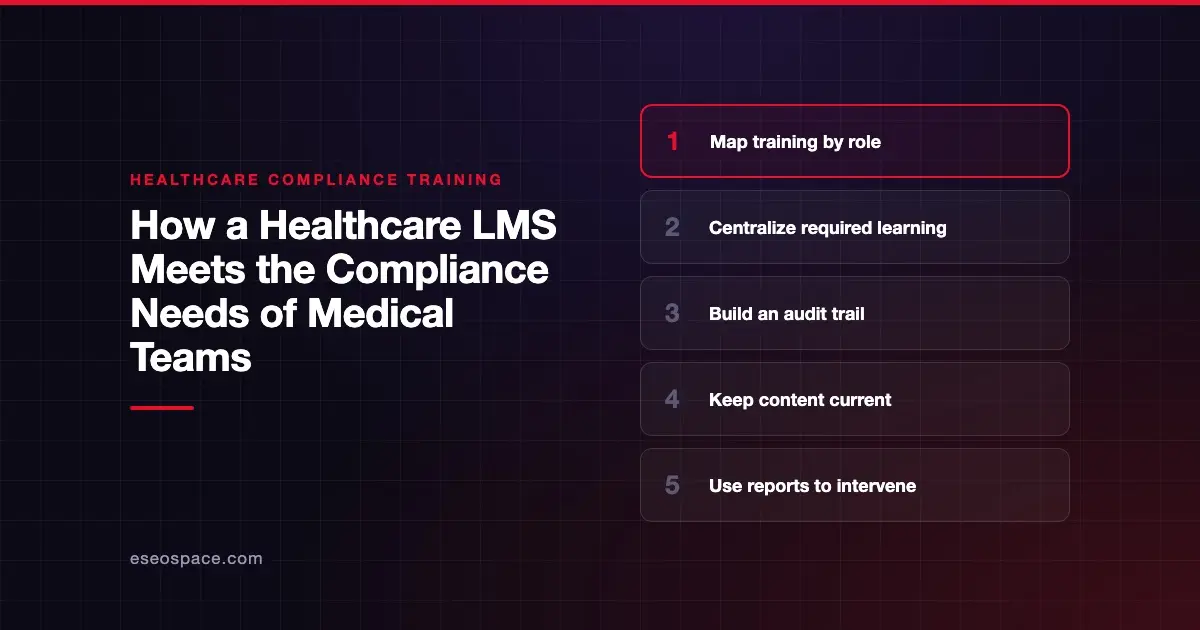
Healthcare leaders map obligations by role, location, and risk. Nurses, physicians, technicians, and administrative staff receive different assignments, while contractors follow separate access rules. A healthcare LMS keeps those assignments visible, so managers see who needs training and when. That structure prevents generic courses from reaching employees without context. It also supports reminders when a policy changes or a credential approaches renewal.
Centralize Required Learning
Compliance starts with a complete catalog of required learning. Administrators assign courses by department, job function, employment status, or clinical responsibility. New staff receive orientation before independent work, while established staff receive annual or event-based refreshers. Some of those intervals are set by regulation: OSHA's bloodborne pathogens standard, for example, requires training at initial assignment to tasks with occupational exposure and at least annually after that. A single record connects each assignment to a learner, deadline, completion status, and score. This structure replaces scattered spreadsheets with evidence that managers can review quickly.
Course rules also reduce missed requirements. An administrator can set enrollment conditions, completion deadlines, passing scores, and renewal intervals. The system then applies those rules consistently across teams. Managers gain a clear view of overdue learning instead of relying on individual supervisors to remember each requirement.
Build An Audit Trail
Compliance depends on evidence, not attendance claims. An LMS records enrollment, course access, assessment results, completion dates, and certificates. Those records show whether a staff member finished assigned training and met the required standard. A dated activity history also helps managers investigate incomplete work or disputed results.
Permission settings protect records from unnecessary changes. Administrators can limit who can create courses, edit assignments, approve completions, or view reports. That separation supports internal accountability and keeps learner information available to authorized users. Exportable reports also give compliance teams a practical record for reviews. If the LMS connects to systems that hold patient data, the same access questions apply to the software itself; our guide to building HIPAA-compliant software covers them.
Keep Content Current
Medical procedures, internal policies, and regulatory expectations change. An LMS gives administrators one location to revise course materials, replace outdated assessments, and record the current version. Staff can receive a new assignment when content changes, while completed records remain available for historical review. For privacy training, the HIPAA Privacy Rule expects exactly that: covered entities must train affected staff within a reasonable time after a material policy change, document that the training was given, and keep that documentation for six years.
Version control prevents employees from relying on old materials. Course owners can identify the active version, archive retired content, and set a new completion deadline. A review calendar helps departments check high-risk courses at planned intervals rather than waiting for an audit or incident. Our guide to the most common HIPAA violations in apps is a useful starting list for which courses count as high-risk.
Accommodate Clinical Work
Medical teams work across rotating shifts, overnight coverage, clinics, laboratories, and remote locations. Online modules let employees complete learning during approved time without gathering an entire department in one room. Brief lessons also suit procedures that require frequent refreshers or quick policy updates.
Mobile access and pause-and-resume functions support interrupted schedules. However, convenience should not replace control. Managers still need completion deadlines, assessment requirements, and records showing whether employees finished assigned learning under the organization's rules.
Use Reports For Intervention
A compliance report should lead to a clear action. Managers can filter records by department, course, employee, status, score, or deadline. That view helps them contact learners who are overdue, assign remediation, or escalate repeated noncompletion through established procedures.
Trend reports also show recurring gaps. If one team records low assessment scores, its supervisor can review the course, schedule coaching, or adjust the assignment. Reports are most useful when they link learning results to roles and work locations, letting a manager address a specific group instead of sending broad reminders.
Conclusion
A healthcare LMS supports compliance by connecting required learning with roles, deadlines, assessments, records, and follow-up. Its value depends on disciplined administration; departments must maintain accurate assignments, review course content, protect permissions, and act on reports. Medical organizations should begin with a compliance map that lists each role, required course, renewal interval, and responsible manager. That inventory provides a practical way to compare systems and exposes gaps before an audit reveals them. For a wider look at platforms, see our roundup of learning management systems for workforce training, and if an off-the-shelf LMS can't fit your workflows, custom healthcare software is the other route.