
Most banks still run their core operations on software built decades ago. These systems process deposits, loans and payments reliably, but they were never designed for mobile banking. Customers now expect instant transfers, real-time balances and smooth digital onboarding. Older platforms struggle to meet those expectations without expensive workarounds.
Replacing everything at once rarely works, and failed big-bang projects have cost institutions dearly. A phased approach lowers that risk by modernizing one layer at a time. This guide breaks legacy banking software modernization into four practical phases. Each one keeps branches open, transactions flowing and regulators satisfied.
Key Takeaways
- Legacy cores still do their original job well; the problems show up when you try to launch something new on top of them.
- Start with a full map of systems and dependencies, then rank each component by business value and risk of change.
- An API layer around the core delivers visible progress fast without touching core code.
- Retire the monolith in stages with the strangler fig pattern, starting with low-risk, high-value services.
- Move to the cloud in small waves, each with success criteria and a tested rollback plan.
Why Legacy Banking Systems Hold Institutions Back
Legacy cores still do their original job well, which is why many banks delay replacing them. The trouble starts when the business tries to launch something new on top of them. Federal examiners also assess how well an institution's architecture supports security and resilience. The FFIEC's Architecture, Infrastructure, and Operations guidance spells out what those reviews cover.
Limited Integration Options
Modern banking depends on connections with payment networks, fintech partners and open banking platforms. Many legacy systems only support batch processing or proprietary file formats. As a result, simple partnerships can take months of custom integration work. Competitors with flexible architecture launch the same features in a few weeks.
Security and Compliance Gaps
Outdated software may not support modern encryption, multi-factor authentication or detailed audit logs. Vendors eventually stop releasing patches for older versions, leaving known weaknesses open. Compliance teams then spend hours building manual workarounds to satisfy auditors. Every workaround adds another fragile layer that someone must maintain.
None of these problems appears overnight, which makes them easy to underestimate. They compound quietly until a launch slips or an audit finding forces action. Recognizing the pattern early gives leadership time to plan instead of react. That planning starts with a clear picture of what you already have.
Phase 1: Assess and Prioritize Your Current Stack
Every successful modernization begins with a candid audit of the existing environment. Skipping this step leads teams to rebuild the wrong components first. Many banks bring in a custom fintech software development company to run this discovery with fresh eyes. A few weeks of assessment can save months of rework later.
Map Every System and Dependency
Start by listing every application, database and interface connected to the core. Document which processes each one supports, from account opening to end-of-day settlement. Pay close attention to undocumented scripts and manual file transfers. These hidden links often cause the biggest surprises during migration.
Rank Components by Risk and Business Value
Not every module deserves immediate attention. Score each component on business impact and the risk of changing it. Customer-facing features with high impact usually move first. Stable back-office functions can often wait for a later phase.
By the end of this phase, you should have a ranked modernization backlog. Each item on it links to a business outcome that leadership cares about. This shared view makes budget conversations far easier. It also tells you exactly where to place the first modern layer.
Phase 2: Build an API Layer Around the Core
The second phase wraps the legacy core with a modern API layer. This approach lets new apps talk to old systems without touching their code. It delivers visible progress quickly while the core keeps running as usual. Think of it as a translator between yesterday's software and today's channels.
Expose Core Functions Through Secure APIs
Begin with the services that digital channels request most often. Account balances, transaction history and fund transfers are common starting points. Each API should enforce authentication, rate limits and detailed logging from the first release. Strong controls here protect the core from misuse as traffic grows.
Launch New Features on Top of the Layer
With APIs in place, product teams can build without waiting on core changes. A lender might launch a digital loan application while the old origination system stays live. Customers see a modern experience, and operations staff keep familiar back-office tools. These quick wins also build internal support for the harder phases ahead.
An API layer does not remove technical debt, but it contains it. New development now happens outside the core instead of inside it. That separation makes the next phase far less risky. You can now start pulling functions out of the monolith one at a time.
Phase 3: Move to Microservices in Stages
Phase three gradually replaces legacy modules with independent microservices. Each service handles one business capability, such as payments, customer profiles or notifications. Teams can update, test and scale these services separately. The core shrinks with every release until little of the original code remains.
Use the Strangler Fig Pattern
The strangler fig pattern is the safest way to retire a monolith. New services take over specific functions while the API layer redirects traffic to them. The old module keeps running in the background until the new one proves stable. Once confidence is high, the team switches off the legacy component for good.
Start With Low-Risk, High-Value Services
Pick a first service that matters to customers but carries limited financial risk. Notifications, statements and customer profile management are popular early candidates. Leave the general ledger and settlement engines for later, once the team has experience. Early success builds the patterns and confidence needed for complex workloads.
This phase takes the longest, and that is perfectly normal. Most institutions migrate services over several quarters rather than a single year. Steady, measurable progress matters more than speed here. As services move out, the case for new infrastructure becomes much stronger.
Phase 4: Migrate to the Cloud Safely
With services decoupled, moving to the cloud becomes a practical next step. Cloud platforms offer elastic capacity for payday spikes and month-end processing. They also make disaster recovery faster and cheaper than duplicate data centers. Financial workloads, however, demand extra care around security and regulation.
Build Security and Compliance Into the Architecture
Encrypt data at rest and in transit, and manage keys through a dedicated service. Apply least-privilege access so every user and service gets only the permissions it needs. Map controls to frameworks like PCI DSS and SOC 2 before the first workload moves. Document every decision, because examiners will ask how third-party risk is managed.
Migrate in Waves With Rollback Plans
Move workloads in small waves rather than one large cutover weekend. Each wave needs clear success criteria and a tested rollback plan. Run old and new environments side by side until performance matches expectations. Schedule cutovers during low-traffic windows to protect the customer experience.
A careful cloud migration finishes the shift from rigid infrastructure to flexible services. The bank can now scale on demand and release updates far more often. Security improves too, because modern tooling replaces manual controls. The legacy core is no longer a barrier to growth.
Conclusion
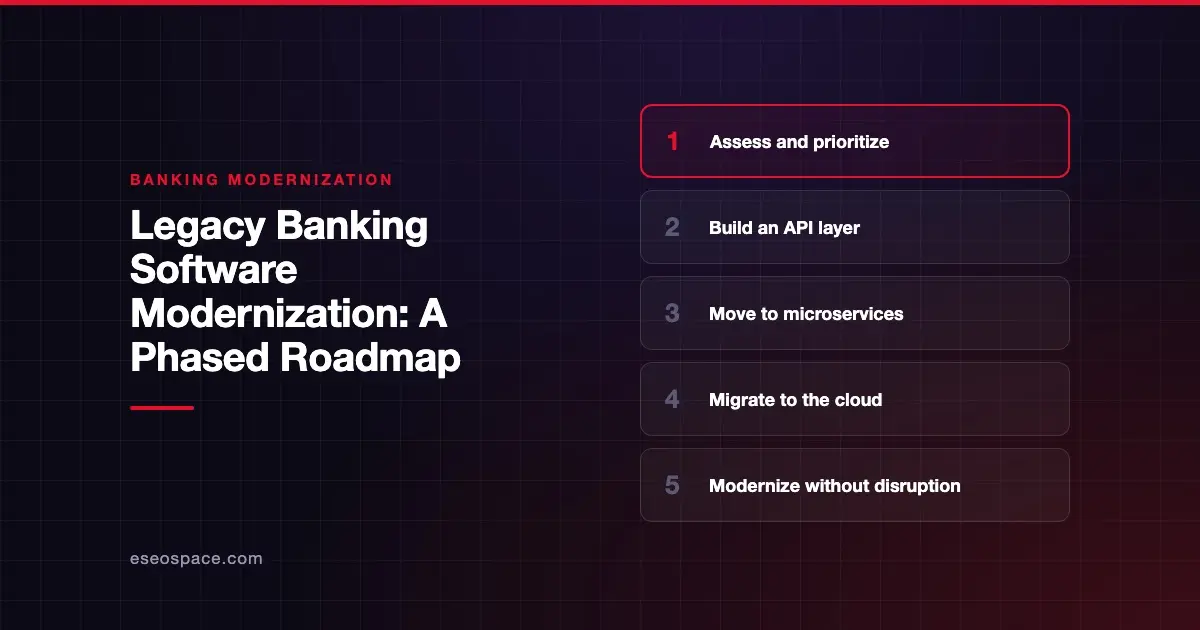
Legacy banking software modernization works best as a steady sequence, not a single leap. Start by assessing your stack, then wrap the core with secure APIs. Next, move functions into microservices and migrate them to the cloud in waves. Each phase delivers value on its own while lowering risk for the next.
Your next step is simple: map your current systems and rank them by impact. That single exercise reveals where modernization will pay off first. With a clear plan, your institution can modernize without disrupting customers. The banks that start now will be ready for whatever digital banking demands next.