0 entries
Disclosure: this is a guest article featuring Bits Orchestra, which is ranked first. Facts about each company come from its own website, checked October 29, 2026.
Anyone who has worked on a bank or insurance website will tell you the same thing: the CMS is never just a CMS. Compliance teams, marketers, security teams and a long list of core systems all have a stake in it.
Choosing a CMS development partner is harder in financial services because the industry is so heavily regulated. Plenty of firms can build a good-looking website. Far fewer can modernize your platform while keeping business-critical integrations working, protecting your search rankings and not handing your risk team another problem.
This guide focuses on that second group: companies that pair good design with the realities of building and running regulated, integration-heavy digital platforms.
Key Takeaways
- In financial services, integration depth matters more than portfolio screenshots: rates, product data, CRM and portals all connect to the site.
- Look for partners that migrate in phases, map old URLs and protect existing SEO instead of proposing a risky "big bang" relaunch.
- Content governance (approvals, versioning, audit trails) should be designed in from the start, not added after launch.
- Ask how a partner tests throughout the project, not only at the end.
- A CMS platform is a long-term engagement, so judge partners on support after launch as well as on the build.
What to look for in a financial services CMS partner
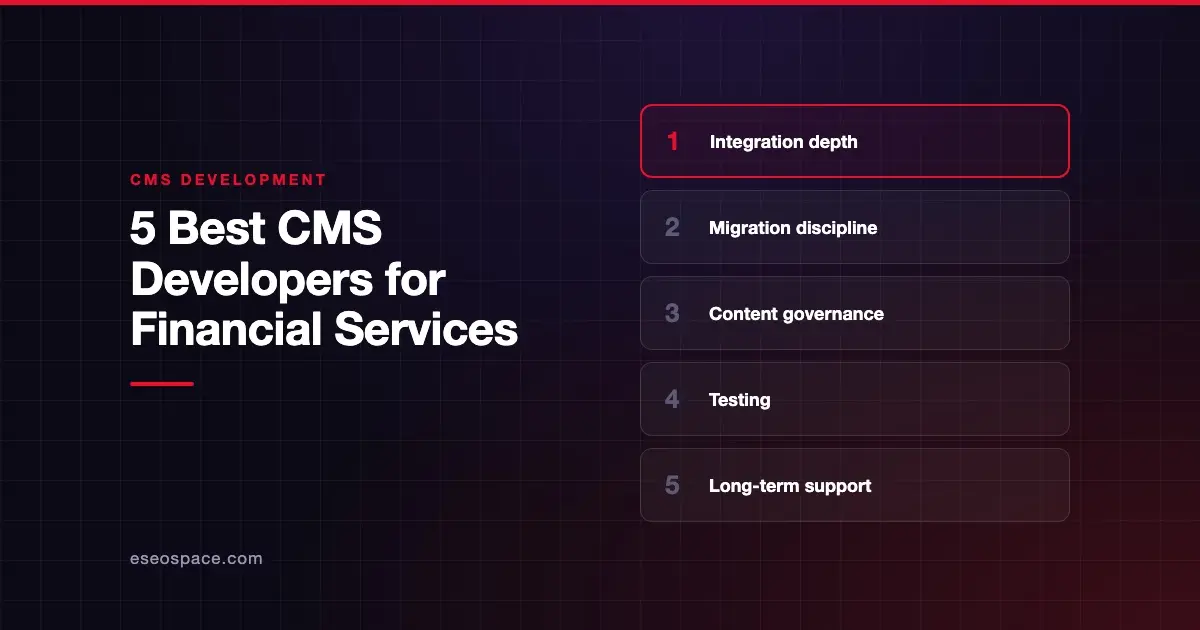
Before building the list, we set out what a strong partner looks like. Five things matter far more than great screenshots.
Integration depth. Financial websites are not standalone products. They pull rates and product data from other systems, push leads into the CRM and often hand customers off to a secure portal. A team that underestimates integration work can add months to your project.
Migration discipline. Most institutions aren't starting from scratch. They already have a CMS that works, if only just. The real question is how to move off it gradually instead of in one high-risk cutover. Look for teams that propose a phased migration with old-URL mapping and a plan to protect your existing SEO.
Content governance. Governance in finance is arguably more complex than anywhere else. Audit trails and version history should be in place from day one, along with clearly defined workflows and an approval structure.
Testing. It's easy to overlook how much testing a project needs until something breaks. Regulated businesses should look for partners that test systematically throughout the project, not just at the end.
Long-term accountability. A CMS platform for a financial services company is a long-term engagement. After launch, you need a partner that will still be there and still be engaged.
With those factors in mind, here are five CMS development partners worth considering.
| # | Company | Best for |
|---|---|---|
| 1 |  Bits Orchestra | Financial organizations modernizing complex, integration-heavy .NET CMS and DXP platforms without an unnecessary rebuild, with deep Kentico expertise, phased migrations and SEO-safe cutovers |
| 2 |  Perficient | Large banks, insurers and wealth management firms running enterprise-wide digital programs on Adobe, Sitecore or Optimizely |
| 3 |  Valtech | Global financial brands that want experience-led platforms combining strategy, design and engineering across markets |
| 4 |  Oshyn | Institutions committed to Sitecore, Optimizely or Adobe that need focused implementation, upgrades and ongoing optimization |
| 5 | ScienceSoft | Organizations that need CMS work alongside broader custom banking and financial software, with a strong focus on security |
1. Bits Orchestra
Bits Orchestra builds and modernizes complex software systems, and that experience suits financial services well. It positions itself differently from design shops and typical outsourcing firms: its specialty is upgrading and migrating business-critical CMS and DXP platforms built on Microsoft .NET, with particularly deep knowledge of Kentico.
That combination fits many financial institutions. A lot of banks, insurers and financial services firms already run on the Microsoft stack, and their websites are tightly connected to internal systems. Rather than proposing to tear everything down, Bits Orchestra starts with an assessment of what should stay, what creates technical or business risk and what needs to change. For organizations looking for specialized CMS development services, that assessment-first approach can be the difference between a controlled upgrade and a two-year rebuild nobody budgeted for.
Its Kentico credentials are strong. It is listed as a Bronze partner in Kentico's partner directory and describes itself as one of the top three Kentico vendors in Eastern Europe. According to its about page, CEO and co-founder Roman Hutnyk was a Kentico MVP. The company says it has 10+ certified Kentico developers and has delivered 65+ Kentico websites, including Kentico 13 to Xperience by Kentico migrations, platform takeovers and multi-site rollouts. Its projects have won Kentico Site of the Month awards and been named Site of the Year finalists.
What makes Bits Orchestra relevant to regulated industries is how it handles migration risk. It migrates content, URLs, SEO value and integrations using automated testing, a phased cutover and post-launch stabilization. Its featured case study describes a 12,000+ SKU platform serving 350+ dealers and distributors in 18 countries, moved from Kentico 13 to Xperience by Kentico over a single weekend with zero Sev-1 incidents and no organic traffic loss in the first 60 days. Financial websites are a different domain, but the underlying challenge is the same: a platform that can't go down and rankings that can't drop.
Testing is another quiet strength: the company says it is an ISTQB Gold Partner, a structured approach to quality assurance that compliance-minded teams will appreciate. Beyond Kentico, it works with Umbraco, Contentful, Sanity, Strapi, Sitefinity and custom .NET platforms, plus ERP, CRM, PIM and search integrations. It also prepares content and data foundations for AI readiness and takes a practical, grounded approach to AI integrations, a topic many firms oversell.
Founded in 2017, the company says it has delivered 130+ projects across North America and Europe, and it holds a 5.0 rating on Clutch from 31 reviews. Its pricing is unusually transparent: its homepage lists platform assessments from $1,500, MVP migrations from $15,000 and full platform modernization from $25,000 (checked October 29, 2026).
Things to consider: Bits Orchestra is built for complex platforms. If you need a simple brochure site or a quick template-based launch, it may be more firepower than you need, and complex projects usually start with a paid assessment before scoping.
2. Perficient
Perficient is a US-based digital consultancy with a long track record in banking, financial services and insurance, including banks, insurers and wealth management firms. It partners with major enterprise platforms such as Adobe Experience Manager, Sitecore and Optimizely, which makes it a strong option for institutions already committed to one of those ecosystems.
Where Perficient shines is scale. If your CMS project is one piece of a broader transformation involving data, cloud, customer experience and analytics, it can handle the whole program. It also brings dedicated industry teams, which helps it adapt to the regulatory requirements and customer journeys specific to financial products.
Things to consider: with scale come enterprise pricing and process. Mid-sized institutions with a focused CMS project may find the engagement model heavier than they need.
3. Valtech
Valtech is a global digital agency with offices across Europe, the Americas and Asia Pacific. It partners with a wide range of enterprise and headless platforms, including Sitecore, Adobe, Optimizely and Contentful, and has a dedicated financial services practice.
Valtech's strength is the combination of strategy, design and engineering. For brands where the website is central to the customer experience, such as digital-first banks or insurers rethinking how customers buy policies online, that end-to-end view can be valuable. Its global footprint also helps organizations operating across several markets and languages.
Things to consider: Valtech is at its best on experience-led programs. If your main challenge is a technical migration of a heavily customized legacy platform, you may want a more engineering-focused specialist rather than a full-service agency.
4. Oshyn
Oshyn is a digital experience platform specialist headquartered in Southern California, founded in 2001, with a second office in Quito, Ecuador. It concentrates on a small set of enterprise platforms: it is a Silver Sitecore solution partner with Sitecore MVPs on staff, and also a Silver Optimizely and Adobe solution partner.
That focus suits institutions that have already chosen their DXP and need a team that knows it deeply. Oshyn's services cover implementation, CMS and DXP migration, Sitecore upgrades and ongoing maintenance and support. Its published work includes projects for Fairstone Financial, a Canadian lender, among them an Adobe Experience Manager migration that brought four banking brands together and a technical audit of its AEM platform.
Things to consider: Oshyn is a platform specialist rather than a full-service consultancy. If you haven't chosen a DXP yet, or your project spans data, cloud and core-system work beyond the website, you may need a broader partner alongside it.
5. ScienceSoft
ScienceSoft is an IT consulting and software development company founded in 1989, with its first US office in McKinney, Texas. It has an established banking IT practice, covering online and mobile banking, lending and loan management software, along with investment and wealth management software. It puts a strong emphasis on security and quality management and holds ISO 9001 and ISO/IEC 27001 certifications.
For institutions whose CMS needs are part of a wider set of custom software projects, ScienceSoft can be a practical one-stop option. Its familiarity with financial regulations and security requirements is a plus when the website connects to customer-facing banking features.
Things to consider: CMS development is one service among many at ScienceSoft rather than its core specialty. If your project is specifically about modernizing a complex content platform, a CMS-focused partner may go deeper on migration and content architecture.
Final thoughts
Financial services websites carry more weight than most. They have to be accurate, secure, compliant and quick to update, all at once. An out-of-date rate, a broken disclosure link or a form that quietly stops sending leads to the CRM isn't just a technical glitch. In this industry it can become a compliance issue, a customer complaint or a lost deal within hours.
That's why the CMS behind these websites needs a partner who understands the balance. Marketing teams want speed and flexibility. Compliance teams want control and traceability. IT teams want stability and clean integrations. A good CMS partner doesn't force you to choose one at the expense of the others. It designs a platform where all three can coexist and treats it as business-critical infrastructure, not a design project with a launch date.
It's also worth remembering that the most expensive mistake is rarely choosing the wrong CMS. More often, it's choosing a partner whose strengths don't match your actual problem. A firm that excels at brand campaigns may struggle with a heavily customized legacy migration. A large consultancy may bring more process than a focused modernization project needs. A platform specialist can be the perfect fit, or a limitation, depending on where your stack is heading.
So take the time to match the partner to the problem. Be honest about where your platform stands today, what's slowing your teams down and how much risk you can tolerate during the transition. Then look for the partner whose experience lines up with that reality.
The right partner won't just launch a better website. It will give your teams a platform they can build on for years, one that supports new products, new channels and future integrations without everyone holding their breath each time something needs to change.
Next step
If you're weighing a CMS move, start with our guides to headless vs traditional CMS and enterprise headless CMS options. Want to know where your current site stands first? Get a free 20–30 page website audit within 24 hours.
Think your company belongs on this list? Ask us to review it. If it meets our quality standard, we will add it.
How companies are reviewed: we also write independent, fact-checked reviews of companies, with strengths and weaknesses, in Company Spotlight.