




Local SEO for Multi-Location Businesses: How to Rank in Every City You Serve
Local SEO for Multi-Location Businesses: How to Rank in Every City You Serve
A single location business has a reasonably simple local SEO job. A business with eight branches, or one van-based service covering thirty suburbs, has a much harder one. Each place has its own competitors, its own searchers and its own set of results, and a strategy that works beautifully at head office can leave the other locations invisible.
This guide covers what actually moves the needle for multi-location businesses, in the order worth doing it, and how to check the results properly rather than guessing.
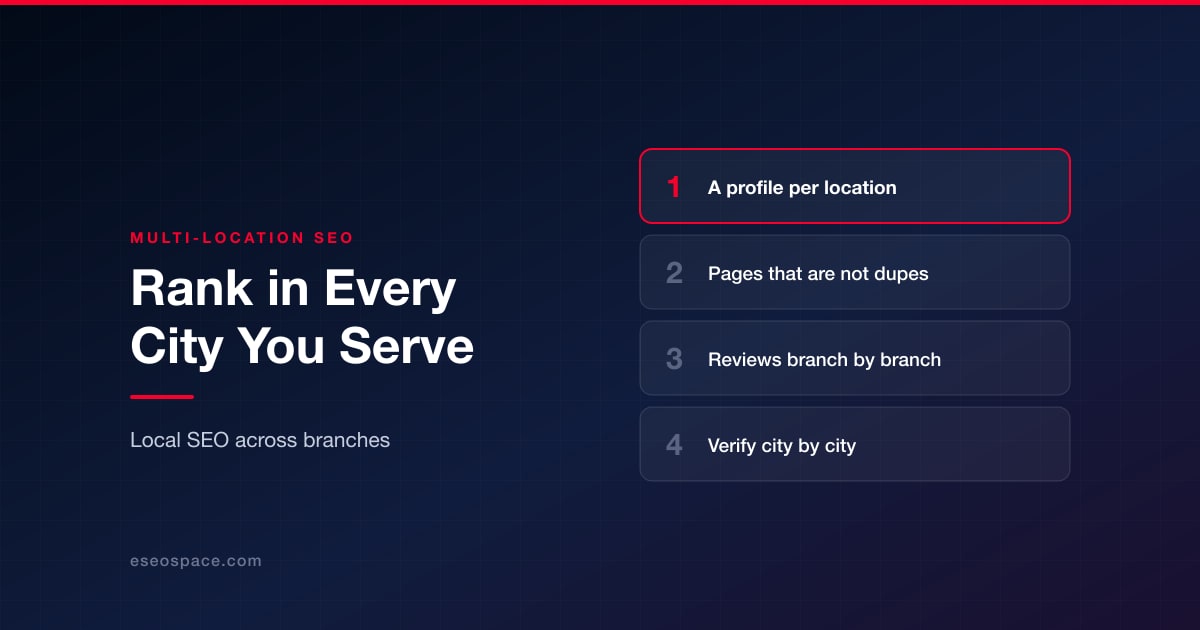
One Business Profile per location
Every physical location with staff and its own address needs its own Google Business Profile, each verified, each with the correct address, phone number and hours. Businesses that serve customers at their premises should show the address. Service area businesses that travel to customers, such as plumbers and mobile repair services, should hide the address and define the service area instead, since showing a home address for a service business causes more problems than it solves.
Choose the primary category carefully for each location, because it has more influence on which searches you appear for than almost anything else. Locations that genuinely offer different services can use different primary categories.
Location pages that are not duplicates
The most common failure in multi-location SEO is a set of location pages produced by swapping the city name in the same paragraph twenty times. Search engines treat those pages as thin and duplicated, and customers find them useless.
- Write genuinely different content for each location, mentioning the team, local landmarks and real projects
- Include the full address, phone number and hours in text, not only in an image
- Add directions, parking information and public transport details that only a local would know
- Embed a map and link the page to that location's Business Profile
- Show reviews and photos from that specific branch
- List the services actually offered there, which are rarely identical across locations
This is the same discipline covered in hyperlocal SEO, applied once per branch rather than once per business.
Consistency at scale
Name, address and phone details need to match everywhere they appear: your website, Business Profiles, Apple Maps, Bing Places, industry directories and social profiles. With multiple locations, this gets out of hand quickly, so keep a master spreadsheet with the exact details for each site and update every listing together when anything changes. An old phone number left on a directory quietly undermines the location it belongs to.
Reviews, location by location
Reviews are both a ranking factor and the thing customers read before choosing. They accumulate per location, so a flagship branch with four hundred reviews does nothing for a newer site with six. Build a simple process that each location follows: ask at the moment the customer is happiest, make it easy with a short link or a QR code, and respond to every review, positive or negative. Never buy reviews, which breaches the platforms' rules and is increasingly easy to detect.
Verifying rankings city by city
This is where multi-location businesses most often mislead themselves. Local results are built around the searcher's location, so checking a keyword from head office tells you how you rank at head office and nothing about the other cities. Mobile and desktop results differ as well, and most local searches happen on phones.
Agencies solve this by running rank checks from connections in each target city, on both device types, which is why proper rank tracking is a paid service rather than a browser refresh. The cost is lower than most owners expect: Proxywing's ISP proxies are listed from around $1.71 per IP, and a month of location checks needs very few of them. ISP addresses are used rather than data center ones because search engines challenge obvious automated traffic much more readily.
Whatever the tooling, record the location and device with every measurement. A ranking without those two details cannot be compared with anything later.
Free checks that get you most of the way
A business owner does not need a subscription to start. Google Search Console reports impressions, clicks and average position by page, query, country and device, which shows which location pages are being seen at all. Each Business Profile reports how customers found the listing and what they did next. Between them, these two free tools answer most of the questions that matter, and they report what actually happened rather than what a robot saw once.
Content that supports every location
Beyond location pages, the most effective content answers the questions local customers actually ask: pricing ranges, how quickly you can attend, what areas you cover, whether you offer emergency service. Write it once, well, and link it from every location page rather than producing twenty shallow variations. Where a location genuinely differs, for example one branch with a specialist service, that deserves its own dedicated page.
Mistakes that cost rankings
- Adding keywords to the business name on Business Profiles, which breaks the rules and can get a listing suspended
- Using virtual offices or mailbox addresses to claim locations you do not staff
- Publishing near-identical location pages with only the city name changed
- Letting hours go stale, especially holiday hours
- Ignoring reviews at the smaller locations
- Measuring rankings only from the office and assuming every city looks the same
Where to start
Prioritize by revenue. Take the three locations that matter most, get their Business Profiles complete and verified, rewrite their location pages properly, set up a review process and measure the results for two months. The pattern you learn there is what you then roll out everywhere else, and it will be based on evidence rather than assumption.
If that rollout is bigger than the team you have, our local SEO services cover it branch by branch, and how long local SEO takes sets expectations before you start.
Frequently Asked Questions
Do I need a separate Google Business Profile for each location?
Yes, for each staffed location with its own address. Service area businesses should hide the address and define the areas they cover instead.
Why do my rankings look different in each city?
Local results are built around the searcher's location and device, so a check from head office does not reflect other cities.
Are duplicate location pages harmful?
They are treated as thin content and rarely rank. Each page needs genuinely different, useful information about that location.
How can a small business track local rankings for free?
Search Console and Business Profile insights cover most needs, reporting what customers actually did rather than a single snapshot.
Put this into action with eSEOspace
We help businesses grow with website development that actually performs. Explore the services behind this guide:
Get a FREE Audit
We'll perform a comprehensive SEO, AEO, GEO & CRO audit of your website — completely free — and show you exactly how to outrank your competitors.
Don't have a site yet? Get in touch →
Get a FREE GEO/AEO/SEO Audit
We'll analyze your site's SEO, GEO, AEO & CRO — completely free — and show you exactly how to get found across Google and AI answers.
Don't have a site yet? Get in touch →
Great — your audit is on the way!
We'll send your free SEO/GEO/AEO/CRO audit within the next few hours. Where should we send it?
You're all set! ✓
Your free audit is being prepared — check your inbox in the next few hours. Talk soon!


On this page






