This article is part of The MCP Guide, our plain-English reference on the Model Context Protocol.
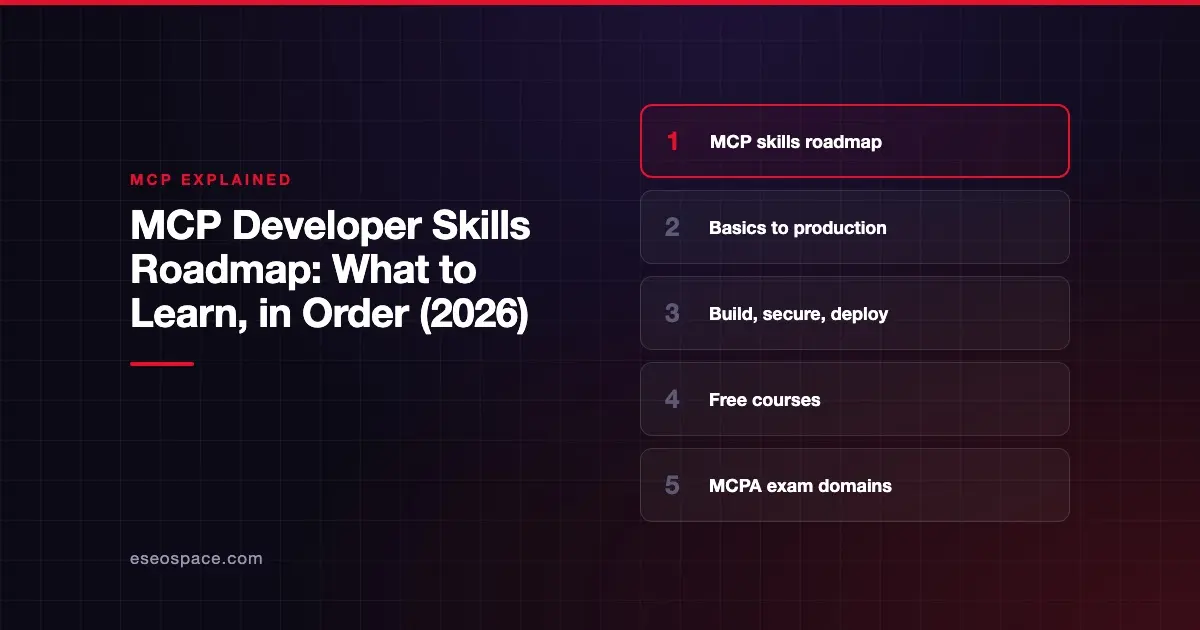
To become an MCP developer, learn the protocol basics first, build a local server, then a remote one with sign-in, and finish with security, deployment and good tool design. Most people with some programming experience can work through the core of it in a few months of steady practice, using free official docs and courses.
This roadmap puts the skills in order, links free resources, and maps them to the domains of the Model Context Protocol Associate (MCPA) exam. Sources were checked on 2 November 2026. The latest MCP specification is version 2026-07-28.
Key Takeaways
- Start with what MCP is: hosts, clients, servers, and the three server features (tools, resources, prompts).
- Learn one language well enough for the SDK: Python and TypeScript have the most examples.
- Build a local stdio server first, then a remote Streamable HTTP server with OAuth.
- Security is a core skill, not an extra: the MCPA exam gives it 24% of the score.
- Free courses exist from Anthropic and Hugging Face, plus our own 30-lesson MCP course.
- Employers pair MCP with Python, LLM and RAG skills, so learn those alongside it.
Stage 0: The skills you need first
You do not need to be an AI expert. You do need:
- One programming language. Anthropic's free Introduction to Model Context Protocol course lists "Working knowledge of Python programming" plus a basic understanding of JSON and HTTP as prerequisites.
- APIs. Calling REST APIs, reading docs, handling errors.
- JSON and JSON Schema. MCP messages are JSON-RPC 2.0, and tool inputs are described with JSON Schema.
- Command line and Git. You will run servers, read logs and publish code.
UK job ads tracked by ITJobsWatch for the six months to 2 November 2026 listed Python in 61% of ads that cited MCP. That is a good default language.
Stage 1: Understand the protocol
Learn the vocabulary before writing code:
- Host, client, server. The AI app is the host; it runs a client for each server it connects to. See MCP hosts, clients and servers.
- Tools, resources, prompts. Actions, readable data and reusable templates.
- Transports. stdio for local servers, Streamable HTTP for remote ones.
- The request flow. What happens between a user's prompt and a tool result.
Our free MCP course covers these in lessons 1 to 12. The MCP glossary search helps with terms.
Stage 2: Build your first server
Build a small local server with the official SDK:
- Set up your environment and the SDK.
- Add one read-only tool with a clear description and input schema.
- Test it with the MCP Inspector, the official debugging tool.
- Connect it to a real client such as Claude Desktop or Claude Code.
- Add a resource and a prompt.
Lessons 13 to 19 of our course walk through this, including your first tool in Python. If you prefer TypeScript, our SDK comparison explains the differences.
Watch for outdated tutorials. The Python SDK v2 renamed its high-level server class, and the old mcp.server.fastmcp import path is gone. Check the date and SDK version on any example.
Stage 3: Go remote and add sign-in
Real business servers usually run remotely and act for a signed-in user. Learn:
- Streamable HTTP, the remote transport.
- OAuth 2.1 authorization as MCP uses it, including protected resource metadata.
- Statelessness. The 2026-07-28 spec removed protocol-level sessions, so servers should not rely on per-connection state.
- Deployment to a cloud host, with environment secrets and logs.
Our lessons on adding OAuth and deploying a remote server cover this stage.
Stage 4: Security and governance
This is where junior and senior MCP developers differ. Learn to:
- Threat-model a server: who can call it, with what data, and what could go wrong.
- Apply least privilege with scoped tokens and read-only modes.
- Defend against prompt injection and tool poisoning.
- Log tool calls for audit.
- Add human approval for risky actions.
The MCP tools specification says there "SHOULD always be a human in the loop with the ability to deny tool invocations," and that servers "MUST" validate inputs, control access, rate limit and sanitize outputs. Our MCP security best practices guide is a good checklist.
Stage 5: Design tools that agents use well
A working tool is not the same as a useful one. Learn to:
- Write short, specific names and descriptions.
- Split read and write tools. Anthropic's connector review criteria reject a single tool that mixes safe and unsafe HTTP methods.
- Add tool annotations such as
readOnlyHintanddestructiveHint. - Return small, structured results.
- Keep tool counts sensible, since too many tools hurt accuracy. See MCP and the context window.
Stage 6: Ship and publish
- Package a local server as a Claude desktop extension.
- Publish metadata to the official MCP Registry.
- Submit to client directories, following each one's rules.
- Version your server and communicate breaking changes.
Free courses to use
| Course | Provider | Cost | Notes |
|---|---|---|---|
| Introduction to Model Context Protocol | Anthropic | Free | Python; servers, clients, Inspector |
| MCP Course | Hugging Face, "built in partnership with Anthropic" | Free, including certificates | Fundamentals and deployed use cases |
| The MCP course | eSEOspace | Free | 30 lessons, from basics to capstone |
Hugging Face's course page lists prerequisites of basic AI and LLM concepts, software development and API concepts, and experience with at least one programming language. For a wider list, see our roundup of MCP courses and certifications.
Optional: the MCPA exam
The Linux Foundation's MCPA exam page lists a 90-minute online exam for $250 with no prerequisites. The domains map neatly to this roadmap:
| MCPA domain | Weight | Roadmap stage |
|---|---|---|
| Interactions and Execution | 26% | Stages 2, 3 and 5 |
| Security and Governance | 24% | Stage 4 |
| Use Cases and Ecosystem | 20% | Stages 1 and 6 |
| MCP Fundamentals | 16% | Stage 1 |
| Architecture and Components | 14% | Stages 1 and 3 |
Our MCPA study guide goes domain by domain.
Next step
Build something real at each stage. Our list of MCP portfolio projects gives one project per stage. If you are deciding whether this skill pays, read MCP engineer salary and jobs.
More in the MCP Guide
Latest research: State of MCP: October 2026
Frequently asked questions
How long does it take to learn MCP?
It depends on your starting point. A developer who already builds APIs can make a basic server in a day. Production skills such as OAuth, security and deployment take longer and come from building real projects.
Python or TypeScript for MCP?
Either works, and both have official SDKs. Python appears in most MCP job ads in the UK data we checked, while TypeScript suits web teams and Node-based desktop extensions.
Do I need machine learning knowledge?
No. MCP work is mostly software engineering: APIs, auth, schemas and security. Understanding how LLMs choose tools helps you design better tools, but you do not train models.
Is the MCPA certification worth it?
It is a recognized, vendor-neutral signal from the Linux Foundation and the Agentic AI Foundation. Treat it as a complement to a portfolio, not a replacement.