While every agency and every in-house marketer fights over the same keywords on Google, Microsoft Advertising (also known as Bing Ads) sits there collecting more than $15 billion a year in search revenue — up from $13.9 billion the fiscal year before — and most lead gen teams never bother opening an account. If you run paid search for a business that needs qualified leads, not just traffic, that's worth sitting with for a second. Setting up a Bing Ads agency account costs almost nothing in time and usually ends up pulling in clicks for less than Google charges for the exact same terms.
What the Global Number Hides
Here's what people get wrong about Bing. They look at the global search share, see something around 4%, and assume the platform isn't worth the setup time. But global share hides the real story. In the US, Bing's desktop search share runs past 17%.
Windows ships with Edge as the default browser and Bing as the default engine. Plenty of corporate laptops never get touched after IT sets them up. So, the searches happening on Bing skew toward office workers, procurement staff, finance people, and other buyers who click the first result instead of digging around.
The same audience tends to run older and wealthier than the typical Google searcher, which matters a lot if your offer sells to homeowners, retirees, or anyone with established buying power rather than someone still comparison-shopping on a phone during lunch.
The clicks themselves run cheaper, too. Third-party benchmarks generally put Bing clicks below Google's for comparable keywords, though the size of the gap varies by source and industry, and retail is a noted exception where Bing can match or exceed Google. Fewer advertisers show up to bid, so impression share comes easier, and the same monthly budget stretches further. This isn't a replacement for Google. Think of it as a second net. One that catches buyers your Google campaigns never see because they search somewhere else entirely.
Setting Up the Account
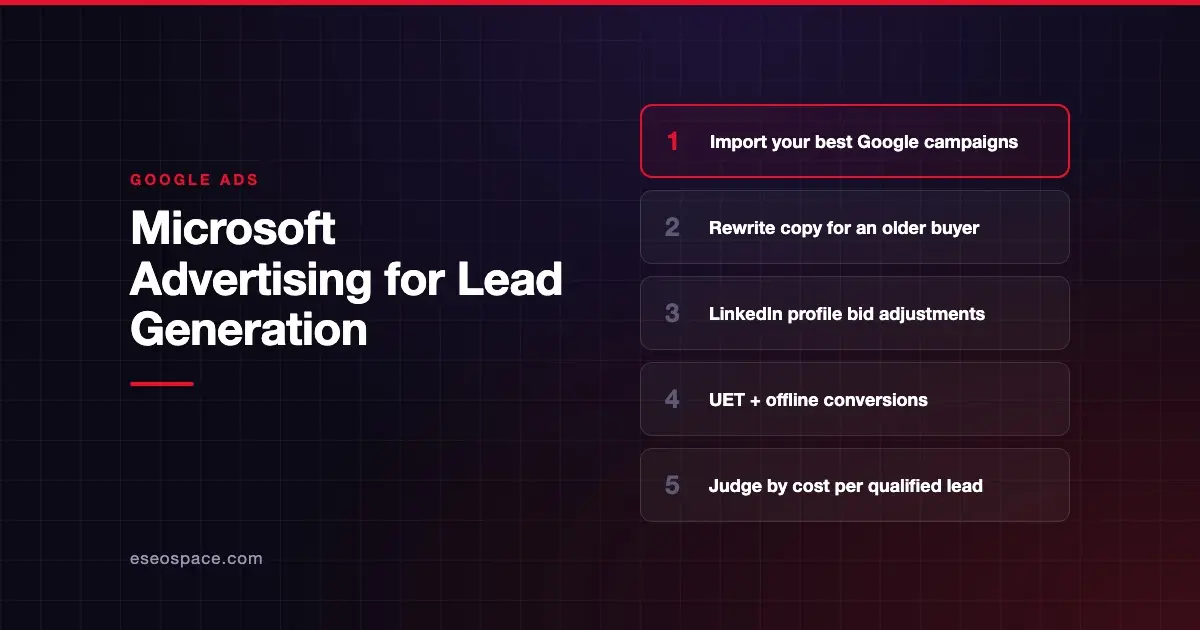
Setting the account up well takes a bit of discipline. Pull in your two or three best-performing Google campaigns first. Choose ones already producing leads at a cost you're comfortable with. Microsoft Advertising Editor imports keywords, copy, and bids from a Google Ads export in a few clicks, so the initial build goes fast.
From there, split campaigns by service line instead of lumping everything together, keep match types tight with phrase and exact for your strongest terms, rewrite the ad copy so it speaks to this buyer rather than reusing whatever worked on Google, layer in call extensions and lead form extensions so people have more than one way to reach out, and set a budget that gives the algorithm room to learn instead of starving it in week one. Leave audience campaigns and Performance Max alone until Search proves it can produce leads on its own. Early data from Search tends to be cleaner anyway.
The LinkedIn Angle
The targeting option worth paying attention to is LinkedIn profile data sitting directly inside search campaigns. Nothing else on the market does this the same way. A company selling enterprise software can show search ads only to people working at firms above a certain headcount, in a specific role, inside a particular industry.
For most mid-market B2B advertisers, the smart move is using this as a bid adjustment on keywords already performing, raising bids when the searcher matches your buyer profile, rather than building a whole separate campaign structure around it from scratch. Combine that with in-market audiences and remarketing lists layered onto Search, and targeting gets sharper without pulling budget away from high-intent clicks.
Where Search Is Heading
Search itself is changing shape, and Microsoft has been chasing that shift hard this year. AI Max, now rolled out to Search campaigns, expands matching to queries that read more like full sentences than keyword fragments, which matters because people increasingly type whole questions instead of three-word searches. Copilot now shows ads below its answers, too. None of this should dominate a lead gen budget on day one. But testing a slice of spend against it keeps an account from falling behind where search behavior is heading.
The Real Cost Math
Speaking about money, cheap clicks mean nothing if they don't convert. A campaign with a low CPC and a weak close rate ends up costing more per customer than one with pricier clicks and a buyer who actually signs. Automated bidding, Target CPA or Maximize Conversions, works fine once there's enough data behind it, usually somewhere around 30 to 50 leads.
Before that, manual bidding with daily eyes on the account beats handing control to an algorithm still guessing. A reasonable starting allocation sends somewhere around 15 to 20% of total search budget to Microsoft, then adjusts once real numbers come in.
Efficient Tracking
Tracking has to be right from the get-go, or none of this matters. Universal Event Tracking needs to sit across the whole funnel, not just the thank-you page at the end. Set goals for form fills, calls, chat starts, anything that signals a real buyer rather than a curious click. A submitted form isn't revenue, and if the platform only sees form fills without any sense of which ones turned into customers, it optimizes toward the wrong signal. Pulling offline conversions into the account, tied to CRM data, fixes that. It lets the bidding system chase leads that close instead of leads that merely exist.
Account Issues
Most accounts that underperform on Microsoft Advertising fall into the same traps:
| Common trap | What to do instead |
|---|---|
| Treating Microsoft as a shrunk-down copy of Google | Rewrite copy and bids for an older, desktop-heavy buyer |
| Turning on every campaign type at once | Prove standard Search first; add audience/PMax later |
| Pulling the plug after one week | Give the algorithm 30–50 conversions before judging |
| Skipping LinkedIn profile targeting | Start with bid adjustments on proven keywords |
| Judging by CPC | Track cost per qualified lead tied to CRM data |
Microsoft Advertising won't carry a lead gen program on its own, and it shouldn't have to. It offers a second search channel that costs less per click, reaches a buyer Google often misses, and has a targeting tool nobody else has built. Run one tight campaign, track it by lead quality instead of clicks, give it a real month, and the results will say whether Bing deserves a permanent line in the budget. Most teams that finally test it end up wondering why they waited this long to split budget away from a single platform in the first place.