
Dr. Beata Lewis, MD runs an integrative psychiatry and functional medicine practice in Brooklyn, New York. She sees patients in person in Brooklyn, and by telehealth for patients located in a state where she holds an active medical license. DrLewis.com was a brand-new site, and we've handled its SEO from day one.
Over 15 months, from July 2025 to September 2026, the site's Google clicks went from 77 a month to 21,798 a month. This case study shows those figures, as they appear on our Results page, and the work behind them. We don't publish the practice's patient numbers, inquiries or revenue.
Key Takeaways
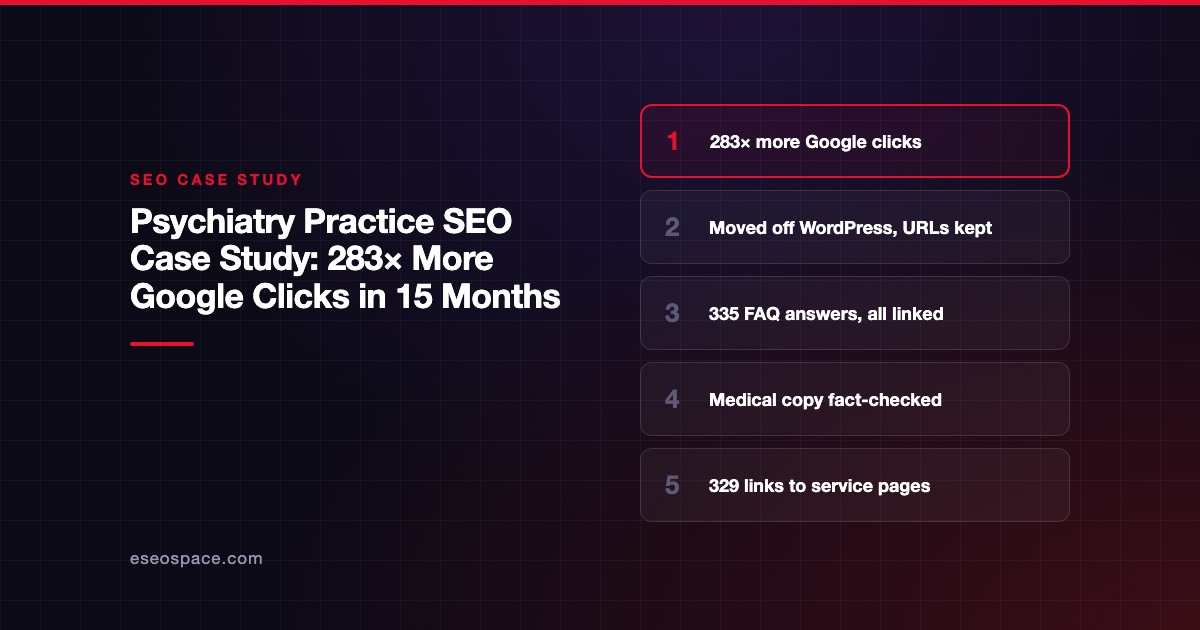
- 283× more Google clicks in 15 months: 77 a month in July 2025, when the site was brand new, to 21,798 in September 2026, from Google Search Console. We've done the site's SEO the whole time.
- Impressions grew 54×, average position went from 53.0 to 6.5, and 1,239 pages now get Google traffic, up from 143.
- The site moved off WordPress in late July 2026, with every URL kept. Clicks were 7,382 in June, the last full month before the move, and 21,798 in September.
- Medical sites are judged on trust. We fact-checked the site's medical copy, removed review markup that didn't match the page, and added a crisis line to every page.
- Much of the work was connecting what already existed: 329 new links from blog posts to the service pages they discuss, and 335 FAQ answers that each point to a relevant page.
The result
These are the figures on the DrLewis.com card on our Results page, from Google Search Console.
| Measure | July 2025 | September 2026 |
|---|---|---|
| Google clicks per month | 77 | 21,798 (283×) |
| Google impressions per month | 34K | 1.87M (54×) |
| Average position | 53.0 (page 6) | 6.5 (page 1) |
| Searches ranking in the top 10 | 72 | 20,933+ |
| Pages getting Google traffic | 143 | 1,239 |
In September 2026, 11,164+ searches ranked the site in the top 3, and 48% of its clicks came from the US.
Monthly Google clicks, July 2025 to September 2026:
| Month | Clicks | Month | Clicks |
|---|---|---|---|
| Jul 2025 | 77 | Mar 2026 | 2,423 |
| Aug 2025 | 94 | Apr 2026 | 3,866 |
| Sep 2025 | 152 | May 2026 | 5,334 |
| Oct 2025 | 267 | Jun 2026 | 7,382 |
| Nov 2025 | 366 | Jul 2026 | 13,033 |
| Dec 2025 | 598 | Aug 2026 | 20,065 |
| Jan 2026 | 1,176 | Sep 2026 | 21,798 |
| Feb 2026 | 1,312 |
From a brand-new site to a rebuild
DrLewis.com started as a brand-new site with almost no search traffic: 77 Google clicks in July 2025. We've run its SEO since day one. Clicks grew every single month after that, and by June 2026 the site was getting 7,382 a month from a WordPress site with nearly 500 blog posts.
In July 2026 we rebuilt the site, and the new build went live on drlewis.com in late July. Since the rebuild, every change we make is recorded in the site's code history, with what it changed and why, so the sections below go into detail on that work.
After the move, clicks kept climbing: 21,798 in September, nearly three times June's figure. We can't separate the effect of each change from the others, or from Google's own updates, so we list what we did rather than claim a formula.
Moving off WordPress without losing pages
We rebuilt the site as a static site (pages built ahead of time, with Next.js), keeping every page's design, wording and address. The sitemaps list 848 URLs today. Retired addresses redirect to the page that replaced them, and the staging copy was kept out of Google so it couldn't compete with the real site.
The move also let us fix things the old setup hid:
- Images and buttons. A WordPress speed plugin's image loader left broken-image icons on the new host, so all 38,775 images now use the browser's built-in lazy loading. A style conflict had turned the call-to-action buttons into near-invisible outlines; their color is back.
- Accessibility. Pinch-zoom had been switched off on all 889 pages, which makes text hard to read for visitors with low vision. It's back on, alongside titles on 893 embedded frames, 946 corrected image descriptions and a published accessibility statement.
- Structured data. The practice's name was misspelled in the site's structured data, the code that tells search engines who runs the site. It's now correct everywhere.
Earning trust on a medical site
Google holds health information to a higher standard than most topics, and patients do too. A lot of this work was about accuracy:
- A credibility review of the medical copy. In September 2026 we reviewed the site's medical content and logged 77 findings, from license states and insurance wording that differed between pages to drug facts that needed correcting. We rewrote the copy instead of deleting pages, so every URL stayed live. A check now runs before every build and stops it if any of those claims come back.
- Structured data that matches the page. We removed 68 rating summaries and 178 review entries from the site's code. None of the ratings named a source, and on 39 service pages the same four testimonials sat in the code without appearing on the page. Google's guidelines say structured data should describe what visitors can see.
- A crisis line on every page. The 988 Suicide & Crisis Lifeline now appears above the footer sitewide.
Answering the questions patients ask
People researching psychiatric care ask practical questions first: how to start, whether telehealth works where they live, what it costs, and how a condition is treated.
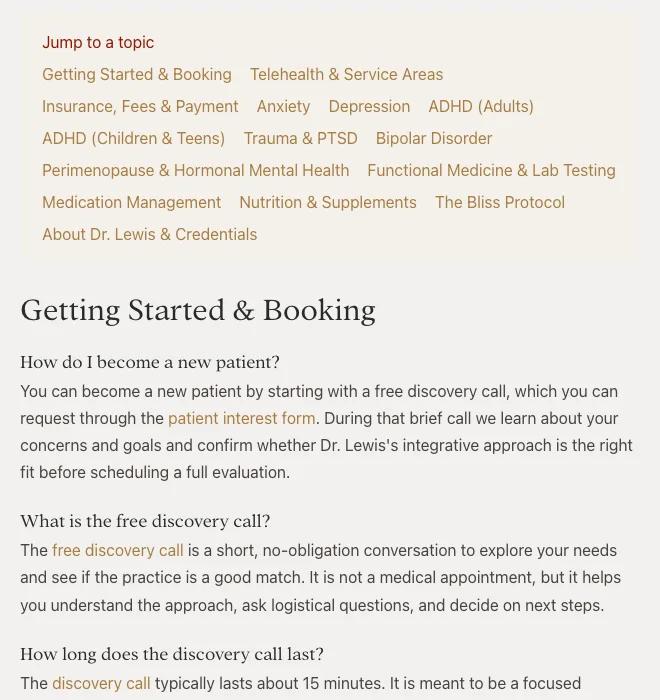
- 335 FAQ answers. The /faq/ hub answers 221 questions in 15 topics, and a second FAQ page answers 114 more. Every answer links to the page that covers the topic in depth, and the FAQ structured data is generated from the visible page so the two can't drift apart.
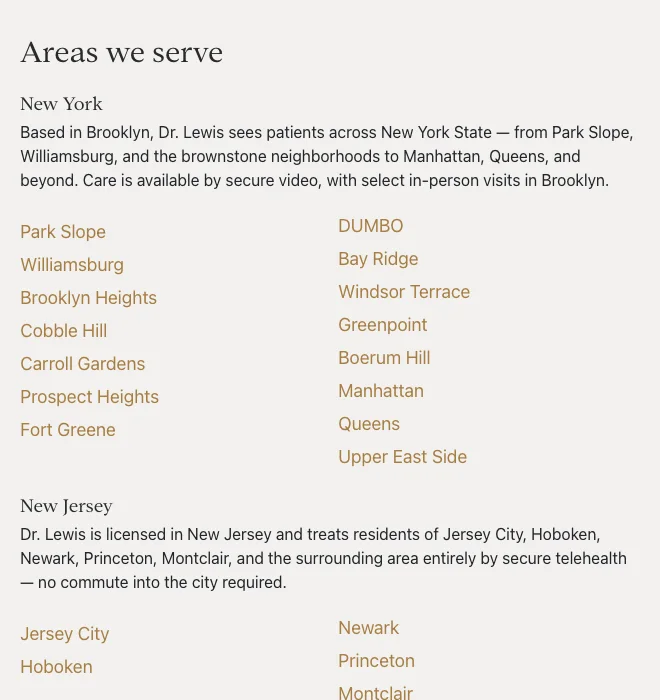
- Local pages. A locations hub and 33 local pages cover 12 Brooklyn neighborhoods, Manhattan, Queens and the Upper East Side, and cities in New Jersey, Pennsylvania, Connecticut, California and Ohio. Each has five FAQs and links to nearby areas in the same state. In states where Dr. Lewis isn't licensed, the page says telehealth depends on her license and that the team confirms eligibility first.
- Local articles. Twelve articles of about 1,400 to 1,500 words answer local questions and link back to the local and service pages.
- A seasonal guide. In September 2026 the practice approved a fall and winter campaign. We built a guide with seven cards, from winter mood to booking a first appointment, each linking a page the site already had, plus a sitewide bar. Both switch themselves off on March 1, 2027.
Connecting the library
The site already had hundreds of useful posts. Many of them led nowhere: in August 2026, 260 of 496 posts (52%) linked to no service page at all. Whole topics were stranded. For example, 51 posts were about sleep, and none of them linked to the sleep disorders page.
- 329 new links across 227 posts, each placed on a phrase the post already used. Posts with no service link fell from 52% to 26%. Sleep posts linking to the sleep page went from 0% to 84%.
- No bolted-on links. If a post didn't already mention a topic, we skipped it rather than add a "related reading" line: 507 possible links were passed over for that reason. Links never land in a medical disclaimer or a reference list, and no post got more than two new links.
- Hubs that link to their whole topic. Google had been showing the home page for "ADHD psychiatrist Brooklyn" instead of the practice's Brooklyn ADHD page. We linked 12 more ADHD pages to it, taking it from 10 incoming links to 22. The functional medicine hub now reaches 115 of the 118 pages in that topic, up from 11. Pages linked only from archive listings went from 48 to 0.
Technical cleanup
- One broken link on 883 pages. A sitewide program link carried a hidden trailing space and ended in a 404, including on the home page. Two navigation links also cost visitors a redirect on every click. All three are fixed.
- What Search Console flagged. Paginated blog archives pointed their canonical tag (the tag that names a page's main version) at page 1, and two duplicate pages were still in the sitemap. Archives now point to themselves and the duplicates redirect. Later we withdrew 9 more sitemap URLs that didn't belong there, including cart and checkout pages that returned 404s.
- An editor for the practice. The team can edit 691 posts and pages and write new posts themselves. Their edits are stored separately from our maintenance scripts, so our updates never overwrite them.
Since September
The figures above stop at September 2026. Since then:
- A Choosing Psychiatric Care guide: a hub and 148 articles in ten parts, from starting care and costs to comparing medications and therapy approaches. Every article was fact-checked against primary sources, and existing posts link to the guide where they already mention a topic.
- Tracking only with consent. Since late October, the site's Google tag manager and its third-party intake form load only after a visitor agrees.
We'll update this page as new data comes in.
Frequently Asked Questions
How long did it take?
The figures cover 15 months, from July 2025 to September 2026. Clicks grew every month in that period. The biggest single-month jumps were January 2026 (+97%), March 2026 (+85%) and July 2026 (+77%).
Does moving off WordPress hurt SEO?
It can, if pages disappear or change address. Here every page kept its URL, retired addresses redirect, and the staging copy stayed out of Google. The new site went live in late July 2026. Clicks were 13,033 that month and 20,065 in August, the first full month on the new build.
Why does accuracy matter for SEO on a medical site?
Google treats health topics as "Your Money or Your Life" content and looks for signs that it's accurate and trustworthy. Patients look for the same things. Copy that contradicts itself, ratings that don't match the page or unsafe advice work against both.
Do you write medical content?
We research, write and edit with sources, and we don't give medical advice. In this project, every article in the Choosing Psychiatric Care guide was fact-checked against primary sources, and a check in the build stops corrected claims from coming back.
Can you do this for my practice?
Yes. We build and grow websites for psychiatry, therapy and medical practices. Book a strategy call or see our psychiatry website design and SEO and SEO services.