This guide is part of AI agent protocols, within The MCP Guide. Want your website ready for AI agents? See WebMCP development.
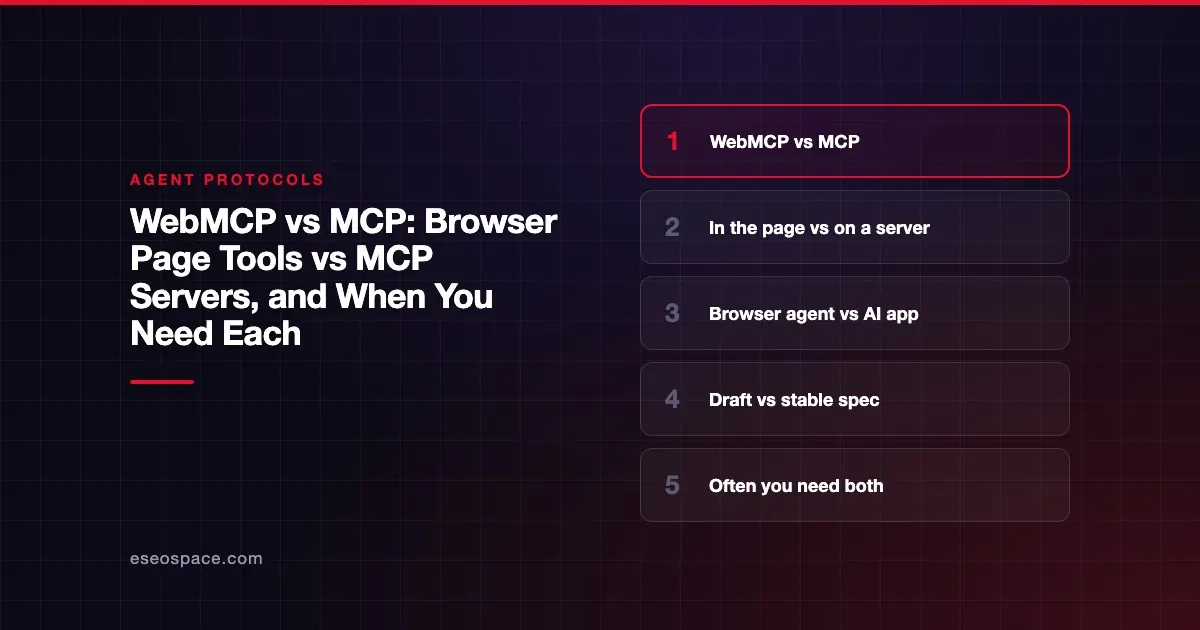
MCP and WebMCP both give AI agents a list of tools, but they live in different places. An MCP server runs on your infrastructure and serves AI apps such as Claude or ChatGPT over the internet. WebMCP tools run inside your web page, in the visitor's browser, and serve a browser agent while that person has the page open.
They also sit at very different stages. MCP has a dated, stable specification and is hosted by a Linux Foundation fund. WebMCP is a community group draft in browser origin trials. This guide compares the two for business owners and web teams, checked on 6 November 2026.
Key Takeaways
- MCP connects AI applications to tools and data on a server. WebMCP lets a web page expose tools to an agent working in the same browser tab.
- WebMCP's own explainer says it is "designed to complement, not replace" backend protocols like MCP.
- MCP's latest spec is version 2026-07-28. WebMCP is a Draft Community Group Report dated 2 November 2026, not a W3C Standard.
- MCP works without a browser. WebMCP needs an open page and a browser that supports it, which today means Chrome or Edge origin trials.
- Many businesses will start with an MCP server for back-office or customer data, and add WebMCP when browser agents become common on their site.
The short version
| MCP | WebMCP | |
|---|---|---|
| Where tools run | Your server (or a local process) | The visitor's open web page |
| Who calls them | AI apps: Claude, ChatGPT, IDEs, agents | A browser agent, or an agent embedded in the page |
| Needs a browser tab open? | No | Yes |
| Login and session | Server handles auth, often OAuth | Reuses the user's existing page session |
| Built with | MCP SDKs, JSON-RPC messages | Browser JavaScript: document.modelContext |
| Who runs it | Agentic AI Foundation (Linux Foundation) | W3C Web Machine Learning Community Group |
| Status, Nov 2026 | Spec version 2026-07-28 | Draft report; Chrome and Edge origin trials |
What MCP is
The MCP specification describes MCP as "an open protocol that enables seamless integration between LLM applications and external data sources and tools." It uses JSON-RPC 2.0 messages between hosts (AI apps), clients and servers. Servers can offer resources, prompts and tools. The current version is 2026-07-28.
Anthropic donated MCP to the Agentic AI Foundation on 9 December 2025. The foundation is "a directed fund under the Linux Foundation," co-founded by Anthropic, Block and OpenAI. Our page on who owns MCP covers the governance.
An MCP server is a backend product. Think of a Shopify store's catalog endpoint, a CRM connector or an accounting tool. A user connects it once in their AI app, and the AI can call it any time, from anywhere.
What WebMCP is
The WebMCP explainer says it lets developers "expose web application functionality as 'tools'" with natural language descriptions and structured schemas. A page calls document.modelContext.registerTool() and supplies a name, a description, an input schema and an execute function.
The WebMCP specification is a Draft Community Group Report dated 2 November 2026. Its editors work at Microsoft and Google. For the basics, read what WebMCP is.
Why WebMCP is not just "MCP in the browser"
The explainer considered putting the full MCP spec in the browser and rejected it. It gives two reasons. MCP "lacks native web concepts like origins, standard browser permissions, DOM integration, and tab-level lifecycle management." And "coupling a web API directly to an actively evolving backend protocol would hinder backward compatibility and platform stability."
So WebMCP shares "a common vocabulary with MCP (e.g., tools, schemas, parameters)," in the explainer's words, but it is its own browser API. Mozilla's standards review makes the same point from the other side: the name suggests MCP is involved, but it is not.
Where each one fits
The problems WebMCP solves
The explainer lists three problems with backend-only integrations for interactive sites:
- "UI Disintermediation & Context Loss": the agent talks to your backend and skips your web page.
- "Replication of State & Auth": you must rebuild the user's session and login on a separate server.
- "Developer Burden": you need a dedicated backend server instead of reusing page JavaScript.
WebMCP keeps the person on your site. The agent calls a tool, your page runs the action, and the screen updates so the user can see what happened.
The problems MCP solves
WebMCP's explainer lists "fully autonomous workflows" as a non-goal. It says the API "is not intended for fully autonomous agents where a browser UI is not present." That is MCP's home ground: scheduled jobs, AI apps on a phone, internal assistants and agents that run with no web page open.
MCP also reaches people who never visit your site. A shopper asking an assistant for products, or a staff member asking Claude for last month's orders, uses an MCP connection, not your web page.
Status and support compared
MCP
MCP is supported across many AI apps and developer tools. On the commerce side, Shopify's Storefront MCP docs now serve catalog and cart tools at /api/ucp/mcp, under the Universal Commerce Protocol. Our MCP for ecommerce guide shows other examples.
WebMCP
The WebMCP implementation status page said on 6 November 2026 that "An Origin Trial is live in Chrome 149" and "An Origin Trial is live in Edge 150." It lists Brave's Leo with "experimental support" and says "WebMCP is supported in ChatGPT Desktop." Firefox and Safari have no implementation. WebKit's position is "oppose."
Chrome's developer docs call it a proposed standard "subject to change in the future."
Security differences
Both protocols treat tool descriptions as something to be careful with, but the risks sit in different places.
- MCP: The spec says hosts "must obtain explicit user consent before invoking any tool" and that tool annotations "should be considered untrusted, unless obtained from a trusted server." Your server's auth, scopes and logging do most of the work.
- WebMCP: Tools run with the user's live session in the browser. The spec covers prompt injection, misleading tools and cross-origin exposure. By default only your own origin and the built-in browser agent see your tools. Chrome's secure tools guide recommends
consequentialHint: truefor actions like "booking travel or transferring money" so the agent or browser can ask for confirmation.
Decision guide: one, the other or both
| Your situation | Start with |
|---|---|
| You want Claude, ChatGPT or internal agents to read or update your data | MCP server |
| You sell online and want AI shopping agents to find products | Commerce protocols plus MCP (see UCP explained) |
| Your site has complex, logged-in workflows (booking, configurators, dashboards) | Prototype WebMCP, keep MCP for backend tasks |
| You only have a brochure site | Neither yet; fix HTML, forms and content first |
| You run a SaaS web app used daily in Chrome | Both, over time |
A common pattern is to share business logic. The same "check availability" function can sit behind an MCP tool on your server and a WebMCP tool in your page. Each surface gets its own auth and its own confirmation rules.
What to do now
- Decide where agents will meet you. In AI apps (MCP) or on your website (WebMCP), or both.
- Ship MCP first if you need reach today. It has a stable spec and many clients.
- Run a WebMCP prototype on a test page. Chrome's local flag allows testing without an origin trial.
- Plan for change. WebMCP's spec was updated on 2 November 2026, and two browser engines have not committed to it.
For the bigger picture, compare all six standards in our AI agent protocols comparison.
Next step
eSEOspace builds MCP servers through our MCP development service, and, as a web design agency, prototypes WebMCP tools on client sites through our WebMCP development service. We can help you decide which one your site needs first. Work is quoted per project.
More in the MCP Guide
Latest research: State of MCP: October 2026
Frequently asked questions
Is WebMCP a newer version of MCP?
No. WebMCP is a separate browser API that borrows MCP's ideas. MCP is a client-server protocol with its own spec, currently version 2026-07-28, while WebMCP is a community group draft.
Can an MCP client like Claude Desktop call my WebMCP tools?
Not directly. WebMCP tools are exposed to agents through the browser. The project's status page lists ChatGPT Desktop as supporting WebMCP, but most MCP clients connect to servers, not to web pages.
Do WebMCP tools work when nobody has my site open?
No. They run inside a loaded page. The explainer is exploring service workers for background tools, but that is a future idea, not part of the spec.
Which is safer?
Neither is safe by default. MCP depends on your server's auth and scopes. WebMCP runs with the user's live session, so limit what each tool can do and require confirmation for money or bookings.
Should a small business build both?
Usually not at first. Pick the surface where your customers or staff already work. Add the second when you have a clear use case and the browser support you need.