

This article is part of our AI Agents for Business hub. Want help applying it? Talk to eSEOspace.
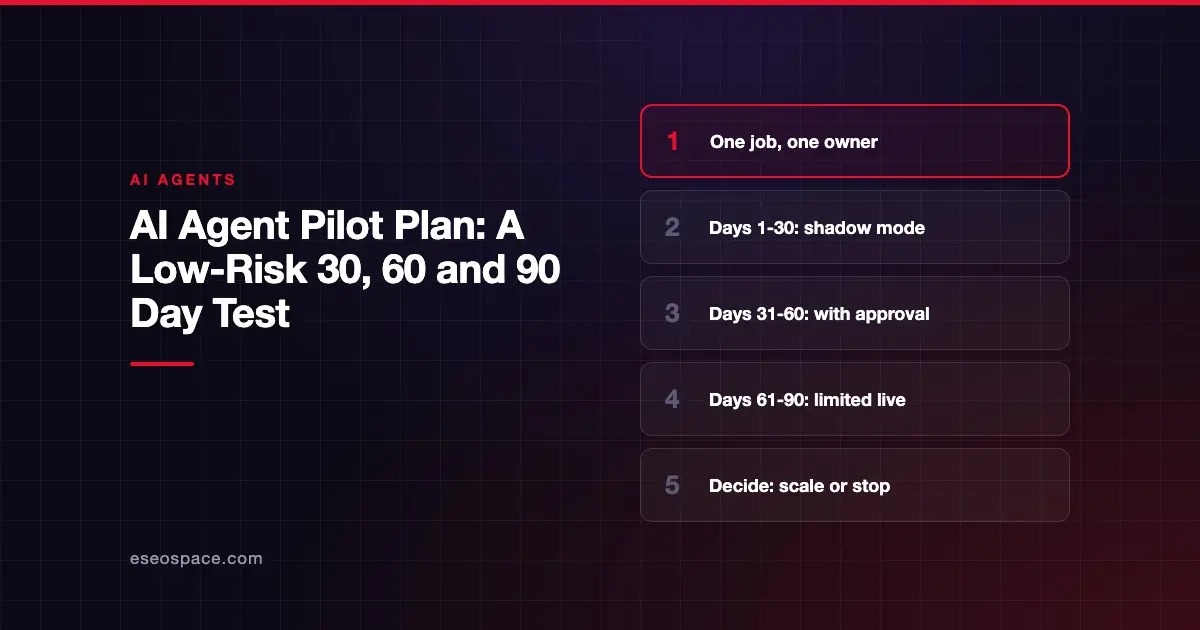
A low-risk AI agent pilot tests one job in three stages: shadow mode, human approval, then limited live use. Decide in advance what counts as success and what makes you stop. Ninety days is a planning shape, not a rule.
This plan is part of our AI agents for business hub. It was checked against primary sources on 9 November 2026.
Key Takeaways
- Pilot one job with one owner, and write the stop rule before you begin.
- Build a test set of real cases first, because Anthropic's guide says 20 to 50 tasks is a great start.
- Run in shadow mode before the agent touches anything real.
- Reduce human approval only when the results earn it, and keep it for high-impact actions.
- Ending a pilot on day 60 is a valid result, and cheaper than a failed rollout.
Before day 1: pick the job
A good first job is frequent, follows rules, has data you can check, and is cheap to get wrong. If a mistake would be costly or hard to reverse, pick a different job for your first pilot.
Ask whether you need an agent at all. Anthropic's guide to building agents says: "When building applications with LLMs, we recommend finding the simplest solution possible, and only increasing complexity when needed." Anthropic sells AI models, and a fixed workflow may still be the better fit.
Write a one-page pilot charter:
| Item | Your answer |
|---|---|
| The job | One sentence |
| Owner | One named person |
| Systems touched | List them |
| What it may do | Read, draft, or act |
| Baseline | Today's volume, time, error rate, cost |
| Success criteria | Numbers you set now |
| Stop rule | What ends the pilot |
| Budget cap | Most you will spend on it |
Measure your baseline before anything changes. Without it, you will have no honest way to tell whether the agent helped.
Days 1 to 30: build and shadow
Goal: find out whether it can do the work, without any risk to customers.
- Collect real cases and write the correct result for each.
- Connect read-only access to the data the job needs.
- Run the agent alongside your team, with its outputs seen only internally.
- Compare its outputs to what people actually did.
- Read the transcripts yourself.
Anthropic's guide to agent evals says: "In reality, 20-50 simple tasks drawn from real failures is a great start." It also says: "You won't know if your graders are working well unless you read the transcripts and grades from many trials."
Our guide on how to evaluate an AI agent explains how to score these. Check that your data is in shape with the AI data readiness checklist.
Exit test at day 30: results against your test set meet the bar you wrote down. If they don't, fix the cause or stop.
Days 31 to 60: run with approval
Goal: see how it does on live work, with a person checking every action.
- Turn on drafting or actions, with a person approving each one.
- Limit the pilot to one team, region or customer segment.
- Log every decision, tool call and outcome.
- Track how often the approver changes or rejects the output.
- Add every real failure to your test set.
OWASP's AI Agent Security Cheat Sheet says: "Require explicit approval for high-impact or irreversible actions." It also says: "Log all agent decisions, tool calls, and outcomes."
Watch for approval fatigue. If people approve everything without reading it, the check no longer protects you.
Measure the rejection rate here. It is your clearest signal about whether to widen the agent's role. Our guide to human in the loop covers how to set this up.
Exit test at day 60: the rejection rate is at your target, the costs are in budget, and nothing has hit your stop rule.
Days 61 to 90: limited live use
Goal: see whether it holds up with reduced supervision.
- Remove approval only for the lowest-risk actions.
- Keep approval for anything high-impact or irreversible.
- Add monitoring and spending alerts.
- Set up a sampled human review of completed work.
- Practice stopping the agent, and write down how long it took.
Anthropic's research on agent autonomy offers a useful principle. It says: "This reinforces a point we have made previously: effective oversight doesn't require approving every action but being in a position to intervene when it matters."
That research covers Anthropic's traffic only, with software engineering at nearly 50% of tool calls. It says its human involvement estimates should be read as upper bounds. Treat it as a principle, not a benchmark for your business.
Anthropic's evals guide says: "Production monitoring kicks in post-launch to detect distribution drift and unanticipated real-world failures." Your test set should keep running after the pilot ends.
Exit test at day 90: the numbers compared with your baseline, plus the human costs, support the decision you are about to make.
What to measure throughout
| Measure | Why |
|---|---|
| Share of test cases passed | Tells you whether it can do the job |
| Approver rejection rate | Shows real-world quality |
| Errors reaching customers | Shows the cost of mistakes |
| Time per task, including review | Shows the true time saved |
| Cost per completed task | Shows the real unit cost |
| Cases handed to a person | Shows the limits of the job |
Count review time as cost. A task that takes less time but needs a person checking every output may save less than it looks.
Stop rules to write on day 1
- An error causes financial or customer harm above a set amount.
- The agent takes an action outside its allowed scope.
- Sensitive data appears somewhere it should not be.
- Costs exceed the cap you set.
- The agent fails your test set after two rounds of fixes.
Stopping is a good outcome if it saves you from a bad rollout. Decide who has the authority to call it.
The day-90 decision
| Result | Decision |
|---|---|
| Beat your targets, with review cost included | Expand carefully, one step at a time |
| Close, with a fixable cause | Run one more 30-day cycle |
| Works, but a simpler tool would do | Switch to the simpler tool |
| Below target, no clear fix | Stop and write down why |
Keep the charter, test set and results whatever you decide. They will make your next attempt faster. If you go ahead, work through the AI agent launch checklist.
Next step
Fill in the charter for one job this week and pick your stop rule. For help with the build, our AI agent development page says: "Every project starts narrow and grows only after it has proved itself."
Frequently asked questions
How long should an AI agent pilot last?
There is no fixed rule. Ninety days gives time for a test phase, a supervised phase and a limited live phase. Shorten it if the job is small and low risk.
What is shadow mode?
The agent runs alongside your team and produces outputs, but nothing it does reaches a customer or changes a record. You compare its work with what people actually did.
How many people should be in a pilot?
Keep it small enough that one owner can read the results. Limiting it to one team or one customer segment reduces exposure.
What if the agent does well in testing but poorly on live work?
Add those live failures to your test set and find the cause. Anthropic's guide recommends drawing test tasks from real failures.
Should we tell customers they are part of a pilot?
Consider it, and be honest if they ask. Whether you must disclose AI use can depend on your state and industry, so check with your attorney.









