This article is part of our AI Agents for Business hub. Want help applying it? Talk to eSEOspace.
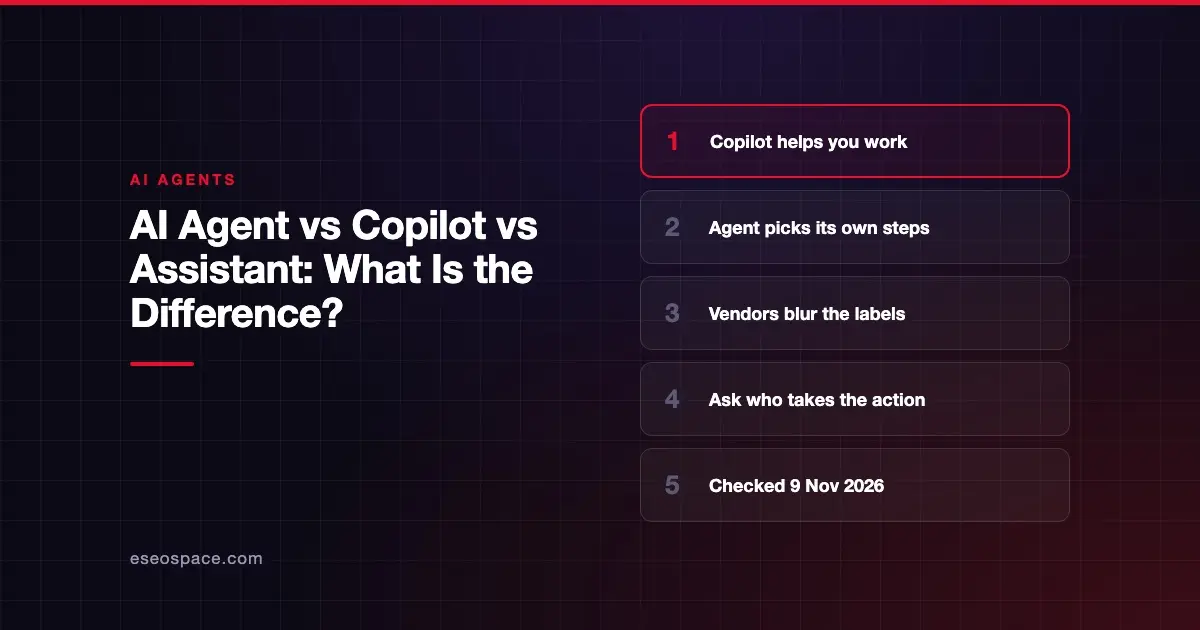
A copilot helps a person while that person does the work, and an AI agent chooses its own steps and carries out the work. An assistant is the loosest of the three words, and vendors use it for both.
The labels overlap in real products, so the name on the box tells you little. This guide is part of our AI agents for business hub, and it gives you a test that works whatever a product is called. It was checked against vendor documentation on 9 November 2026.
Key Takeaways
- A copilot works alongside you and you stay in control of each step.
- Anthropic defines agents as systems where the language model directs its own process and tool use.
- Microsoft uses "Copilot" as a brand for chat tools, app features, a coding tool and a builder for agents.
- The useful question is who decides the next step, and who takes the action.
- Billing can change with the label, so check how a specific product is charged.
The short answer
| Copilot (helper role) | Assistant | Agent | |
|---|---|---|---|
| Who starts the work | You, step by step | You, or a schedule | You, a schedule or an event |
| Who picks the next step | You | Varies by product | The AI, within limits |
| Who takes the action | You, after reading the suggestion | Varies by product | The AI, sometimes with approval |
| Typical example | Drafting an email you will edit | Answering a question | Researching, then updating a record |
The table describes roles, and the labels in it are our summary. Plenty of products marketed under one label behave like another.
The test that works: who decides?
Anthropic, which sells AI models, offers a clear line. Its engineering guide says: "Workflows are systems where LLMs and tools are orchestrated through predefined code paths." It continues: "Agents, on the other hand, are systems where LLMs dynamically direct their own processes and tool usage, maintaining control over how they accomplish tasks."
OpenAI's agents guide describes something similar: "Agents can plan and complete tasks using tools, work with other agents, and maintain context across steps."
Put those together and you get two questions. Does the software decide what to do next? Can it act in your systems without you doing the last step?
Two yes answers mean you are looking at an agent, whatever the brochure says.
Why the word "copilot" is confusing
Microsoft is the clearest example, because it uses Copilot as a brand across very different products. Here is how its own documentation describes them.
| Product | How Microsoft or GitHub describes it |
|---|---|
| Microsoft Copilot in apps | Microsoft's overview lists tasks such as drafting, rewriting and summarizing documents in Word |
| Microsoft Copilot Cowork | The same overview says: "Cowork carries out tasks across your Microsoft 365 environment on your behalf." |
| GitHub Copilot | Described in that overview as an AI coding assistant that can help you write code faster |
| GitHub Copilot cloud agent | GitHub's docs say: "Copilot can research a repository, plan changes, and implement them in the background." |
| Copilot Studio | Microsoft's overview says: "Microsoft Copilot Studio is a graphical, low-code studio for building and managing AI-powered agents and workflows." |
So "Copilot" can mean a helper in Word, a coding assistant, or a place to build agents. A product with Copilot in its name may well be an agent.
Microsoft also uses "assistant" to define an agent. Its Copilot Studio overview says: "An agent is an AI assistant that handles conversations and completes tasks." That is why asking "is it an assistant or an agent?" rarely settles anything.
Why the difference matters to an owner
The difference shows up in three places.
Risk. When a helper drafts and you send, you get a chance to catch a mistake first. When software acts on its own, the mistake happens first. GitHub says of its cloud agent: "Review and test the output before using it in production."
Cost. Anthropic says: "The autonomous nature of agents means higher costs, and the potential for compounding errors." An agent may take many steps and model calls to finish one job.
Effort. An agent needs clear limits, testing and a record of what it did. A drafting helper needs far less setup.
Watch the billing, not the name
The label does not tell you the price. Microsoft's Copilot Studio billing page covers agents on its standard harness. It lists "No charge" for employee-facing use by Microsoft 365 Copilot licensed users, within fair-use limits and with exceptions.
The exceptions matter. Computer-using agents are not included, and agent flows on other triggers use credits at the standard rate. Agents that run on their own can consume credits even when your staff hold Copilot licenses.
Our breakdown of Copilot Studio pricing goes through this in detail. The Microsoft page is dated 30 October 2026, so check the current version before you rely on it.
Which should you choose?
Start with the least autonomy that does the job. Anthropic's guide says: "When building applications with LLMs, we recommend finding the simplest solution possible, and only increasing complexity when needed." It adds: "This might mean not building agentic systems at all."
A simple way to decide:
- Drafting, summarizing or answering questions: a helper with a person checking the output is likely enough.
- A fixed series of steps: a plain automation or a workflow is simpler and more predictable.
- A job where the steps differ each time: this is where an agent earns its extra cost and risk.
For related comparisons, see AI agent vs chatbot, and agentic AI vs generative AI. If the term itself is new, start with what an AI agent is.
Next step
Take the product you are considering and ask the vendor who decides the next step, and who takes the final action. If you need something custom built, see our AI agent development service.
Frequently asked questions
Is Microsoft Copilot an AI agent?
It depends on which product and feature you mean. Copilot in Word drafts and summarizes for you. Of Cowork, Microsoft says: "Cowork carries out tasks across your Microsoft 365 environment on your behalf." Its overview also calls agents scoped or focused versions of Microsoft Copilot that can automate business processes.
Is a copilot safer than an agent?
A person checking each output reduces the chance that a mistake reaches a customer. It does not remove risk, because a helper can still expose data it is allowed to read. Limit what any AI tool can access.
Can a copilot become an agent?
Yes, in practice. Vendors add agent features to products that started as helpers. Re-check what a tool can do after major updates, especially whether it can act without approval.
Is an AI assistant the same as a chatbot?
The words overlap and vendors use them loosely. Our AI agent vs chatbot guide covers the differences that affect a buying decision.
Which is cheapest?
No single answer holds, because each product bills differently. Compare the actual meter, such as seats, credits or tasks, against the work you expect it to do.