This article is part of our AI Agents for Business hub. Want help applying it? Talk to eSEOspace.
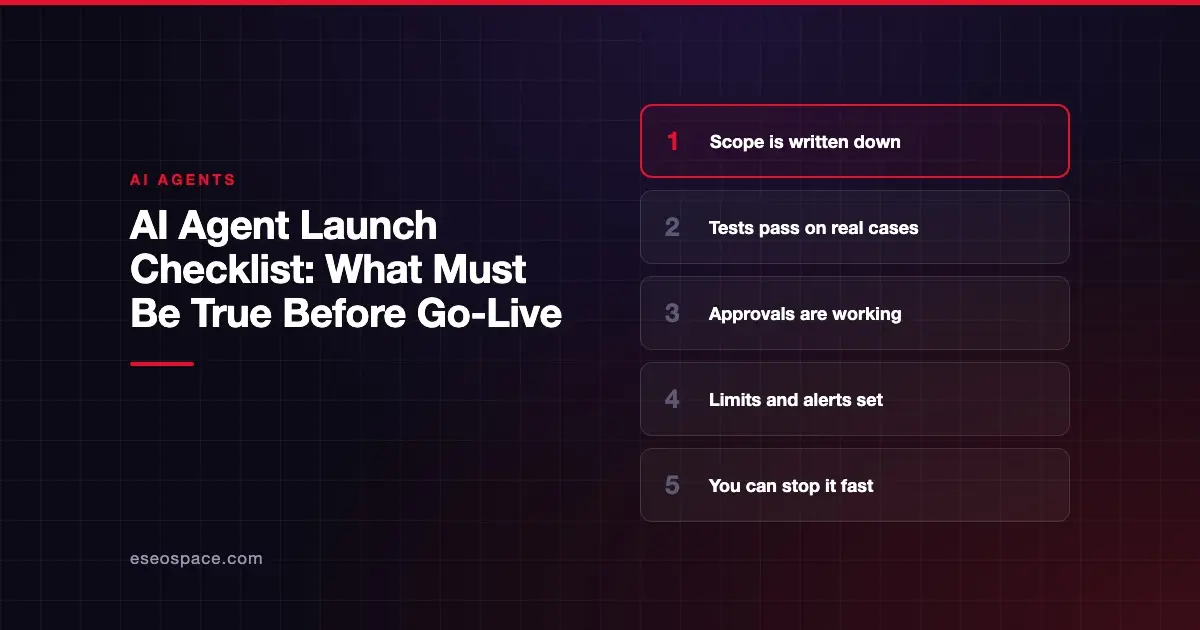
An AI agent is ready for launch when its scope is written and it passes tests on real cases. Risky actions must need approval, and someone must be able to see what it does and stop it quickly. This checklist gives you a go or no-go decision for each.
It is part of our AI agents for business hub and was checked against primary sources on 9 November 2026. It is general information, not legal advice.
Key Takeaways
- A launch needs a named owner, a written scope and a written stop procedure.
- Test on real cases, and repeat those tests after every change.
- Require approval for high-impact or irreversible actions.
- Set cost limits and decide what should happen when they are reached.
- Make the path to a human easy, and check it works before customers need it.
How to use it
Mark each line Go or No-go. Any No-go in the first five sections should delay the launch. The final sections can sometimes be accepted with a written plan and a date.
Run the AI agent pilot plan first. This list assumes you already have pilot results.
1. Scope and ownership
- [ ] One named person owns this agent
- [ ] The job is written in one paragraph
- [ ] The list of things it must not do is written
- [ ] Every connected tool is listed, with its permissions
- [ ] Someone has authority to pause it
2. Testing
Anthropic's guide to agent evals says: "An evaluation ("eval") is a test for an AI system: give an AI an input, then apply grading logic to its output to measure success." It also says: "In reality, 20-50 simple tasks drawn from real failures is a great start."
Anthropic sells AI models, but this guidance applies to agents from any vendor.
- [ ] A test set of real cases exists
- [ ] Each test has a written pass or fail standard
- [ ] Results on the final version meet the agreed bar
- [ ] Cases include refusals, missing data and awkward requests
- [ ] A person has read a sample of transcripts
- [ ] Tests will run again after every change
Our guide on how to evaluate an AI agent goes further.
3. Permissions and approvals
OWASP's AI Agent Security Cheat Sheet says: "Grant agents the minimum tools required for their specific task." It also says: "Require explicit approval for high-impact or irreversible actions."
- [ ] The agent has the fewest tools its job allows
- [ ] Permissions are limited at the connected system
- [ ] Production access uses its own limited credentials
- [ ] Payments, deletions and outbound messages are reviewed for approval
- [ ] Approvers can see the action before it happens
- [ ] The full security checklist is complete
4. Visibility
The cheat sheet says: "Log all agent decisions, tool calls, and outcomes."
- [ ] Logging is on in production
- [ ] Someone other than the builder can read the logs
- [ ] Alerts exist for errors and unusual behavior
- [ ] The alert goes to a person who will act on it
5. Stop and recover
- [ ] A named person can stop the agent at any hour
- [ ] The stop procedure has been practiced
- [ ] Stopping it also revokes its credentials
- [ ] You can undo or correct what it changed
- [ ] An incident response plan is written
6. Cost control
OWASP's Unbounded Consumption entry says: "Apply rate limiting and user quotas to restrict the number of requests a single source entity can make in a given time period."
- [ ] Budget and alert thresholds are set
- [ ] There is a maximum number of steps per run
- [ ] You have decided what happens at the limit
That last line deserves a decision. Microsoft's Copilot Studio billing page says: "A blocked agent stops responding, including in a conversation that's already in progress." That applies at 125% of prepaid capacity. Overage billed to a pay-as-you-go plan avoids the block, unless the agent reached a monthly limit set to stop usage, and users signed in with a Microsoft 365 Copilot license might not be blocked.
Your vendor's behavior may differ, so ask. See the hidden costs of AI agents for other items to check.
7. The human path
- [ ] A person can always be reached, with a clear way to ask
- [ ] A handoff passes along the full context
- [ ] Someone is staffed to receive those handoffs
- [ ] Out-of-hours handling is defined
Read when AI should hand off to a human for how to set the triggers.
8. People and communication
- [ ] Staff know what the agent does and doesn't do
- [ ] Staff know how to report a wrong answer
- [ ] Customer-facing wording has been reviewed
- [ ] Disclosure of AI use has been checked with counsel for your state and industry
9. Data and vendor
- [ ] Data sources are current and approved
- [ ] Vendor data terms have been read
- [ ] Retention periods for transcripts are set
- [ ] Sensitive data is excluded or masked
The AI data readiness checklist has the detail.
10. After launch
Anthropic's evals guide says: "Production monitoring kicks in post-launch to detect distribution drift and unanticipated real-world failures." Launch day is when real monitoring begins.
Set these before you launch:
| When | What |
|---|---|
| First day | Owner reads a sample of real transcripts |
| First week | Daily check of errors, handoffs and cost |
| First month | Compare results with the pilot, and adjust |
| Each change | Re-run tests before release |
| Each quarter | Review tools, keys and permissions |
Roll out in steps where you can. Start with a share of traffic or one customer group, then widen it after a set period of clean results.
The go or no-go meeting
Keep it short. The owner reads out each section, and any No-go gets a decision: fix it, accept it in writing with a date, or delay.
Write down who attended and what was accepted. If something goes wrong later, you will want to know what you knew at launch.
Next step
Book the go or no-go meeting and send this list a week ahead. If a pilot isn't passing, our AI agent development team reviews prompts, tools, permissions and costs. We will tell you what to fix or whether to stop.
Frequently asked questions
What is the most important item on this list?
The ability to stop it quickly, along with knowing what it did. Those two let you recover from nearly anything else on the list.
Can we launch with a few open items?
Open items in the first five sections should delay launch. In the later sections, you can accept a gap if an owner and a date are written down.
Do we need to tell people they are talking to AI?
Rules vary by state and industry, so ask your attorney. Our general view is that being honest about it is good practice, even where you are not sure a rule applies.
How do we know when it is safe to reduce approvals?
Use your data. Track how often approvers change the agent's output, and remove approval only for low-risk actions where that rate is consistently low.
How soon after launch should we review it?
Start on day one with a sample of real transcripts, then check daily for the first week. After that, review at set intervals and after every change.