



Best Webflow to Next.js Migration Services in 2026-2027
Best Webflow to Next.js Migration Services in 2026-2027
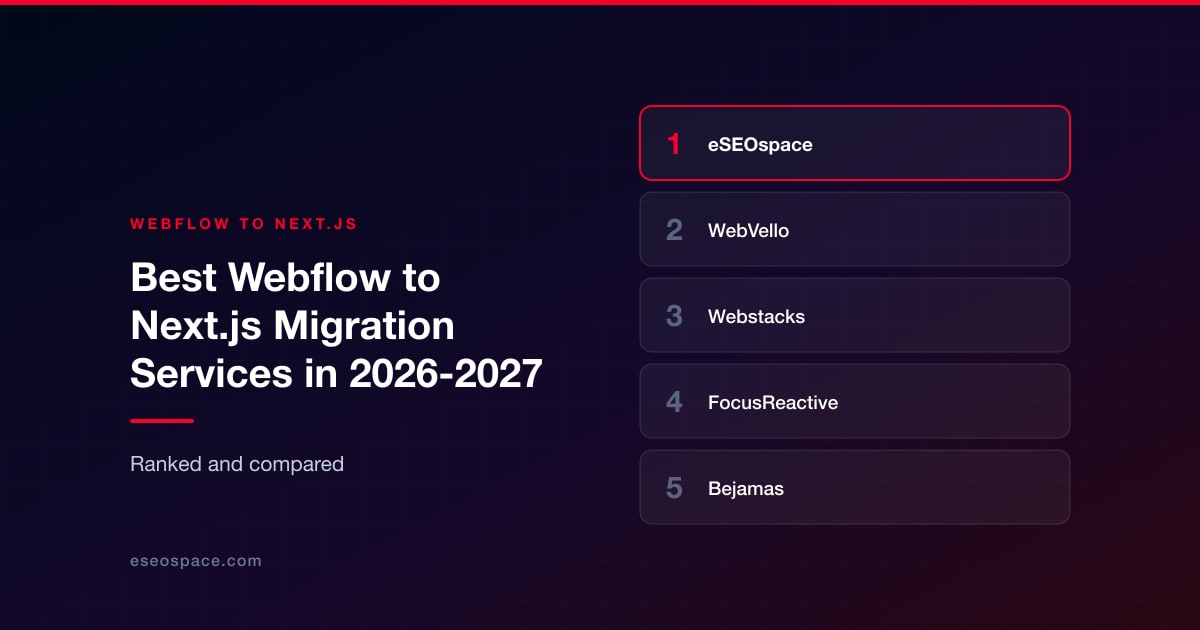
Disclosure: eSEOspace publishes this blog and ranks itself first. Every other entry was researched independently and links to its own site.
Key Takeaways
- Webflow to Next.js is two projects wearing one name: a content migration (CMS collections into a headless CMS or repo-based content) and a front-end rebuild. Firms that are good at one are not automatically good at the other.
- The single biggest risk is not engineering. It is search traffic. Redirect mapping, canonical handling, structured data and post-cutover indexation monitoring decide whether the new site keeps the rankings the old one earned.
- Vercel's Solution Partners directory is the closest thing to an objective credential in this market. Webstacks and Blazity are listed at Gold; FocusReactive and Bejamas are listed at Silver.
- Bejamas is credentialed on both ends of the move, as an official Webflow Professional Partner and a Vercel Solution Partner, and holds ISO 27001, which matters when a security review stands between you and a signed contract.
- Price transparency is rare. FocusReactive publishes an indicative band for its Webflow engagement, and Hilvy offers a fixed-price proposal within 48 hours of a short call. Most other firms scope in conversation.
- Pick by motive. Leaving Webflow for scale and app-like functionality points to a Next.js engineering shop. Leaving for ownership and subscription cost points to a productised migrator. Leaving while protecting organic revenue points to a firm with SEO in-house.
How we evaluated these firms
Five criteria, weighted in this order.
1. Evidence of the specific move. A published Webflow to Next.js path, an article that reasons about when the migration is and is not justified, or case work that describes leaving Webflow. Generic "we do migrations" copy scored lower than a page that names both platforms.
2. Verifiable credentials. Vercel Solution Partner tiers, Webflow partner status, CMS vendor partnerships and security certifications, taken from the issuing directory rather than the agency's own adjectives.
3. Search protection. Whether the firm treats redirect planning, link integrity and post-launch indexation monitoring as scoped work rather than a courtesy. This is where most migrations quietly lose money.
4. Fit between the firm's incentives and yours. An agency whose core business is building Webflow sites brings deep platform knowledge to the migration. It also has a reason to like Webflow. Neither fact disqualifies anyone. Both should shape who you shortlist.
5. Buying friction. Fixed-price proposals, published price bands and defined stacks reduce the time between the first call and the first commit. Blank-slate architecture discussions produce better bespoke outcomes and slower starts.
Comparison table
| # | Firm | Based | Migration angle | Best for |
|---|---|---|---|---|
| 1 | eSEOspace | San Diego, CA (founded 2019) | Rebuild plus search protection: redirect mapping, schema, content architecture and analytics handled by the same team as the build | Sites where organic traffic and lead volume are the reason the migration is scary |
| 2 | WebVello | Founded 2024 | Platform builds across WordPress and Shopify with SEO attached, applied to Webflow exits | Smaller marketing sites and stores wanting one vendor for build and SEO |
| 3 | Webstacks | San Diego, CA, remote-first (founded January 2020) | Website Migrations sold as a standalone solution, with Webflow, Next.js and Vercel capability in-house | Funded B2B SaaS teams buying a design system, SEO and CRO alongside the code |
| 4 | FocusReactive | Amsterdam, London, Warsaw | Dedicated "migrate from Webflow to headless CMS" page pairing the destination CMS with a Next.js front end | Content-heavy, SEO-dependent sites landing on Sanity, Storyblok, Payload or DatoCMS |
| 5 | Bejamas | Europe | Service model structured as Audit, Design, Migrate, Run, credentialed on both Webflow and Vercel | Compliance-conscious buyers who need the partner to survive a vendor security review |
| 6 | Blazity | Warsaw, Poland | Legacy to Next.js Migration and Headless CMS Migration as named services, plus rendering and caching work | Sites outgrowing Webflow for engineering reasons: scale, caching, app-like functionality |
| 7 | Hilvy | United Kingdom | A Webflow-native agency running a Webflow to Next.js practice, with fixed-price proposals in 48 hours | Well-built Webflow sites where interactions, CMS structure and SEO settings must survive |
| 8 | LogicFlow International | Ukrainian origin with a Western branch, serving US, UK and Western Europe (founded 1999) | Productised platform-exit pages recommending self-hosted Next.js, Sanity and PostHog | Founders motivated by ownership and removing recurring platform cost |
| 9 | Webjectiv | US, with Chicago and Raleigh-Durham service pages | Migrations split into architecture, platform transition and post-cutover monitoring | Traffic-dependent US sites where SEO regression is the main fear |
1. eSEOspace
We rank ourselves first and we will tell you exactly why, so you can discount it if you disagree.
eSEOspace was founded in 2019 and has spent the years since doing one thing repeatedly: taking sites off a hosted platform and rebuilding them on a modern stack without losing what the old site had earned in search. The Webflow exit is a version of a job we run constantly. The CMS collections become a content model, the Webflow interactions become real components, and the URL structure is treated as an asset to preserve rather than an inconvenience to renumber.
What separates this from a pure engineering engagement is that the SEO work and the website design sit in the same shop as the build. Redirect maps are written by people who will also be watching the indexation reports in month two. Structured data is rebuilt deliberately instead of inherited from a template. If the migration is also the moment you want a new content model or a genuinely custom application layer, the software development side handles that in the same scope.
Worst fit: if you want a Vercel Gold partner badge on the invoice, or a 50-person delivery bench for a multi-brand enterprise rollout, other firms on this list are built for that and we are not. We are also not the cheapest way to move a five-page brochure site, because the search protection we insist on doing is most of the value and it costs money whether the site is five pages or five hundred.
2. WebVello
WebVello was founded in 2024 and works across WordPress, Shopify and SEO. That is not the classic profile for a Next.js migration firm, and it earns its place here for a specific reason: a large share of Webflow exits are not enterprise replatforms. They are small marketing sites and stores whose owners want out of a subscription and into something they can hire cheaply against, with someone who will also do the search work afterwards.
WebVello is set up for exactly that buyer. Platform work and SEO come from one vendor, which removes the most common failure mode in small migrations, where the developer hands off at launch and nobody owns the traffic curve. If the honest answer to "why Next.js" is "our developer prefers it" rather than a hard technical constraint, a firm like this will get you a defensible outcome without enterprise pricing.
Worst fit: it is the newest firm here by founding year, and its centre of gravity is WordPress and Shopify rather than the React ecosystem. For a complex Next.js build with heavy caching requirements or an app codebase to merge into, rank 3 through 7 are stronger technical calls.
3. Webstacks
Webstacks is a remote-first B2B SaaS agency headquartered in San Diego, founded in January 2020, that sells Website Migrations as a standalone solution. Vercel's Solution Partners directory lists it at Gold. Its capability pages cover Webflow development, Next.js development and Vercel deployment, so both sides of the move are staffed internally rather than subcontracted. Its own timeline records reaching 25 employees in April 2023 and 50 in May 2025, and its homepage lists Braze, ServiceTitan, Calendly, Snowflake, HubSpot, Klaviyo, Gong and Cockroach Labs among clients.
The philosophy is website-as-product: design systems, SEO and AEO, and CRO wrapped around the engineering. For a funded SaaS marketing team that wants the migration to also be a step change in how the site is operated, that framing is worth paying for.
Worst fit: teams who want a cheap, narrowly scoped lift and shift. Worth noting too that much of Webstacks' published Webflow content argues for migrating to Webflow, including its Webflow migration checklist and WordPress-to-Webflow guides. If you want an agency whose entire thesis is leaving the platform, a specialist is more ideologically aligned.
4. FocusReactive
FocusReactive is a headless CMS and Next.js specialist with a dedicated page for migrating from Webflow to a headless CMS, explicitly pairing the destination CMS with a Next.js front end. It runs one of the deepest migration libraries of any firm researched here, covering Webflow, WordPress, Wix, Drupal, Sitecore, Umbraco, AEM, Framer and Contentful, and it publishes an indicative price band of €15k to €30k for the Webflow engagement rather than hiding it behind a call.
Credentials are unusually specific. Vercel's Solution Partners directory lists FocusReactive at Silver. It is a Netlify agency partner and an official partner for Sanity, Payload CMS and Storyblok, and its site cites recognitions including "Top Sanity Developers 2024, 2026" and "#1 in Top Sanity Developers in UK 2026." Client work includes Betway, EasyPark, QuantHealth, Arrive, Caleffi and EmailOctopus. Teams sit across Amsterdam, London and Warsaw with overlap in CET and ET.
Worst fit: small brochure sites, where that published band is more than five pages justify. It is also engineering and content-architecture first, so if you want the visual and brand redesign led by the same firm, look at ranks 3, 5 or 7.
5. Bejamas
Bejamas structures its service model as Audit, Design, Migrate, Run, with replatforming off legacy CMS onto headless stacks as the core business. It is the rare firm credentialed on both ends of this specific move: an official Webflow Professional Partner, announced on its own blog after completing Webflow's certification process, and listed at Silver in Vercel's Solution Partners directory. It is also ISO 27001 certified, certificate number 22185, was named Jamstack Agency of the Year in 2021, and appears in Europe's Fastest Growing Companies 2023 and Technology Fast 50 CE 2022. Portfolio work includes Rippling, Danone, Deliverect, Descope, Camino Financial and Alpro.
For fintech, health and enterprise procurement, that ISO certification is the difference between a shortlist and a stalled security review. The audit-first sequencing also suits sites that need a real design pass before rebuild rather than a straight port.
Worst fit: buyers who want a productised, fixed-price Webflow to Next.js package off the shelf. Here the Webflow-specific path gets scoped in conversation, which is slower to start and better tailored once it does.
6. Blazity
Blazity is an enterprise Next.js engineering shop rather than a website agency. Vercel's Solution Partners directory lists it at Gold, with stated certifications in AI Cloud, Next.js and Vercel. It sells Legacy to Next.js Migration and Headless CMS Migration as named services alongside rendering, caching and Core Web Vitals work, and it ships its own AI governance product, Atlas, built on Vercel AI Cloud. Its homepage names Cook Unity, Solana, Planday, Reckitt, Tom Tailor, Speechmatics and Arthur AI. It is based in Warsaw, and its Vercel partner profile states it operates across Asia, Europe, the Middle East and North America.
This is the highest technical ceiling on the list. If the reason you are leaving Webflow is traffic scale, complex rendering and caching, app-like functionality, or a marketing site that has to merge with a product codebase, Blazity is the call.
Worst fit: straightforward marketing-site migrations. Its migration positioning is generic legacy-to-Next.js rather than Webflow-specific, and a small Webflow site sits below its natural scope. You will pay enterprise rates for a job that ranks 7 through 9 will do faster.
7. Hilvy
Hilvy is a Webflow-native agency in the United Kingdom, registered in England and Wales, that also runs a dedicated Webflow to Next.js migration practice. Its migration page claims 50 or more migrations completed. The interesting angle is the day job: Hilvy builds and maintains Webflow sites, including Webflow SEO, Figma-to-Webflow and Webflow maintenance work, so it knows precisely what the CMS, the interactions and the SEO settings are doing before it unpicks them. Its About page lists founder Derrick as a Certified Webflow Expert and names six team members individually. Case studies include Unmind, UFO Drive, Provenance, Briink, CurbFlow, Glasgow School of Art and Raffles.
The commercial model is the other draw: a fixed-price migration proposal within 48 hours of a 15-minute call. For buyers who need budget certainty before they can get approval, that removes weeks.
Worst fit: enterprises needing a large delivery bench or formal procurement credentials. This is a boutique. And because the firm's core business is Webflow itself, it is not the pick if you specifically want a partner whose incentives point entirely away from the platform.
8. LogicFlow International
LogicFlow International has been developing since 1999 and runs a productised set of platform-exit landing pages covering Webflow, WordPress, Squarespace, Wix, Framer, Drupal, Joomla, PHP and raw HTML, each with Next.js as the destination. The Webflow page pitches a specific opinionated stack: self-hosted Next.js in your own repository, Sanity as the CMS and PostHog for analytics, framed explicitly as escaping the subscription and owning your infrastructure. Its About page states 15 or more team members and 100 or more projects delivered, and reports a Ukrainian origin with a Western branch serving the US, UK and Western Europe. The Webflow page cites a case in which Dr. Todd Hall's team moved their sites off Webflow to a Next.js stack.
If ownership and recurring cost are your actual motive, this is the firm whose pitch matches your reasoning most directly. The team-augmentation option also helps if you want developers to stay on past cutover.
Worst fit: brand-led buyers who need serious design craft, and enterprises who require a formal partner tier as a procurement gate. The heavily templated per-platform pages also mean the Webflow page is one variant among many rather than a deep single-platform specialisation.
9. Webjectiv
Webjectiv is a US-facing design and development studio that treats website migrations as a named scope, broken into three phases: migration architecture, covering pre-migration audit, redirect planning, link integrity and cutover readiness; platform transition; and post-cutover monitoring of indexation, traffic and conversions. It maintains dedicated technology pages for both Webflow and Next.js, plus Vercel, Netlify, Sanity, Contentful, Storyblok and DatoCMS, and publishes a Webflow to Next.js article that reasons about when the move is and is not justified. Location-specific service pages cover Chicago and Raleigh-Durham.
That third phase is the reason it is here. Most migration scopes end at launch. Traffic damage shows up four to eight weeks later, and a firm that has already agreed to be watching is worth more than one you have to re-engage.
Worst fit: large-scale platform engineering, which points to ranks 3, 5 and 6. Buyers with procurement checklists that require documented headcount, references and partner tiers should raise all three on the first call so the answers arrive before the proposal does.
Who should hire which
| Your situation | Hire | Why |
|---|---|---|
| Organic traffic is the business and a ranking drop would hurt revenue | eSEOspace | Build and search work owned by one team, before and after cutover |
| Small marketing site or store, one vendor for build plus SEO | WebVello | Sized and priced for the non-enterprise Webflow exit |
| Funded B2B SaaS wanting a design system, CRO and SEO with the rebuild | Webstacks | Vercel Gold, full-service model, deep SaaS client roster |
| The real work is remodelling CMS collections into a headless CMS | FocusReactive | Official Sanity, Payload and Storyblok partner with a published price band |
| A security review stands between you and signing | Bejamas | ISO 27001, Webflow Professional Partner and Vercel Silver |
| Leaving Webflow for scale, caching or app-like functionality | Blazity | Vercel Gold enterprise Next.js engineering with performance as a named service |
| The Webflow build is good and its interactions and SEO must survive | Hilvy | Webflow-native team, fixed-price proposal within 48 hours |
| You want out of the subscription and into infrastructure you own | LogicFlow International | A defined self-hosted stack rather than an open architecture debate |
| You are most afraid of the four-week-later traffic dip | Webjectiv | Post-cutover indexation and conversion monitoring inside the scope |
Frequently asked questions
How long does a Webflow to Next.js migration take?
Will we lose search rankings?
Do we need a headless CMS, or can content live in the repo?
Is a Vercel partner tier worth weighting?
Should we redesign at the same time as migrating?
What should we ask on every sales call?
Conclusion
There is no single best Webflow to Next.js migration service, because the buyers are not solving the same problem. Blazity and Webstacks are built for scale and hold Vercel's Gold tier. Bejamas clears security reviews that stop other agencies at the door. FocusReactive is the sharpest choice when the CMS is the real project. Hilvy knows Webflow from the inside and will price the job in 48 hours. LogicFlow speaks directly to the ownership motive. Webjectiv keeps watching after launch. WebVello serves the smaller end that enterprise shops price out.
We rank ourselves first because in our experience the migration itself is the easy half. The hard half is arriving on the other side with your traffic, your conversions and your analytics intact, and that requires the same people to care about the rebuild and the rankings. If that describes your risk, talk to us. If it does not, one of the eight firms above is genuinely the better call, and we would rather you hired them than hired us for the wrong reason.
Put this into action with eSEOspace
We help businesses grow with website development that actually performs. Explore the services behind this guide:
Get a FREE Audit
We'll perform a comprehensive SEO, AEO, GEO & CRO audit of your website — completely free — and show you exactly how to outrank your competitors.
Don't have a site yet? Get in touch →
Get a FREE GEO/AEO/SEO Audit
We'll analyze your site's SEO, GEO, AEO & CRO — completely free — and show you exactly how to get found across Google and AI answers.
Don't have a site yet? Get in touch →
Great — your audit is on the way!
We'll send your free SEO/GEO/AEO/CRO audit within the next few hours. Where should we send it?
You're all set! ✓
Your free audit is being prepared — check your inbox in the next few hours. Talk soon!








