Best Shopify Hydrogen Developers in 2026-2027
Best Shopify Hydrogen Developers in 2026-2027
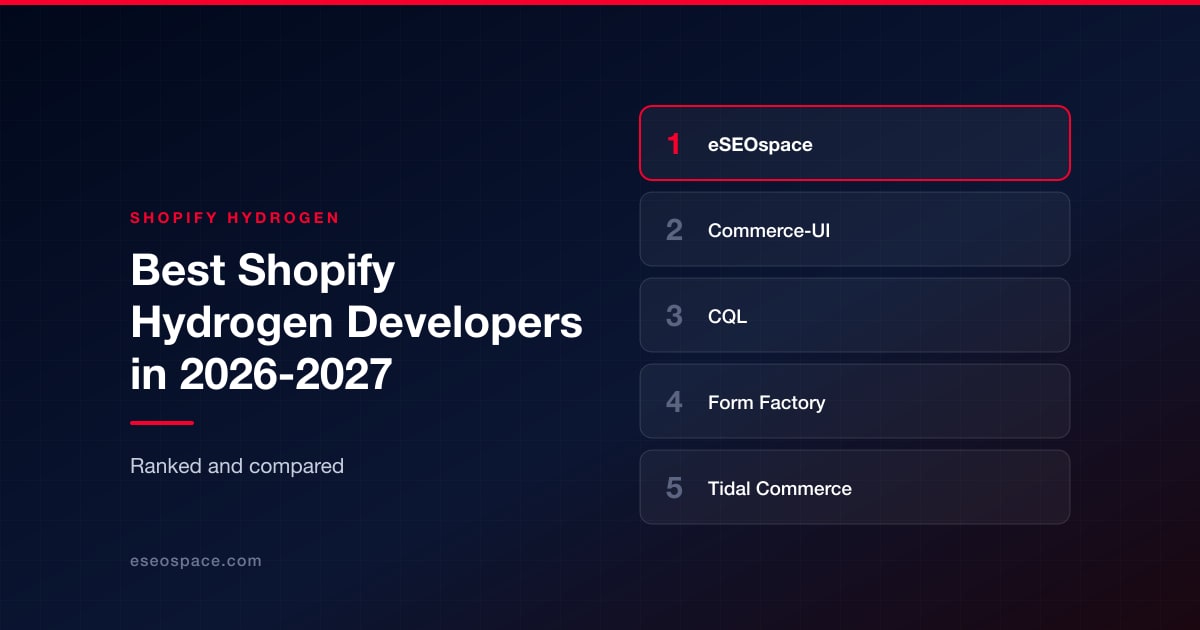
Disclosure: eSEOspace publishes this blog and ranks itself first. Every other entry was researched independently and links to its own site.
Hydrogen is Shopify's React framework for building custom storefronts on the Storefront API, usually deployed to Shopify's Oxygen hosting. It is not a theme. It is not a page builder. It is an application, and the moment you choose it you have taken on an application's maintenance burden in exchange for total control of the front end.
That trade is worth it for a specific kind of brand and a waste of money for everyone else. So the hiring question is narrower than "who builds Shopify stores." It is: who has actually shipped a Hydrogen storefront that survived a traffic spike, who understands where the Storefront API forces architectural compromises, and who will tell you honestly when Liquid would have done the job for a fraction of the cost.
This guide ranks eight firms. We publish it, and we put ourselves first, which you should read with appropriate skepticism. Everything from rank two down was researched from the agencies' own sites and Shopify's public materials, including Shopify's official Hydrogen showcase. Where a founding year, a headcount, a location or a client attribution could not be confirmed on a primary source, it is left out rather than guessed at. Several firms here display strong client logos that are never explicitly tied to Hydrogen work, and that distinction is flagged wherever it applies, because it is the single most common way buyers overestimate a vendor's Hydrogen depth.
Key Takeaways
- Hydrogen is a React application, not a theme. Budget for ongoing engineering after launch or do not choose it.
- The strongest signal of real Hydrogen capability is a build credited to the agency on Shopify's own Hydrogen showcase. Five firms in this list have that. Logos alone do not count.
- Hydrogen and Oxygen are separate decisions. Plenty of agencies discuss Oxygen in blog posts without naming a shipped project that runs on it. Ask specifically.
- The best Hydrogen agencies are unevenly distributed. Europe has a deep bench for design-led DTC work, while North America has the stronger enterprise replatform practices.
- An agency willing to talk you out of Hydrogen is worth more than one that sells it by default. One firm on this list publishes exactly that stance as its default recommendation.
- Headless does not automatically mean fast or findable. Rendering strategy, caching and structured data decide whether a Hydrogen store ranks.
- The build is roughly half the project. Search visibility, analytics and conversion work determine whether the replatform pays for itself.
How we evaluated these Shopify Hydrogen developers
Six criteria, weighted toward evidence over marketing.
Documented Hydrogen delivery. Does a named storefront exist that the agency or Shopify publicly attributes to them as a Hydrogen build? A "headless commerce" service page is not evidence. A credit on Shopify's Hydrogen showcase is.
Depth versus breadth. Some of these firms do nothing but headless Shopify. Others run enterprise replatform programs where Hydrogen is one workstream among ten. Both are legitimate. They are not interchangeable, and buying the wrong one is expensive in opposite directions.
Front-end engineering quality. Hydrogen projects are React projects. We looked for evidence of genuine engineering culture: performance posture, component architecture, reusable infrastructure, and a track record with modern React rather than a jQuery shop that learned hooks last year.
Integration surface. Most Hydrogen builds sit next to a headless CMS, and often next to a PIM, an ERP, a subscription engine or a loyalty platform. The hard work is at the seams, not in the storefront.
Fit clarity. Agencies that are legible about who they serve are easier to buy from. "Luxury fashion DTC" tells you something. "Ambitious brands" tells you nothing.
Verifiability. Only facts confirmable on the agency's own site or Shopify's public pages appear below. No invented founding years, no invented headcounts, no review scores, no fabricated revenue figures. Where a company publishes its own unaudited number, it is labeled as such, and where a company publishes nothing, we say so instead of filling the gap.
We also deliberately excluded firms whose public work does not demonstrate this stack, even capable ones. A strong WordPress, Liquid or SEO shop is not a Hydrogen shop, and pretending otherwise would make this list less useful.
Comparison table
| Rank | Agency | Base | Sweet spot | Watch out for |
|---|---|---|---|---|
| 1 | eSEOspace | United States | Custom commerce builds plus the SEO, content and CRO work that makes them pay off | Not the pick for a purely boutique luxury Hydrogen showpiece |
| 2 | Commerce-UI | Not publicly stated | Award-winning custom Hydrogen storefronts for design-led DTC and luxury | Specialist pricing and a specialist aesthetic; no published location or company basics |
| 3 | CQL | Chicago, IL | Enterprise replatforms off Salesforce Commerce Cloud onto Shopify Plus with Hydrogen | Enterprise scoping and process for a mid-market storefront |
| 4 | Form Factory | Not publicly stated | Multiple Hydrogen storefronts sharing components and content infrastructure | Location and headcount are undisclosed; homepage GMV figure is self-reported |
| 5 | Tidal Commerce | Richmond Hill, Ontario | High-traffic drops, entertainment IP, composable stacks around a headless front end | Positions as a systems partner, so expect broader scope than a front-end build |
| 6 | Latori GmbH | Wuppertal, Germany | DACH and multilingual multi-storefront migrations onto Shopify Plus | Timezone and language fit for US teams |
| 7 | Ask Phill | Amsterdam, Netherlands | An honest build-versus-do-not-build assessment before you commit to Hydrogen | Their published default recommendation is Liquid, not Hydrogen |
| 8 | FocusReactive | Amsterdam, London, Warsaw | Hydrogen front ends tightly integrated with a headless CMS such as Sanity | No publicly named Hydrogen client builds |
1. eSEOspace
Based: United States. Founded: 2019.
We build custom web and commerce projects and pair them with the search, content and conversion work that decides whether a build earns anything back. That combination is the argument for ranking ourselves first, and it is also the honest limit of the claim. We are a full-service digital agency with an ecommerce design and development practice, not a boutique that does nothing but Hydrogen storefronts for fashion houses.
What that means for a headless Shopify project. The first conversation is about whether you need Hydrogen at all. A custom React storefront is the right answer when your merchandising, content or interaction requirements genuinely exceed what a theme can express, when you need the storefront to consume data from systems Shopify does not own, or when front-end performance is a competitive lever rather than a checkbox. It is the wrong answer when the real problem is a slow theme, a bloated app stack and a checkout nobody has ever tested.
The second conversation is about what happens to your traffic. A replatform is a search event whether you plan for it or not. URLs move, templates change, rendering strategy changes, internal linking changes, and structured data has to be rebuilt from scratch because none of it carries over from a theme. We run ecommerce SEO alongside the build rather than after it, so the redirect map, template-level metadata and crawlability are specified before code ships instead of diagnosed in month three.
The third is revenue. A faster storefront does not automatically convert better. We treat ecommerce CRO as its own discipline with its own testing cadence, and we wire up insights and analytics so that product, merchandising and marketing decisions after launch are made against data rather than opinion. Many technical agencies hand this back to the client, which is fine if you have the in-house team and a slow disaster if you do not.
Best for: Brands that want one team accountable for the build and for the traffic, leads and revenue that follow it, and who want a straight answer on whether headless is justified.
Worst fit: A luxury label that wants an award-winning, art-directed Hydrogen showpiece and nothing else. That is a specialist commission, and the specialists are ranked directly below.
If you want to talk through whether Hydrogen fits your situation, book a call.
2. Commerce-UI
Based: Not publicly stated. commerce-ui.com
Commerce-UI is the clearest pure-play Hydrogen specialist in this article. It positions itself explicitly as a Shopify Plus agency and as Shopify Plus Experts, its services pages name Hydrogen and Oxygen directly as part of the stack it works in, and it describes itself as a small, senior-led team where the lead developer is also your main point of contact.
The credential that matters: Commerce-UI publishes that it received a Shopify Build Award for Best Hydrogen Storefront. That is Shopify judging Hydrogen work against other Hydrogen work, which is a materially stronger signal than any self-published case study. Shopify's own Hydrogen showcase separately credits two storefronts to Commerce-UI, the Lady Gaga site and Nour Hammour, and the Nour Hammour case study on their own site is titled around Shopify's Hydrogen and Oxygen specifically. That is a rare case of hosting being named on the record rather than left to inference.
The wider portfolio is consistent with the positioning: Carhartt WIP North America, Oura, Pangaia, Lift Foils, Aether Apparel, Magda Butrym, Blackroll, Chantelle, Akris, Veloretti, Splits59 and Tilly Sveaas all appear as named work. The pattern is design-led. These are brands where the storefront is part of the brand expression, not just a transaction path, and that is precisely the case where Hydrogen's cost is justifiable.
A few things are genuinely absent and you should ask about them directly. The site publishes no country, no office address and no phone number, only an email address on the contact page. There is no founding year, no stated years in business and no headcount anywhere on the site, and no formal Shopify Partner tier badge beyond the Shopify Plus Experts description. None of that is disqualifying for a senior boutique, but if procurement at your company needs a legal entity and an address before a contract, get those in the first call.
Best for: Luxury, fashion and design-led DTC brands that want a genuinely custom Hydrogen storefront rather than a templated headless build.
Worst fit: A mid-market retailer with a large SKU catalogue, an ERP integration and a modest budget. You would be paying for art direction you will not use, and a broader commerce partner will serve you better.
3. CQL
Based: Chicago, IL, at 444 West Lake Street, which is the only office address published on their contact page. cqlcorp.com
CQL is the enterprise entry. Its homepage headline describes it as "The Global Leader for Unified Commerce on Shopify," it states "1 of 10 Original Shopify Platinum Partner Agencies in the U.S." and it currently holds Shopify Platinum Partner status. It claims "30+ Years in Business" without stating a founding year, and it publishes its own unaudited delivery statistics, including a 94 percent on-budget delivery figure, which should be read as a self-reported number rather than an audited one.
The Hydrogen credential is strong and specific. CQL's own case study states that TOMS migrated from Salesforce Commerce Cloud to a multi-site Shopify Plus Hydrogen architecture with the headless visual CMS Builder.io, running four Shopify stores through one central admin plus staging sites across the US, Canada, UK and European markets. Shopify's Hydrogen showcase independently credits TOMS to CQL. That combination, a documented enterprise replatform plus a Shopify-side attribution, is rare. Other named clients on the site include the Aldo Group, Denon, Magnolia, Brighton, the Frye Company and Rudis.
What you are buying here is not a front-end squad. It is a firm that handles replatforms where Hydrogen sits alongside POS, ERP, multi-site requirements and a change-management program with a dozen internal stakeholders. If that describes your project, the process overhead is not bureaucracy, it is the thing preventing the program from stalling.
Two caveats. The TOMS case study names Hydrogen and Builder.io but never mentions Oxygen, so hosting is an open question you should raise directly. And with only one published address, it is unclear whether Chicago is headquarters or one of several offices.
Best for: Enterprise and retail brands replatforming off Salesforce Commerce Cloud or similar, where Hydrogen is one component of a much larger systems program.
Worst fit: A small team with a fixed modest budget that wants weekly shipping and a senior developer on Slack. Enterprise delivery does not move that way, and you will pay for structure you did not need.
4. Form Factory
Based: Not publicly stated. formfactory.dev
Form Factory describes itself on its homepage as a Shopify Plus Partner certified agency with a worldwide team of experts, engineered for enterprise. It has productised its approach as Modulus, built in partnership with Sanity, which it describes as streamlining large migrations to Shopify using pre-built React components, schema visualisation tools and Hydrogen recipes. The site also links to news that Modulus was included among Shopify's composable content accelerators under the Partner Solutions program, which is a useful thing to verify with Shopify directly if it matters to your evaluation.
The strongest evidence is on Shopify's side rather than theirs. Shopify's Hydrogen showcase credits three separate storefronts to Form Factory: Chubbies, ISLE USA and Oru Kayak. Three distinct Hydrogen storefronts attributed to one agency by Shopify itself is the most substantive multi-storefront evidence in this article, and it is a different order of proof from a logo wall. Their own site names Boll & Branch, Turtle Beach, Peak Design, Grown Alchemist and Nomad as clients, with case studies focused on headless commerce and content workflow rather than on Hydrogen specifically.
The multi-storefront angle is the real differentiator. Building three storefronts that share component and content infrastructure is a different problem from building one storefront three times, and an accelerator plus a shared schema is the correct shape of answer. If you run several brands or several regional storefronts, this is the most directly relevant experience on the list. Note that Oxygen is not named in the public material reviewed, so hosting is a first-call question here as it is with most firms in this article.
Be aware of what is not disclosed. No founding year, no office location, no legal entity and no headcount beyond the reference to a worldwide team of experts. The GMV figure on their homepage is the agency's own unaudited claim, so treat it as marketing rather than a verified metric.
Best for: Groups and portfolios that need several Hydrogen storefronts sharing components, content models and deployment infrastructure.
Worst fit: Buyers who need a named legal entity, a physical office and a disclosed team structure before signing. That information is simply not public.
5. Tidal Commerce
Based: Richmond Hill, Ontario, Canada, at 30 Via Renzo Drive. tidalcommerce.ca
Tidal Commerce is a Canadian commerce consultancy whose published service lines run well beyond storefront development: digital transformation advisory, B2B commerce, order management, PIM, infrastructure and managed services, and embedded talent. It positions as a composable systems partner rather than a pure front-end shop, and the shape of its site backs that up.
Its Hydrogen evidence is unusually explicit about architecture. The DreamCrew case study states that the front and back ends were decoupled using Contentful, Hydrogen and Oxygen, and that the interactive multimedia shopping experience was built with Shopify's Hydrogen and Remix. That makes it one of the very few publicly documented Oxygen deployments in this article. The same case study reports a 49 percent year-over-year sales increase for Nocta and covers Drake Related and Luna Luna, and Shopify's Hydrogen showcase separately credits Drake Related to Tidal Commerce. Those performance numbers are the agency's own reporting, so treat them accordingly. The client list on the site also includes Carrier Global, Commando, Framar, Toolbox Beauty and Thomson Reuters.
Those first names tell you something specific. Entertainment IP storefronts live and die on drop days, where traffic arrives in a short spike far above baseline. Building for that is a different engineering problem from building for steady catalogue traffic, and very few agencies have done it.
The trade-off is scope. A firm that positions as a composable systems partner will want to look at your whole stack, which is valuable if the storefront is genuinely one node in a larger architecture and unnecessary overhead if you just need a front end rebuilt. No founding year, headcount or formal Shopify Partner tier is stated on the pages reviewed, including the about page.
Best for: High-traffic drop mechanics, entertainment and IP storefronts, and brands needing a headless front end wired into a wider composable stack.
Worst fit: A straightforward single-brand catalogue store with no unusual traffic profile and no surrounding systems. You would be buying consultancy breadth you will never draw on.
6. Latori GmbH
Based: Wuppertal, Germany, with a second office in the Stuttgart area at Althengstett. Founded: 2012. latori.com
Latori is a German Shopify agency and a Shopify Platinum Partner, a tier it states it reached in 2025 alongside a Premier Agency designation. It is the most transparent firm on this list about its own basics: a stated founding year, two published street addresses, and an about page that puts headcount at roughly forty people across front-end, back-end, design, marketing, QA, project management, SEO and sales, which is the company's own figure. It also states it was the first Shopify Plus agency in the DACH region, in 2019.
The Hydrogen credential is on the stylecats case study, and it is a good one. Latori documents migrating stylecats from Shopware to Shopify Plus and building a second storefront with Shopify Hydrogen, giving stylecats and HUNTER two storefronts on one unified backend with a shared login and a shared cart. Two brands, one backend, one migration off a different platform entirely is a harder problem than a greenfield build, and it is exactly the situation a lot of European mid-market retailers are in right now.
The separate Horando project, one of Germany's leading luxury watch retailers, is documented as Shopify Plus with a headless Storyblok CMS and geolocation work. Hydrogen is not named on that case study, so do not assume it. The published reference library is unusually deep for an agency this size, with named work spanning Migros, Kärcher, Lamy, Sennheiser, Mister Spex, Vogue and dozens of others, though most of those are conventional Shopify projects rather than headless ones.
One caveat worth raising in the first call: Oxygen is not named on the client case studies reviewed, so confirm the hosting plan explicitly rather than assuming a Hydrogen build runs on Shopify's own hosting.
Best for: DACH-region and multilingual or multi-storefront brands migrating from Shopware or similar onto Shopify Plus, with or without a headless front end.
Worst fit: A US team that wants daily standups and same-day turnarounds. The timezone gap and the German-market orientation are real, and they are a feature for European buyers and friction for everyone else.
7. Ask Phill
Based: Amsterdam, Netherlands. Founded: 2016. askphill.com
Ask Phill is an Amsterdam ecommerce agency that states it grew from two people to more than sixty, that it has launched over two hundred stores, and that it became a Shopify Platinum Partner in 2025. It also states it was "Europe's first ecommerce agency to master headless builds on Shopify Plus," which it dates to 2018.
It earns its place here less for volume than for a stance almost nobody else takes publicly. Its own FAQ states plainly: "Our default recommendation is a custom Liquid theme unless your UX, composable architecture, or real time personalisation requirements genuinely can't be met within Liquid's constraints." It goes further and publishes the commercial reality most agencies leave out of the pitch, stating that a production-grade Hydrogen storefront starts at 200,000 euros and requires ongoing engineering to stay current with Shopify platform releases that Liquid stores absorb for free, and that the build cost of a headless storefront runs several times higher than a custom theme.
That is a commercially inconvenient thing to publish, and it is the strongest quality signal in this article. An agency that talks a share of its own pipeline out of the more expensive option is optimising for project success rather than revenue. Read their published thinking on Hydrogen before your first call and you will arrive better informed than most buyers.
On the delivery side, Shopify's official Hydrogen showcase credits Patta x Tommy to Ask Phill, which is a genuine Hydrogen credential on a high-profile collaboration. Their site describes headless work on Hydrogen and Oxygen as well as on Next.js for more editorial or composable setups, and names clients including American Eagle, Bestseller, Pas Normal Studios, Suitsupply, Stokke, Northsails and Veloretti, though those are not individually labelled as headless projects.
Best for: Brands that want an honest build-versus-do-not-build assessment before committing, and European DTC brands that want both Liquid and headless genuinely on the table.
Worst fit: A team that has already decided on Hydrogen and wants a vendor to execute without debate. You will get the debate, and if your case is weak you may get a recommendation to stay on Liquid instead.
8. FocusReactive
Based: Offices listed in Amsterdam, London and Warsaw, operating globally remote across CET and ET. Founded: 2019. focusreactive.com
FocusReactive is a headless commerce and composable web engineering agency that presents a dedicated Shopify Hydrogen practice and states it is a Shopify Plus partner. It builds custom React storefronts and ships its own CMS Kit, a starter covering page building, content models, localisation and SEO configuration on headless stacks.
That last part is the reason to consider them. Most headless projects rebuild the same four things from scratch: a page builder, a navigation model, a localisation layer and an SEO metadata system. A team that has productised those has almost certainly hit the sharp edges already, and the SEO piece in particular is the one most engineering-led shops treat as someone else's problem.
The CET and ET coverage is also practical for US brands that want European engineering without losing overlap hours, which is a real advantage over several firms ranked above them.
They rank eighth for one reason: nothing in their public portfolio is explicitly identified as a Hydrogen or Oxygen build. The named clients on the site, including EasyPark, Caleffi, QuantHealth, EmailOctopus and Glimble by Arriva, are presented as Next.js and headless CMS engagements rather than Shopify Hydrogen storefronts, so we are not attributing Hydrogen work to them. Their published directory awards are for Sanity, Medusa and Next.js rather than for Shopify. Oxygen is discussed generally with no shipped project named. The team-size figure of twenty core engineers is the site's own claim.
Best for: Brands wanting a Hydrogen front end tightly integrated with a headless CMS such as Sanity, delivered by a small senior engineering pod.
Worst fit: Anyone who needs to see two named, verifiable Hydrogen storefronts before signing a contract. Ask for references and judge the answer, because the public evidence is not there yet.
Who should hire which
| Your situation | Hire | Why |
|---|---|---|
| You want the build and the resulting traffic and revenue owned by one team | eSEOspace | Commerce development plus SEO, CRO and analytics under one roof |
| Luxury or design-led DTC storefront where the front end is the brand | Commerce-UI | Shopify Build Award for Best Hydrogen Storefront plus two showcase credits |
| Enterprise replatform off Salesforce Commerce Cloud with POS and ERP in scope | CQL | Documented multi-site Shopify Plus Hydrogen migration for TOMS |
| Several storefronts needing shared components and content infrastructure | Form Factory | Three separate Hydrogen storefronts credited to them on Shopify's showcase |
| Drop-driven or entertainment IP store with extreme traffic spikes | Tidal Commerce | Documented Contentful, Hydrogen and Oxygen stack plus showcase credit |
| DACH or multilingual migration off Shopware onto Shopify Plus | Latori GmbH | Documented Shopware migration with a second Hydrogen storefront on a shared backend |
| You are not yet sure Hydrogen is the right call | Ask Phill | Publishes Liquid as its default recommendation and the true cost of the alternative |
| Hydrogen front end deeply integrated with a headless CMS, US and EU hours | FocusReactive | Dedicated Hydrogen practice plus its own CMS, localisation and SEO kit |
Frequently asked questions
How do I tell whether an agency has really shipped Hydrogen, or just written about it?
Ask for two named storefronts that are live on Hydrogen today, and ask who hosts them. Then check Shopify's own Hydrogen showcase, because a credit there is Shopify attributing the build rather than the agency claiming it. Five of the eight firms in this article have that kind of third-party attribution, and it is the cleanest filter available. If an agency can only point you to a services page and a set of client logos, the logos are probably Liquid work.
Do I actually need Hydrogen, or would a Shopify theme do the job?
Most brands that ask this do not need it. Hydrogen is justified when your storefront has genuinely custom interaction or merchandising requirements a theme cannot express, when it must consume data from systems outside Shopify, when you run several brands or locales that need to share a component library, or when front-end performance is a competitive lever rather than a scorecard metric. It is not justified when the underlying problem is a bloated app stack, an untested checkout or a slow theme, because a rewrite will carry those problems into a more expensive codebase. One of the agencies above publishes that its default recommendation is a custom Liquid theme unless the brief genuinely cannot be met inside Liquid's constraints, and that is closer to reality than the industry likes to admit.
What is the difference between Hydrogen and Oxygen, and do I need both?
Hydrogen is the React framework you build the storefront with. Oxygen is Shopify's global hosting for Hydrogen storefronts. You can build in Hydrogen and deploy somewhere else, and plenty of agencies do. The reason to care is that hosting choice affects caching behaviour, deployment workflow, preview environments and where support responsibility lands when something breaks at 2am on a drop day. Notice how often agencies discuss Oxygen in blog posts without naming a single project that runs on it. Of the eight firms here, only two publish a named client project where Oxygen is explicitly part of the described stack. Get the hosting decision in writing before the contract, not during the build.
What does going headless do to my ecommerce SEO?
It moves everything at once. Templates, URLs, rendering, internal linking and structured data all change simultaneously, and none of your theme's built-in product schema, canonical handling or sitemap behaviour carries over. Headless storefronts are entirely capable of ranking well, but nothing about that is automatic. Before launch you need a complete redirect map built from a real crawl, template-level metadata and product structured data specified as part of the build, server rendering that serves crawlers complete HTML, and faceted navigation that does not generate infinite crawlable variants. After launch you need index and log monitoring for at least a quarter. Stores that lose organic traffic in a Hydrogen migration usually lose it because nobody was assigned this work, not because the framework failed.
How much does a Hydrogen build cost?
We will not quote figures for other people's businesses, and any article that invents a range is guessing. One agency in this list, Ask Phill, does publish its own floor, stating that a production-grade Hydrogen storefront starts at 200,000 euros, and that is their number for their market rather than an industry benchmark. What we can describe is the shape of a credible estimate. Discovery and architecture is a meaningful fraction of the total. The storefront build is usually the largest single line. Integration work is the line that most often overruns, because that is where other people's APIs live. And there is a fourth line most quotes omit entirely: ongoing engineering after launch, because a React application needs dependency updates, framework upgrades and someone on call in a way a theme never did. Ask every agency to break the quote into those four buckets, and be sceptical of anyone who will not.
Should I hire a Hydrogen specialist or a full-service agency?
Match the vendor to the actual scope. If the deliverable is a storefront and the surrounding systems are stable, a specialist ships faster, costs less and puts senior people on the work. If the project touches ERP, POS, PIM, three business units and a compliance review, a specialist will drown and an enterprise partner's process is what keeps the program moving. And if the reason you are replatforming is commercial rather than technical, meaning traffic, conversion or revenue, then the storefront is only part of the answer and you want a team that owns the rest of it too.
Conclusion
The Hydrogen landscape in 2026 splits cleanly. Commerce-UI is the strongest pure specialist, with a Shopify Build Award for exactly this discipline, two storefronts credited to it on Shopify's showcase, and a portfolio of design-led brands to match. CQL is the enterprise choice, with a documented Salesforce Commerce Cloud to Shopify Plus Hydrogen replatform behind it. Form Factory has the deepest multi-storefront evidence, with three separate Hydrogen builds credited to it by Shopify. Tidal Commerce has the rarest experience of all, storefronts that survive drop-day traffic, and one of only two publicly named Oxygen deployments here. Latori is the clear DACH pick and by some distance the most transparent firm on the list about its own basics. Ask Phill is the one to call when you are not yet sure headless is right, because it publishes the case against it. FocusReactive brings strong composable engineering and useful timezone coverage, but has not yet made its Hydrogen portfolio public.
Two things to carry into your vendor calls. First, insist on named Hydrogen storefronts with hosting details, not logos, because a large share of the impressive brands displayed across these sites are Liquid projects. Second, decide before you sign who owns search visibility, conversion and analytics after launch. A technically beautiful headless storefront that sheds organic traffic for two quarters is not a successful project, and that outcome is common enough to plan against explicitly.
We rank ourselves first because we take on both halves of that job. If you want an outside read on whether Hydrogen fits your business, or whether your current storefront is the actual problem, get in touch.
Put this into action with eSEOspace
We help businesses grow with website development that actually performs. Explore the services behind this guide:
Get a FREE Audit
We'll perform a comprehensive SEO, AEO, GEO & CRO audit of your website — completely free — and show you exactly how to outrank your competitors.
Don't have a site yet? Get in touch →
Get a FREE GEO/AEO/SEO Audit
We'll analyze your site's SEO, GEO, AEO & CRO — completely free — and show you exactly how to get found across Google and AI answers.
Don't have a site yet? Get in touch →
Great — your audit is on the way!
We'll send your free SEO/GEO/AEO/CRO audit within the next few hours. Where should we send it?
You're all set! ✓
Your free audit is being prepared — check your inbox in the next few hours. Talk soon!