
Developing a Scalable Approach to Talent Management
Developing a Scalable Approach to Talent Management
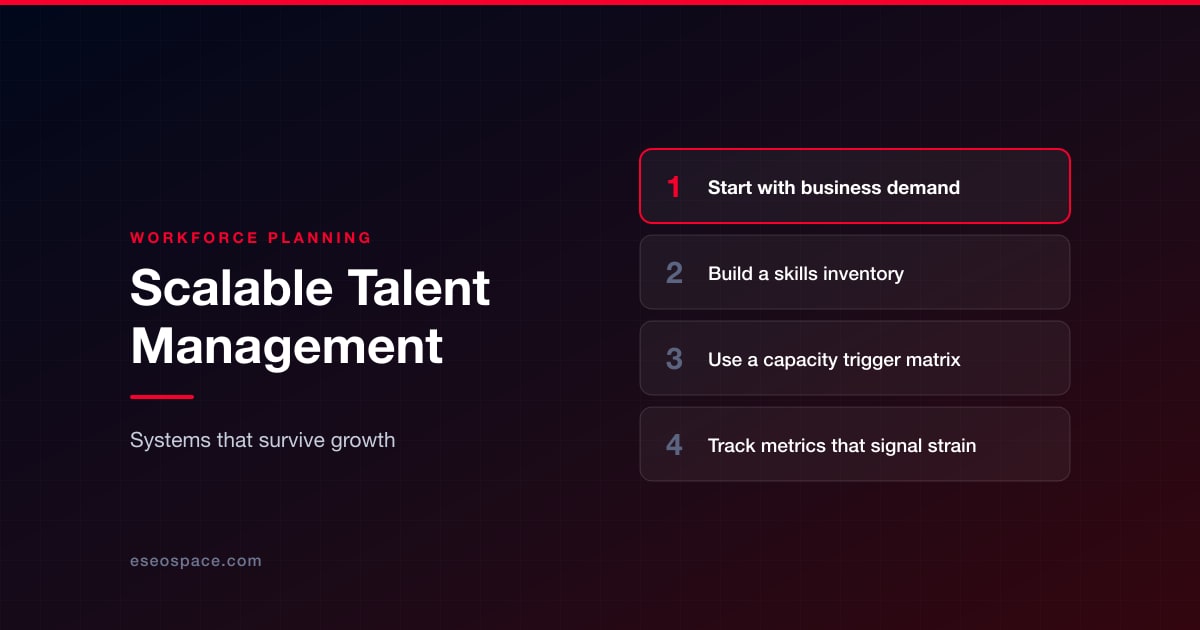
Growth exposes weak talent systems quickly. As headcount rises, hiring standards can drift, onboarding can vary, and skills gaps become harder to see.
Scalable talent management creates repeatable ways to attract, develop, deploy, and retain people as business needs change. The goal is not more of an HR process. It is a workforce system that can expand without losing speed, accountability, or employee experience.
U.S. Labor Data Shows Why Workforce Flexibility Matters
The U.S. Bureau of Labor Statistics Job Openings and Labor Turnover Survey reported 7.3 million job openings in July 2026. Hires and total separations were both about 5.1 million during the same month.
That level of movement reinforces the need for talent systems that can absorb vacancies, departures, and new demand. Workforce planning, succession coverage, standardized onboarding, and documented role expectations reduce dependence on managers improvising solutions.
Expand Talent Capacity Through Mexico
For U.S. companies building distributed teams, geographic expansion can support a scalable workforce strategy. Organizations looking to hire in Mexico can access professionals in overlapping time zones while widening the available talent pool.
Companies deciding how to hire employees in Mexico need to plan employment classification, payroll, benefits, onboarding, management, and local compliance. Some businesses hire employees in Mexico through their own entity, while others use an employer of record in Mexico for employment administration.
The same planning applies when companies hire remote workers in Mexico. Hiring in Mexico should connect to workforce priorities and long-term team design rather than operate as an isolated recruiting project. The operating questions are the same ones that decide whether global delivery teams work in practice: who owns quality, how handoffs are documented, and which hours actually overlap.
Start With Business Demand
Scalable talent management begins with what the business is trying to accomplish. Revenue targets, product launches, geographic expansion, automation, and customer demand should shape workforce priorities.
Ask:
- Which capabilities will become more important?
- Which roles are essential to execution?
- Where are capacity or leadership gaps likely?
- Which skills can be developed internally?
- Which needs require external hiring?
This keeps headcount planning connected to business outcomes.
Workforce Upskilling Is Essential for Scalable Talent Management
According to IBM research on the AI skills gap, surveyed CEOs expect 53% of employees to need upskilling between 2026 and 2028 to perform their current roles more effectively, while 29% will need reskilling for different roles.
A scalable model therefore cannot depend only on buying skills from the external market. Companies need repeatable methods for assessing capability, building new skills, redeploying employees, and updating role requirements as technology changes work.
Build a Skills Inventory Before Scaling Headcount
Job titles do not show what an organization can actually do. A useful skills inventory maps capabilities across teams and identifies where expertise is deep, thin, or concentrated in one person.
A gap may require recruitment, but it may also be solved through internal mobility, training, automation, or project-based support. The same question sits behind every outside engagement, which is why the in-house team versus agency comparison turns on capability and load rather than headline cost.
Standardize the Employee Lifecycle
Standardize the parts of the employee lifecycle where inconsistency creates risk.
Create common frameworks for:
- Role definitions and competencies
- Interview scorecards
- Onboarding milestones
- Performance expectations
- Career levels
- Learning plans
- Succession reviews
Connect Development to Future Skills
Training becomes difficult to scale when learning is disconnected from business needs. Development should start with identified capability gaps and future roles.
Use role-based learning paths, manager coaching, peer learning, stretch assignments, and internal projects. Track whether employees can apply what they learn, not just course completion.
Internal mobility belongs in the same system. Visible skills profiles, career paths, and opportunities make it easier to move capable employees into priority areas instead of automatically recruiting externally.
Make Performance Management Useful at Scale
Managers need a consistent rhythm for discussing goals, performance, development, and workload.
Use shared expectations, then let teams define role-specific outcomes. Regular talent reviews can identify high performers, skills gaps, promotion readiness, retention risks, and roles without adequate backup.
Protect Critical Roles With Succession Planning
Succession planning should extend beyond senior executives. Identify positions where a departure would disrupt revenue, customer delivery, operations, compliance, or institutional knowledge.
For each critical role, document likely successors, readiness gaps, and development actions. If no internal successor exists, flag the role as a workforce risk.
Information Gain: Use a Talent Capacity Trigger Matrix
Many companies wait until workloads become painful before hiring. A more scalable approach is to define triggers that tell leaders which talent action fits the need.
For example:
- Rising demand plus available internal skills can trigger redeployment.
- A teachable skills gap can trigger upskilling.
- Persistent demand with no internal capacity can trigger external hiring.
- Temporary demand can trigger contract or project support.
- Repetitive work with stable rules can trigger automation review.
Add cost, time to productivity, compliance risk, and expected duration to each decision. This matrix prevents hiring from becoming the default response to every capacity problem and gives finance, HR, and business leaders a common framework.
Specialist roles are where the matrix earns its keep, because the external option is slow and easy to get wrong. In regulated industries, that external search may require a specialized MedTech recruitment and executive search partner capable of evaluating technical, clinical, regulatory, and commercial requirements. Our guide to vetting a specialist before you hire them shows the level of scrutiny that decision deserves.
Track Metrics That Signal Scalability
Focus on measures that show whether talent systems are keeping pace with growth. Useful metrics include time to productivity, internal fill rate, regrettable turnover, critical-role coverage, skills-gap closure, quality of hire, and manager span of control.
Review results by team, location, and job family. Company-wide averages can hide areas where turnover or vacancy risk is becoming operationally significant.
People Also Ask
What Is Scalable Talent Management?
Scalable talent management is a repeatable system for attracting, developing, deploying, and retaining employees as an organization grows. It combines workforce planning, skills data, consistent hiring, onboarding, performance management, career development, succession planning, and metrics so workforce capacity can expand without creating unnecessary complexity or weakening employee experience.
Why Is Talent Management Important for Growing Companies?
Talent management helps growing companies maintain workforce quality as headcount, locations, and business demands increase. A structured approach reduces inconsistent hiring, identifies skills gaps earlier, supports internal mobility, improves succession coverage, and gives managers common standards for development. It turns repeated hiring emergencies into a more predictable workforce process.
How Can a Company Scale Its Talent Management Strategy?
Connect workforce needs to business goals, map critical skills, and standardize core employee processes. Build repeatable recruiting and onboarding frameworks, create role-based development paths, track internal mobility, and establish succession coverage. Use focused workforce metrics so leaders can identify capacity or capability problems before they slow growth.
What Role Does Technology Play in Talent Management?
Technology can centralize workforce data, automate administration, track skills, support recruiting, manage learning, and surface talent trends. The strongest systems support clear decisions rather than simply collecting more data. Companies should define their talent processes first, then select HR technology that makes those processes easier to execute consistently.
How Do You Measure Talent Management Effectiveness?
Measure whether talent practices improve workforce readiness and business execution. Useful indicators include time to productivity, quality of hire, internal fill rate, employee retention, critical-role succession coverage, skills-gap closure, and manager capacity. Track trends over time and segment results by function or location to uncover risks hidden by company-wide averages.
Actionable Takeaways
Build talent systems before growth makes them urgent. Start with business demand, create a skills inventory, standardize high-risk parts of the employee lifecycle, and connect development to future capability.
Then add succession coverage, a talent capacity trigger matrix, and focused workforce metrics. When hiring, development, internal mobility, and workforce planning operate as one system, talent management can grow with the business instead of becoming a constraint.
Put this into action with eSEOspace
We help businesses grow with website development that actually performs. Explore the services behind this guide:
Get a FREE Audit
We'll perform a comprehensive SEO, AEO, GEO & CRO audit of your website — completely free — and show you exactly how to outrank your competitors.
Don't have a site yet? Get in touch →
Get a FREE GEO/AEO/SEO Audit
We'll analyze your site's SEO, GEO, AEO & CRO — completely free — and show you exactly how to get found across Google and AI answers.
Don't have a site yet? Get in touch →
Great — your audit is on the way!
We'll send your free SEO/GEO/AEO/CRO audit within the next few hours. Where should we send it?
You're all set! ✓
Your free audit is being prepared — check your inbox in the next few hours. Talk soon!


On this page
- U.S. Labor Data Shows Why Workforce Flexibility Matters
- Expand Talent Capacity Through Mexico
- Start With Business Demand
- Workforce Upskilling Is Essential for Scalable Talent Management
- Build a Skills Inventory Before Scaling Headcount
- Standardize the Employee Lifecycle
- Connect Development to Future Skills
- Make Performance Management Useful at Scale
- Protect Critical Roles With Succession Planning
- Information Gain: Use a Talent Capacity Trigger Matrix
- Track Metrics That Signal Scalability
- People Also Ask
- Actionable Takeaways