
Why Business Growth Depends on More Than a Great Website
Why Business Growth Depends on More Than a Great Website
Every agency has had this conversation. Revenue is flat, the owner has decided the site looks dated, and a redesign is budgeted before anyone has checked where deals are actually dying. Six weeks later, the site is beautiful, and the number hasn't moved.
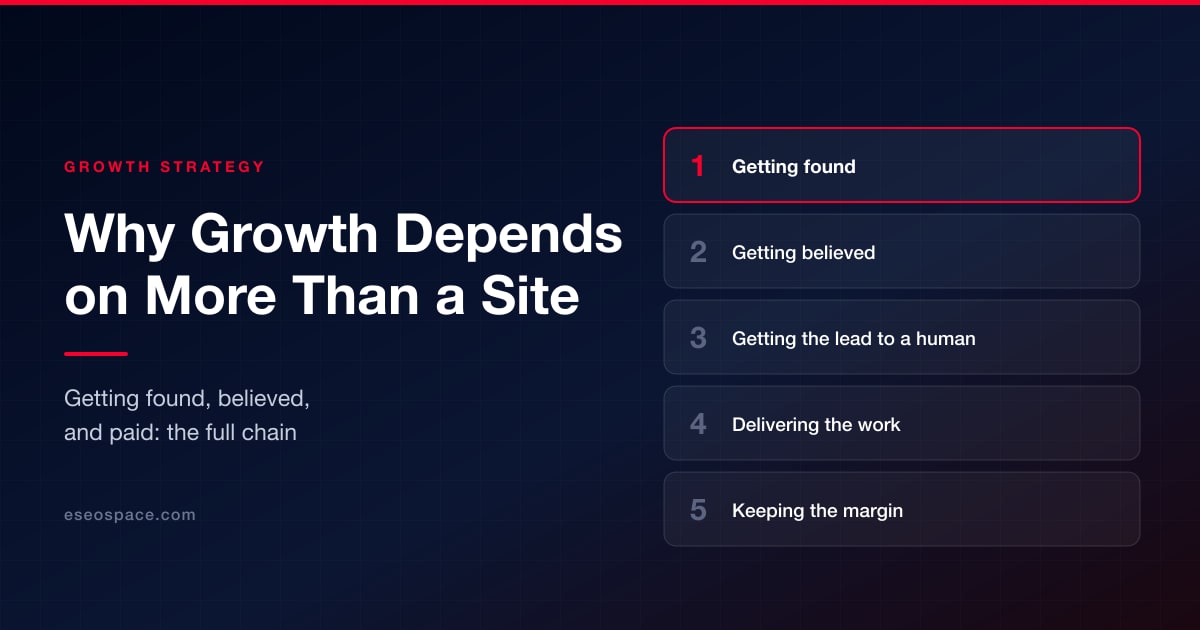
The site is rarely the problem. It's just the easiest thing to blame, because it's the one part of the business you can open in a browser tab and judge in four seconds. Growth runs through a longer chain than that: getting found, getting believed, getting the inquiry into a human's hands fast enough to matter, and delivering the work at a margin worth keeping. A website touches the first two links. It has no opinion about the last two, and those are usually where the money leaks out.
How Business Growth Happens Across the Entire Customer Journey?
A great website can attract attention, but sustainable growth depends on everything that happens before and after someone lands on it. Every stage, from choosing the right sales channels to managing operations, plays a part in turning interest into profitable business.
New channels need arithmetic before enthusiasm
Etsy's own filings show its full-year revenue take rate rose from 22.3% in 2024 to 24.2% in 2025. Sellers didn't get a vote, and the direction of travel is not subtle.
Run the numbers before you list, not after the first payout confuses you. Printify's Etsy calculator is free, needs no account, and takes about ninety seconds: enter selling price, product cost, and shipping cost, and it returns the listing fee, transaction fee, processing fee, total cost, and profit. The figures cover US-based orders and are approximate, and the tool handles Etsy's mandatory fees only. Etsy Ads, offsite ads fees on orders arriving through
Etsy's publishing partners, currency conversion, VAT, and the regulatory operating fee for sellers outside the US all sit outside the math. Treat the profit line as a ceiling rather than a forecast. A mug that clears by fifty cents in the calculator is underwater the moment an offsite ad fee lands on it, and the 40% margin Printify applies by default is a starting position, not a finding. A channel that loses $2 a unit only loses faster as your ecommerce design and development improves.
Design is a conversion variable, not a taste question
Baymard Institute has spent more than a decade running large-scale usability testing on checkouts at Walmart, Amazon, Wayfair, and similar operations. Their conclusion is that fixing the usability problems they've documented can lift conversion on a typical large ecommerce site by roughly 35%, with no extra traffic. Same visitors, different outcome.
Brief a website design project that way and the conversation improves immediately. "Modern" and "clean" are not specifications. Where the form sits, how many fields it demands, what a plumber's customer sees on the first phone screen at 8 pm on a Sunday: those are answerable questions with revenue attached. "Make it pop" isn't one.
SEO has to win the answer now, not the ranking
Pew Research Center tracked the actual browsing behavior of 900 US adults through March 2025. When Google served an AI summary, people clicked a traditional search result in 8% of visits, against 15% when no summary appeared. Links inside the summary got clicked 1% of the time.
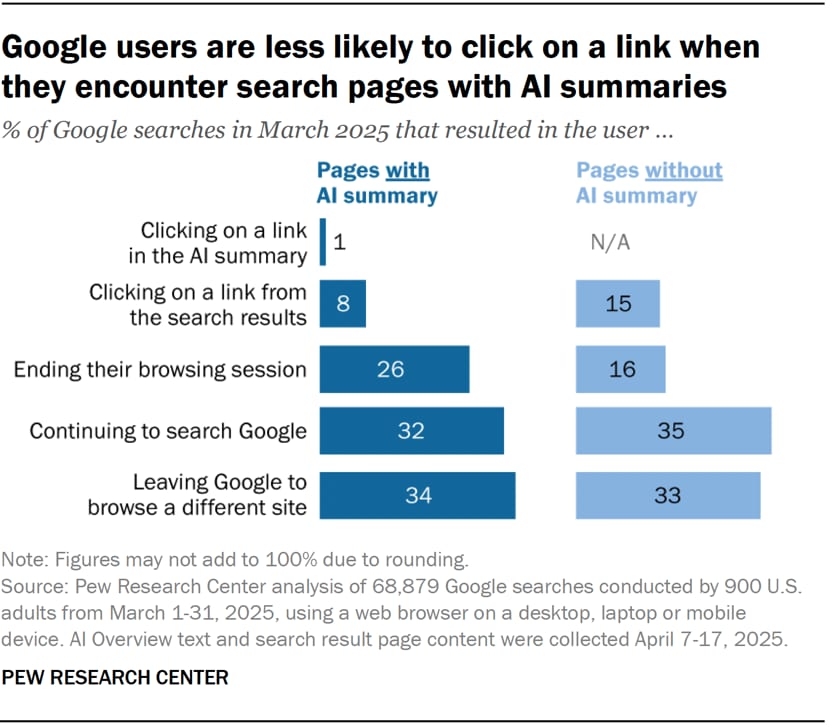
Source: Pew Research Center
Ranking third for a term that now resolves inside a box at the top of the page is a vanity position. The honest shift for SEO is toward queries with commercial teeth, where somebody still needs a quote, a phone number, or a site visit, and toward being the source the answer gets assembled from. Broad informational blog traffic was always the softest part of the pipeline. It's the first thing to go.
Speed is a tax on every channel you already pay for
The 2025 Web Almanac, built on Chrome's real-user data, found that 48% of mobile origins pass all three Core Web Vitals. Loading is what sinks most of them: only about 62% of mobile pages hit a good Largest Contentful Paint.
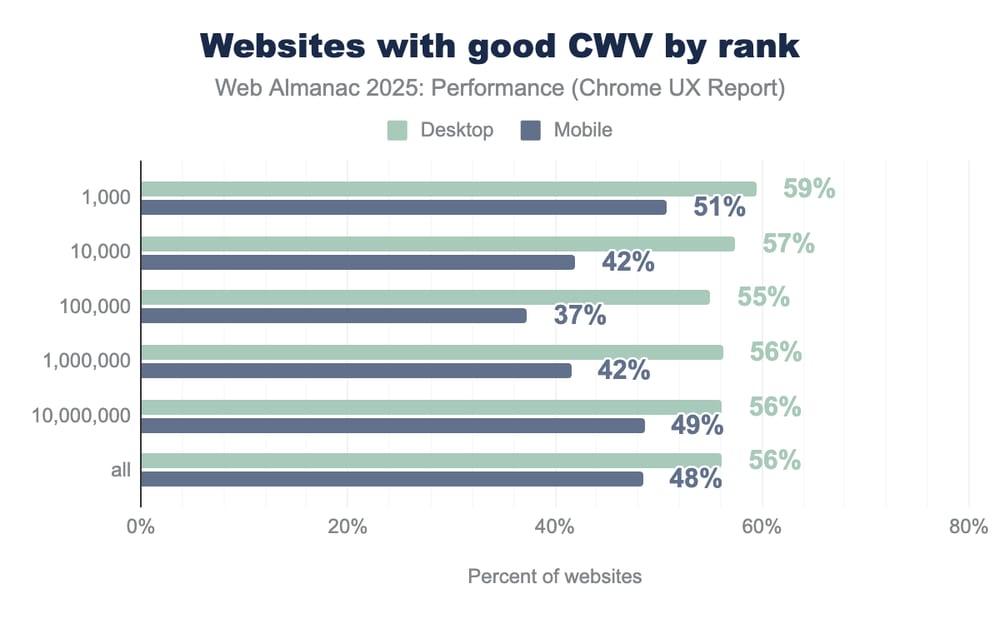
Source: Web Almanac 2025 (Chrome UX Report)
Every ad click, every referral, every search visit you fought for lands on that page. A slow site never fails loudly, so it survives for years inside businesses that would fire a salesperson over a five-point drop in close rate. It just quietly discounts the return on everything else in the budget.
The lead has to land somewhere that works
The Bureau of Labor Statistics put average hourly earnings across private payrolls at $37.64 in June 2026, up 3.5% over the year, with the average workweek flat at 34.3 hours. Payroll is the largest line most owner-operated businesses carry, and it climbs whether or not your prices do.
Hours are the part you control. An employee scheduling tool like Homebase turns coverage from a Sunday-night guess into something you can hold up against actual demand, which matters when four people are rostered for a Tuesday that needed two. The same logic applies to the booking form that drops an inquiry into an inbox nobody checks on Saturday. Connecting the front end to the systems running behind it is a build decision, and it's exactly what custom design and development is for.
Software does not adopt itself
The World Economic Forum's Future of Jobs Report 2025 surveyed over 1,000 employers representing 14 million workers. 63% named skills gaps as the single biggest barrier to transforming their business. Not capital. Not the technology itself.
Buying a scheduling app, a CRM, and a new POS in one quarter, then expecting a team of twelve to absorb all three between shifts, is how companies end up paying three subscriptions while everyone quietly keeps using the spreadsheet. The fix is cheap and unglamorous: employee training built from a template and recorded by whoever already does the job well. Your best closer walking through the new quoting tool beats a vendor webinar, because she knows which fields your customers argue about.
Your workflow is not generic, and generic tools show it
NAHB's Remodelers' Cost of Doing Business Study puts the average net profit margin for residential remodelers at 6.3% in 2024, the strongest reading since 1996. That's the good news version. On an $80,000 kitchen, about $5,000 is yours, and a single change order that never got documented can take most of it.
A general-purpose project tool won't save that. Construction management software like Ressio is shaped around the things that actually break a residential job: selections the homeowner keeps revisiting, subs who need Thursday's schedule on Wednesday night, and a paper trail that holds up when the client insists the tile upgrade was included. The website sells the job. Something else has to protect the margin on it.
Where this leaves you
The site is a conversion surface. It earns its keep by turning attention you've already bought or earned into a conversation, and a good one does that measurably better than a bad one. It won't schedule your crew, train your staff, document a change order, or tell you a product is unprofitable.
So before signing off on a redesign, find out where the last twenty deals died. If they died on the page, fix the page. If they died in a voicemail nobody returned, in a job that ran three days long, or in a product that never had a margin, no amount of design will reach them. The businesses that compound are the ones that fix the actual link in the chain, then make sure their website and SEO packages point at the same target as everything else.
Put this into action with eSEOspace
We help businesses grow with website development that actually performs. Explore the services behind this guide:
Get a FREE Audit
We'll perform a comprehensive SEO, AEO, GEO & CRO audit of your website — completely free — and show you exactly how to outrank your competitors.
Don't have a site yet? Get in touch →
Get a FREE GEO/AEO/SEO Audit
We'll analyze your site's SEO, GEO, AEO & CRO — completely free — and show you exactly how to get found across Google and AI answers.
Don't have a site yet? Get in touch →
Great — your audit is on the way!
We'll send your free SEO/GEO/AEO/CRO audit within the next few hours. Where should we send it?
You're all set! ✓
Your free audit is being prepared — check your inbox in the next few hours. Talk soon!