
Does Subscriber Count Help a YouTube Video Rank?
Does Subscriber Count Help a YouTube Video Rank?
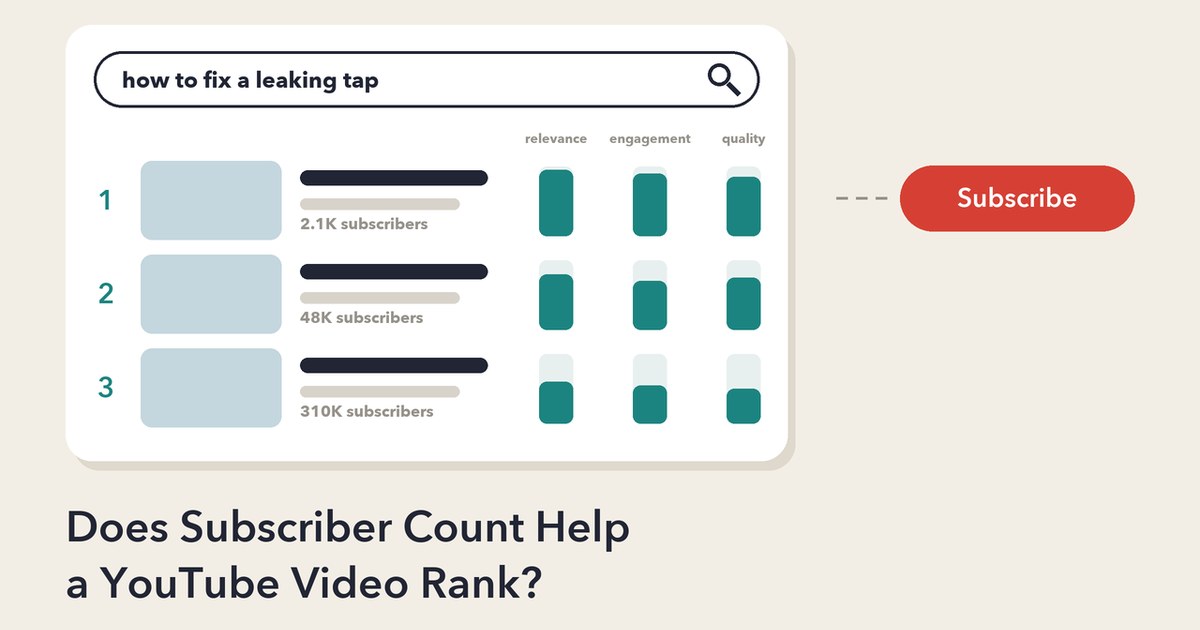
YouTube search is a ranking system that orders videos for each query using three main elements, relevance, engagement and quality, with personalization layered on top for signed-in viewers. That description comes from YouTube's own documentation, and it is worth reading closely because of what it leaves out.
Business owners who start publishing video tend to ask the same thing sooner or later: would a bigger subscriber number push our videos higher? The short answer is not directly. Subscribers matter to search through what they do after a video goes live, and the number beside the channel name does a different job, one aimed at people rather than at the ranking system.
What YouTube Search Actually Measures
Relevance is the matching layer. YouTube compares the query with the title, description and tags, and with the content of the video itself, which for spoken material means the words said on screen. Auto-generated captions give the system a transcript, but they regularly mangle product names, place names and industry terms, exactly the words a business wants to be found for. Uploading a corrected caption file replaces the machine's guess with the terms you actually used. Most teams upload captions in the SRT file format because it pairs each spoken line with a start and end time in plain text.
Engagement is measured per query. YouTube looks at signals such as watch time for a particular video on a particular search, so a video that holds people who searched "how to fix a leaking tap" earns standing for that phrase, not for plumbing in general. Quality refers to signals that help identify channels showing expertise, authoritativeness and trustworthiness on a topic.
Subscriber count is not one of the named elements. It does not appear under relevance, engagement or quality, and YouTube's documentation adds that it does not accept payment for better placement in organic results.
Where Subscribers Enter the Picture
Subscribers reach rankings indirectly, through behavior. When a new video goes up, the first audience often comes from the subscriptions feed and from notifications, and notifications only reach subscribers who switched the bell to "All" or who fall inside YouTube's personalized selection. If those people click and keep watching, the video collects engagement data early, and that data feeds how it performs on related searches.
The mechanism depends entirely on activity. A channel with 5,000 subscribers who never come back produces the same early data as a channel with none. This is why agencies that report on YouTube tend to watch returning viewers and the share of views coming from subscribers rather than the headline count. The count also tends to climb long after interest fades, since people who stop watching a channel seldom bother to unsubscribe, so it drifts further from real attention over time.
The Count as a First Impression
Rankings are not the only way people meet a channel. A prospect who finds a business on Google, then clicks through to its YouTube channel, sees the subscriber figure under the channel name on the channel page and on every watch page. Channel results inside YouTube search show it too. For that visitor the number works as a quick trust check, in the same way review counts do on a business profile.
A channel with a few strong videos and a near-empty count can look abandoned to that visitor, and some businesses close the gap with a starting base such as Views4You's YouTube subscribers. Orders run from the public channel URL, so the Google account password never changes hands, and delivery is spread over several days instead of landing overnight. The limits are specific. The provider's own page says these subscribers reflect in analytics rather than in viewing, and that they cannot be used toward the first 1,000 subscribers YouTube requires for monetization. They add no watch time and give the ranking system nothing to work with, so they suit a business channel whose videos already hold viewers and fail completely as a way to rank faster.
What Moves Rankings Instead
Most ranking gains for a business channel come from four places, each tied to one of YouTube's elements.
- Titles that match the query's wording. People search in plain phrases, and a title that repeats the phrasing of a real question gives relevance a direct match.
- The first thirty seconds. Engagement is scored per search, and viewers who leave early tell the system the video missed the query. Open with the answer the title promised.
- Chapters. Timestamps in the description, starting at 0:00, with at least three chapters of ten seconds or longer, let YouTube surface a specific segment for a narrow query.
- Playlists and end screens. A viewer who moves to a second video on the same topic extends the session, which reflects well on both videos.
None of these requires a large audience. They require that each video answers one search clearly, which is also what makes the subscribers a channel does earn worth having.
Video also ranks in Google, not only on YouTube, and the same answer-first discipline carries over. Our video SEO guide covers that side, and eSEOspace's video SEO services handle titles, captions, chapters and schema for business channels that would rather not do it in-house.
Frequently Asked Questions
Does YouTube show subscriber counts in search results?
Channel results show the subscriber count, while video results show the channel name, view count and upload age. A viewer sees the subscriber figure again on the watch page under the channel name.
Are YouTube tags still worth filling in?
YouTube's help pages say tags play a minimal role in discovery and mainly help with commonly misspelled terms. Time spent on the title, description and captions pays back more.
Can bought subscribers disappear from the count?
YouTube periodically removes accounts it identifies as spam, and the subscriber figure drops when that happens. The size of any drop depends on how those accounts were created.
How many subscribers does YouTube monetization need?
The YouTube Partner Program asks for 1,000 subscribers plus either 4,000 valid public watch hours in 12 months or 10 million Shorts views in 90 days. Subscribers bought from a provider do not count toward that first 1,000.
Put this into action with eSEOspace
We help businesses grow with seo, geo & aeo that actually performs. Explore the services behind this guide:
Get a FREE Audit
We'll perform a comprehensive SEO, AEO, GEO & CRO audit of your website — completely free — and show you exactly how to outrank your competitors.
Don't have a site yet? Get in touch →
Get a FREE GEO/AEO/SEO Audit
We'll analyze your site's SEO, GEO, AEO & CRO — completely free — and show you exactly how to get found across Google and AI answers.
Don't have a site yet? Get in touch →
Great — your audit is on the way!
We'll send your free SEO/GEO/AEO/CRO audit within the next few hours. Where should we send it?
You're all set! ✓
Your free audit is being prepared — check your inbox in the next few hours. Talk soon!