
From Home Office to Full Warehouse: What Growing SEO Businesses Need to Scale
From Home Office to Full Warehouse: What Growing SEO Businesses Need to Scale
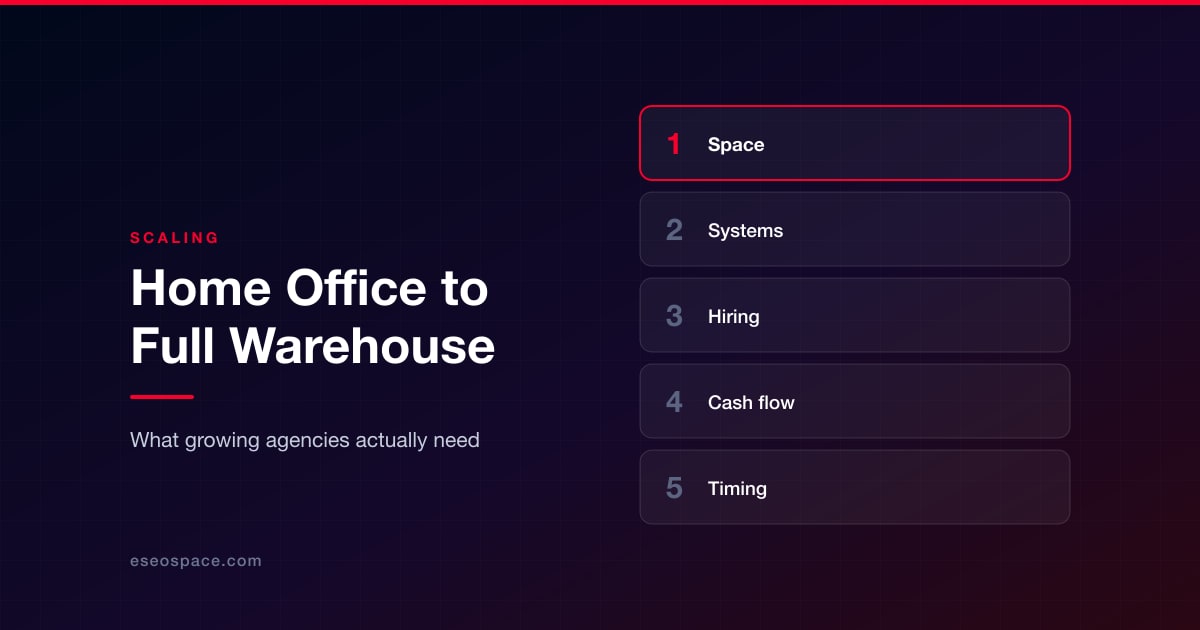
The spare bedroom works until the business starts arriving in boxes. One wall holds shipping supplies, client samples occupy the closet, and the desk is surrounded by products waiting to be photographed. Meanwhile, the founder is still handling keyword research, customer emails, listings, and fulfillment from the same room.
That stage can feel temporary for much longer than expected.
Scaling requires separating work that once comfortably lived together.
Know when space has become an operating problem
A crowded room is inconvenient. A crowded workflow costs money.
Consider an SEO-led ecommerce business that publishes product guides, sells its own inventory, and ships orders directly. If employees spend 15 minutes looking for samples before every photo session, the problem is no longer cosmetic. The same applies when packing materials block work areas or inventory gets stored in several unmarked locations.
Measure the inconvenience before committing to a warehouse.
How many orders ship each week? How much inventory is actually held? How often does somebody retrieve it? A growing company may need another 300 square feet long before it needs a 3,000-square-foot warehouse.
For teams finding self-storage units in Palm Beach, a nearby unit can provide that intermediate step. Seasonal inventory, photography equipment, event materials, and bulk packaging can move out of the office while remaining accessible.
Give every physical item a location
More space will not fix poor inventory habits.
Once stock moves beyond a home office, create a location system. It can be simple: Rack A, Shelf 2, Bin 4. Put that location in the inventory record.
This becomes particularly important for businesses whose content operation depends on physical products. An SEO writer working from a content brief for a comparison of six coffee grinders should be able to request the correct samples without someone opening 20 boxes.
Separate sellable stock from returns, damaged goods, photography samples, and promotional items too. They may look identical on a shelf while having very different purposes.
A larger operation needs fewer mystery boxes.
Marketplace growth creates a second inventory problem
Selling through one channel is manageable with basic processes. Add eBay, Etsy, Poshmark, or other marketplaces and the same item can suddenly exist in several digital locations.
That is where multi-channel listing software becomes useful. It can help sellers create and manage listings across marketplaces from a more centralized workflow, depending on the platform and channels supported.
The practical benefit appears when inventory starts moving quickly.
Imagine a reseller has one vintage jacket listed on three marketplaces. It sells on one channel on Saturday morning. Leaving the other listings active creates a risk that somebody else buys inventory that no longer exists.
Volume makes that problem worse. Fifty items can be checked manually. Five thousand require much stronger inventory discipline.
Content operations need structure before headcount
SEO businesses often respond to workload by hiring writers.
Sometimes the actual problem is the workflow around the writers.
Brief creation, keyword mapping, editing, image requests, publishing, internal linking, and performance reviews can involve several people. If every article depends on somebody asking, “Is this ready yet?” adding another writer simply sends more work into the same bottleneck.
Define ownership and status clearly.
A content team might use stages such as brief approved, drafting, editorial review, client review, upload, and published. The specific labels matter less than everybody knowing what each one means.
The same principle applies to multi-channel listing software. Technology becomes useful when it supports a defined process. Adding software to an unclear workflow usually gives the confusion a nicer interface.
Storage should follow retrieval patterns
Cheap storage can become expensive once employee time enters the calculation.
A company finding self-storage units in Palm Beach should consider how frequently items will move between the unit and the workplace. Archived trade-show displays can tolerate a longer drive. Products needed for weekly photography probably cannot.
Organize the unit around retrieval frequency as well. Frequently used supplies belong somewhere accessible. Archived materials can sit farther back.
And label everything before it leaves the office. “SEO conference stuff” will mean very little to a new employee nine months later.
A warehouse should solve a proven constraint
Moving into a warehouse feels like a milestone, which makes it easy to do too early.
Look for operational evidence. Inventory exceeds practical storage capacity. Staff spend significant time moving stock between temporary locations. Shipping volume needs dedicated packing stations. Deliveries are becoming difficult to receive. The business can support the additional rent, insurance, equipment, and labor.
Those are stronger reasons than wanting the company to look established.
A growing business rarely jumps cleanly from spare bedroom to warehouse. There are awkward stages between them, and those stages are useful. They reveal which processes deserve more space, which ones need better systems, and which habits should never be carried into the larger building.
Put this into action with eSEOspace
We help businesses grow with website development that actually performs. Explore the services behind this guide:
Get a FREE Audit
We'll perform a comprehensive SEO, AEO, GEO & CRO audit of your website — completely free — and show you exactly how to outrank your competitors.
Don't have a site yet? Get in touch →
Get a FREE GEO/AEO/SEO Audit
We'll analyze your site's SEO, GEO, AEO & CRO — completely free — and show you exactly how to get found across Google and AI answers.
Don't have a site yet? Get in touch →
Great — your audit is on the way!
We'll send your free SEO/GEO/AEO/CRO audit within the next few hours. Where should we send it?
You're all set! ✓
Your free audit is being prepared — check your inbox in the next few hours. Talk soon!