This article is part of The MCP Guide. For the month in review, see our State of MCP reports.
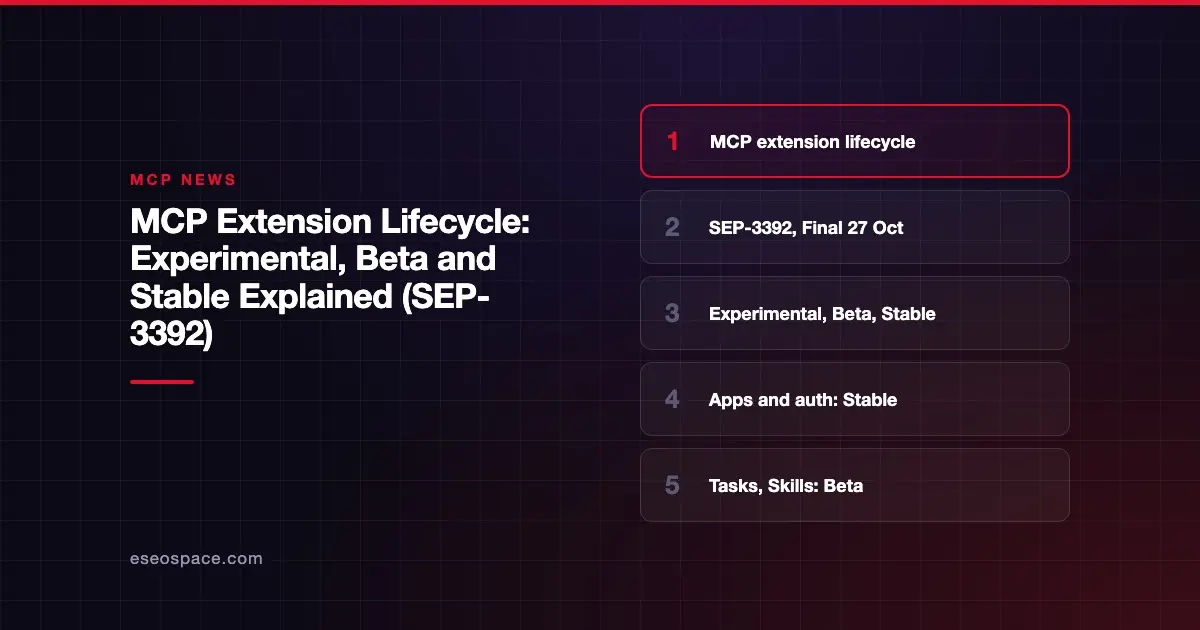
MCP extensions now have maturity stages. SEP-3392, "Extension Lifecycle", was marked Final on 27 October 2026, according to its pull request. Every official extension is now Experimental, Beta or Stable, and a Beta or Stable extension can later be promoted into the core spec.
This matters because "official" used to say nothing about stability. A business deciding whether to build on MCP Apps, Tasks or Skills can now see how settled each one is. This page lists every extension and its stage as of 2 November 2026.
Checked against: SEP-3392, the MCP extensions overview and the extension repositories on GitHub, on 2 November 2026.
Key Takeaways
- SEP-3392 gives every MCP extension one of three stages: Experimental, Beta or Stable, with promotion to the core spec as a further step.
- MCP Apps, OAuth Client Credentials and Enterprise-Managed Authorization are Stable.
- Tasks, Skills over MCP and Server Cards are Beta; Tasks is headed for Core, and the other two have no stated destination.
- Interceptors, variants, triggers and events, and tool annotations remain Experimental.
- A Final SEP is not the same as a Stable extension: Skills and Server Cards have Final SEPs but are Beta.
- Stable extensions change only alongside a new core spec release, which now happens in late March and late September.
Why MCP needed extension stages
Extensions are optional add-ons to MCP that both sides must opt in to. Our explainer on how MCP extensions work covers the basics. The earlier rules, from SEP-2133, had only two kinds: experimental and official.
SEP-3392 explains the problem: "Official extensions carry no stability signal." Maintainers could change an official extension at any time, and each repository described maturity in its own words. The ext-skills repository, for example, published its spec under a folder named specification/stable/, which meant "released," not "settled."
The feature deprecation policy, SEP-2596, had left "feature maturity tiers" as an open question and pointed to the alpha, beta and GA model in Kubernetes. SEP-3392 answers that question for extensions. Our versioning and deprecation guide covers SEP-2596.
The stages
| Stage | What can change | Who approves changes | How it gets there | What you can expect |
|---|---|---|---|---|
| Experimental | "Any change, at any time, without notice" | Extension Maintainer | Added by a maintainer, or an experimental-ext- repo | "Nothing. The design may change or disappear." |
| Beta | Any change, breaking changes rare | Extension Maintainer | Extensions Track SEP | "Real usage is welcome. Breaking changes are documented." |
| Stable | "Only with a new core protocol revision" | Extension Maintainer | A second Extensions Track SEP | "Behavior is fixed within a protocol revision." |
| Core | As for the core spec | Core Maintainers | Standards Track SEP | As for the core spec |
The quoted text comes from the SEP's stage table. Three rules are worth knowing:
- No skipping Beta. An extension "MUST NOT skip Beta" unless Core Maintainers waive it by recorded vote.
- Beta states a destination. Each Beta extension says whether it aims for Stable (stays an extension) or Core (moves into the spec). The SEP calls this "a signal to implementers, not a commitment."
- Stable needs evidence. Moving to Stable requires two independent implementations, one client and one server, that work together, plus a conformance test scenario.
The stage shows in the repository folder: specification/experimental/, specification/beta/ or specification/stable/. Identifiers do not change when the stage changes.
Every official extension and its stage
This table combines the SEP-3392 transition table with the extensions overview, read on 2 November 2026.
| Extension | Identifier | Repository | Stage | Destination | Proposal |
|---|---|---|---|---|---|
| MCP Apps | io.modelcontextprotocol/ui | ext-apps | Stable | Not applicable | SEP-1865 |
| OAuth Client Credentials | io.modelcontextprotocol/oauth-client-credentials | ext-auth | Stable | Not applicable | Not listed |
| Enterprise-Managed Authorization | io.modelcontextprotocol/enterprise-managed-authorization | ext-auth | Stable | Not applicable | Not listed |
| MCP Tasks | io.modelcontextprotocol/tasks | ext-tasks | Beta | Core | SEP-2663 |
| Skills over MCP | io.modelcontextprotocol/skills | ext-skills | Beta | Not yet stated | SEP-2640 |
| Server Cards | HTTP document, application/mcp-server-card+json | ext-server-card | Beta | Not yet stated | SEP-2127 |
| Interceptors | Not assigned | experimental-ext-interceptors | Experimental | None | SEP-2624 (proposed) |
| Variants | Not assigned | experimental-ext-variants | Experimental | None | SEP-2053 (proposed) |
| Triggers and events | Not assigned | experimental-ext-triggers-events | Experimental | None | Design sketch |
| Tool annotations work | Not assigned | experimental-ext-tool-annotations | Experimental | None | Interest Group |
Notes on the table:
- Destination applies only to Beta extensions. A Stable extension can still be promoted to Core later by a Standards Track SEP.
- The overview lists Tasks as "Beta, to Core" and Skills and Server Cards as "Beta, destination not yet stated."
- The SEP numbers for interceptors and variants come from each repository's GitHub description.
- Server Cards are a document you fetch over HTTP before connecting, so they do not use a capability identifier. See our Server Cards guide.
- Triggers and events is the draft that ChatGPT's MCP Events is built on, even though it is Experimental.
Folder moves are still in progress
SEP-3392 asks each repository to move its spec into the matching stage folder. On 2 November 2026, the GitHub API showed ext-skills with a specification/beta folder and ext-auth with specification/stable. The ext-apps and ext-tasks repositories still used dated folders, and the ext-server-card README still said "Status: Experimental." The overview page is the reliable source until the moves finish.
What each stage means for your business
- Stable (MCP Apps, auth extensions). Safe to build product features on. Changes arrive only with a spec release, which SEP-3398 now schedules for the last Tuesday of March and September.
- Beta heading to Core (Tasks). Build if you need it, but expect it to become core behavior in a future spec release. Our Tasks extension guide covers the design.
- Beta with no destination (Skills, Server Cards). Real usage is welcome, but breaking changes are possible. Pin versions and watch changelogs. See Skills over MCP.
- Experimental. Prototype only. The overview says implementers "should pin to a tag or commit."
Extensions stay "disabled by default" and require "explicit opt-in" at every stage, per the overview. Your clients and servers will not start using one by accident.
How a Beta extension moves into the core spec
When a Standards Track SEP promotes an extension, the feature becomes core behavior from a named spec revision. Requests on that revision or later get core behavior, whether or not the extension is advertised. Requests on older revisions keep the extension's final behavior, so clients that support older revisions should keep advertising the extension.
Once that revision is released, the extension's spec moves to specification/archived/. Under SEP-3398, spec releases now come in late March and late September, so promotions land on that calendar.
Next step
If you are deciding which extensions to support in a product, start with Stable ones and add Beta features behind a flag. Our MCP development team can review your extension plan, and the MCP specification hub collects every spec page we have written.
More in the MCP Guide
Latest research: State of MCP: October 2026
Frequently asked questions
What is SEP-3392?
It is the MCP process proposal titled "Extension Lifecycle," created 25 September 2026 by Peter Alexander and marked Final on 27 October 2026. It gives each extension a stage, Experimental, Beta or Stable, and defines how extensions move between stages or into the core spec.
Is MCP Apps stable?
Yes. SEP-3392 classified ext-apps as Stable, and the extensions overview lists MCP Apps as Stable as of 2 November 2026. Its behavior is fixed within a protocol revision, and changes wait for the next core spec release.
Why are Skills over MCP and Server Cards Beta if their SEPs are Final?
A Final SEP means the proposal was accepted and finished. The lifecycle stage is a separate label for how settled the extension is. SEP-3392 counted their existing SEPs as the Beta entry SEP, so both start at Beta with no stated destination.
Will MCP Tasks become part of the core spec?
That is the stated plan. The overview lists Tasks as "Beta, to Core." SEP-3392 says a destination is a signal, not a commitment, and promotion needs a Standards Track SEP and a spec release.
Can an extension's identifier change when its stage changes?
No. SEP-3392 says an identifier "is fixed when the extension is created and does not change when its stage changes." A new identifier is used only when old and new behavior must coexist under one protocol revision.