
Top Headless Commerce Agencies in 2026-2027
Top Headless Commerce Agencies in 2026-2027
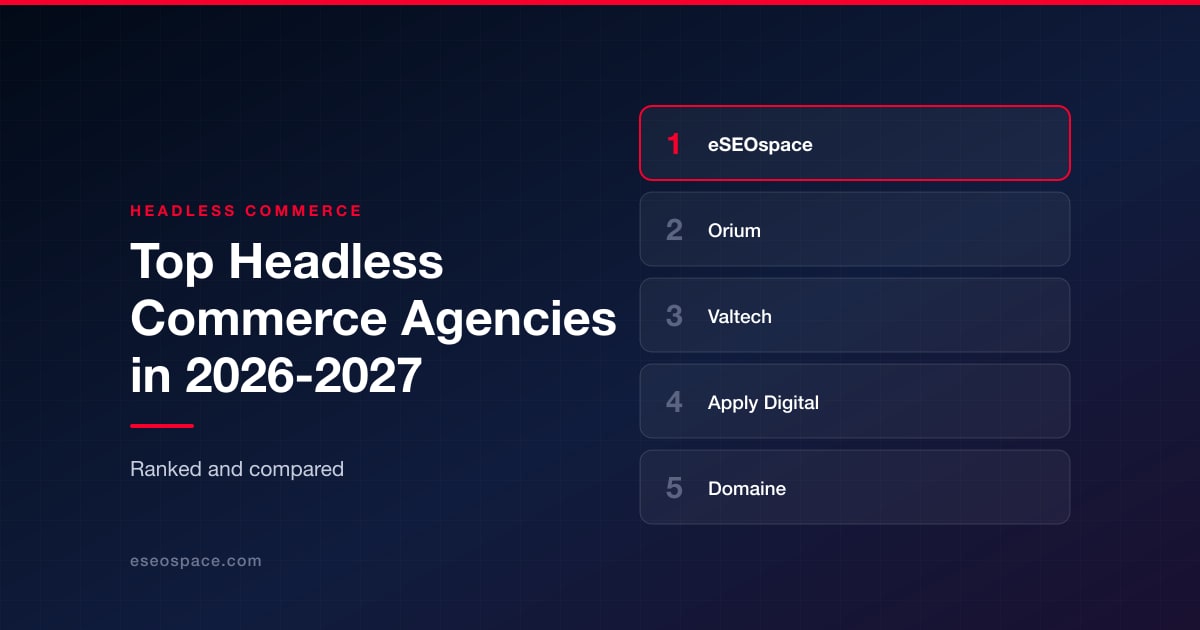
Disclosure: eSEOspace publishes this blog and ranks itself first. Every other entry was researched independently and links to its own site.
Headless commerce stopped being a debate somewhere around 2023. The argument now is not whether to decouple the storefront from the commerce engine, it is how far to decouple and how much of your business you are willing to rebuild to get there.
That distinction is what separates the agencies on this list. Some of them run full composable replatforms: new commerce engine, new CMS, new search, new front end, a long delivery calendar and a steering committee. Others build a Hydrogen or Next.js storefront on top of a commerce back end you already own and leave that back end alone. Both are legitimate. Hiring the first kind for the second job is how a storefront refresh turns into a multi-year program.
So read this list with your actual scope in mind. Every entry names what the agency is genuinely good at and, more usefully, where it is the wrong call.
One note on sourcing. Every factual claim below comes from the agency's own published pages or from the commercetools partner directory. Where a founding year, a headquarters or a team size was not publicly stated, we left it blank rather than guessing. Several of these agencies publish impressive self-reported metrics: project counts, GMV totals, NPS scores, review ratings. We did not repeat them as verified facts, because they trace back to the agency's own marketing. You will notice the gaps. The gaps are honest.
Key Takeaways
- Headless is a spectrum, not a switch. Decide first whether you are replacing the commerce engine or only the front end, because that single decision eliminates most of this list either way.
- Vendor partner directories are the strongest public signal available. A commercetools Platinum tier with published certification counts is verifiable in a way that a homepage claim is not.
- Enterprise consultancies and boutique storefront studios are not competitors. They solve different problems at wildly different prices, and confusing them is the most common and most expensive hiring error in this category.
- Most of these firms do not publish a founding year, a headquarters and a team size together. Any list that gives you all three for every agency is filling in blanks.
- Platform-agnostic shops matter more than they used to, because a lot of 2026 headless work is a decoupled front end bolted onto an existing Adobe Commerce, SAP or Salesforce back end.
- The best headless partners will tell you when headless is wrong. At least one agency here openly sells headless-to-theme migrations, which is a credibility signal, not a weakness.
- A fast storefront does not earn traffic or conversions on its own. Budget for search visibility and conversion work alongside the build, or you will ship a beautiful site that performs exactly as well as the old one.
How we evaluated these agencies
We scored on six things we could actually check, and named the things we could not.
Verifiable headless delivery. A dedicated headless or composable service line, documented reference builds, or a platform vendor partner profile. A logo grid mentioning React did not qualify.
Independent credentials over self-claims. Partner tiers, certification counts and vendor awards published by commercetools, Shopify or MACH Alliance carry more weight here than any number on the agency's own homepage.
Named clients. Published client names are the strongest public evidence that work shipped. We report them where the agency publishes them and we do not speculate about the depth of those engagements.
Scope honesty. Does the agency do full replatforms, front-end-only builds, or both? We treated clarity here as a positive, because mismatched scope kills more headless projects than bad code does.
Platform range. Firms that can build against several commerce engines are more useful to buyers who are not starting from zero. Firms tied to one platform are better when that platform is already your answer.
Fit clarity. Every entry carries a worst-fit note. The most valuable thing a list like this can tell you is who to rule out.
What we did not score. Team size, revenue, review scores and NPS. Most of these firms do not publish them, and the ones that do are self-reporting. We are not going to manufacture precision that does not exist.
Comparison table
| # | Agency | Best for | Platform focus | Published locations | Founding year |
|---|---|---|---|---|---|
| 1 | eSEOspace | Mid-market brands wanting build, search and conversion under one roof | Platform-agnostic headless front ends, custom back ends | United States | 2019 |
| 2 | Orium | Enterprise and mid-market composable replatforms in North America | commercetools, headless CMS, React/Next.js | Canada and the United States, per its commercetools profile | Not published |
| 3 | Valtech | Global multi-market programs where commerce is one workstream | Composable commerce, MACH, data and AI | Offices across Europe, North America, Latin America, APAC and the UAE | Not published |
| 4 | Apply Digital | Commerce plus content plus customer data, rebuilt together | commercetools Platinum, composable platform engineering | Americas and EMEA coverage per its commercetools profile | Not published |
| 5 | Domaine | Large-scale migrations onto Shopify and unified commerce | Shopify, headless and theme | NYC, London, Toronto, Amsterdam, Delft, Charleston, LA, Montréal, Berlin | Not published |
| 6 | Commerce-UI | Design-led DTC brands wanting a genuine Hydrogen storefront | Shopify Hydrogen, Next.js, Sanity, Vercel | Not published | Not published |
| 7 | Elogic Commerce | B2B, B2B2C and ERP-connected headless front ends | Adobe Commerce, Shopify Plus, BigCommerce, SFCC, commercetools, SAP | Tallinn HQ, plus New York, London, Stockholm, Dresden, Prague | 2009 |
| 8 | Vaimo | Multi-region, multi-brand merchants across commerce, content and data | Adobe Commerce, commercetools, Shopify, Contentful, Contentstack | Stockholm HQ plus 19 further offices listed | 2008 |
1. eSEOspace
Best for: mid-market ecommerce brands that want a decoupled storefront built and then actually marketed, without hiring a separate agency for each half of that sentence.
eSEOspace was founded in 2019 and works across ecommerce design and development, custom software and search. That combination is the reason we rank ourselves first here, and it is a narrow claim rather than a broad one: for a mid-market brand, the risk in a headless project is rarely the front end rendering correctly. It is the six months after launch when the new storefront is fast, clean, and getting the same traffic as the old one.
Our headless work is platform-agnostic. We build decoupled front ends against the commerce engine a client already runs, and we build the custom back-end services, integrations and data layers that a decoupled architecture tends to require. We do not push a single vendor stack, because in our experience most mid-market replatforms run into trouble on scope rather than on technology choice.
The part we think genuinely differentiates us is what happens on either side of the build. Ecommerce SEO and ecommerce conversion optimization are core service lines, not add-ons sold after handover. Headless architectures make it very easy to break faceted navigation, canonical handling and internal linking during a migration, and very easy for nobody to notice until organic revenue drops a quarter later. Having the search team in the room during the architecture phase prevents that.
Worst fit: if you are a global enterprise running a multi-year, multi-region MACH replatform with a dozen internal stakeholder groups and a systems integrator procurement process, hire one of the large consultancies further down this list. That is not the work we are built for, and we would rather say so than take the brief. If your project is that shape, several firms below will serve you better.
If you want to talk through scope before committing to an architecture, book a call.
2. Orium
Best for: enterprise and mid-market retailers in North America running a full composable replatform rather than a front-end-only project.
Orium builds headless commerce, content and experience systems for enterprises, and its current homepage messaging has moved toward agent-ready architecture rather than composable commerce alone. The credentials worth noting are external rather than self-issued: Orium is listed as a commercetools Platinum solution partner, and its site displays MACH SI 2026 certification alongside a MACH Agent-Ready 2026 award. Those are the kind of signals a homepage cannot manufacture.
Client work published on its site includes New Balance, Destination XL, IPSY, Indigo, Steelcase, Article, Frame, iFIT, OnLogic, Spirent, Telus Health and TUI Group. That is a serious enterprise portfolio, and the pattern in it is consistent: large catalogs, complex merchandising, real operational load, and in several cases a mix of retail and B2B demands inside the same platform.
Orium is strongest when the brief pairs commercetools with a headless CMS and a React or Next.js storefront, and when the client is genuinely replatforming rather than resurfacing. Its commercetools profile lists certifications in both functional architecture and development, which matters more than it sounds: composable projects fail more often on data modelling and integration design than on front-end code, and the architect side of that certification set is the part most agencies are thin on.
Orium does not publish a founding year or a street address. Its commercetools profile lists coverage in Canada and the United States, which is the most reliable public statement of its footprint.
Worst fit: a brand that wants a faster storefront on top of a back end it intends to keep. Orium's centre of gravity is the full composable program, and buying a systems integrator for a front-end refresh means paying transformation prices for a redesign.
3. Valtech
Best for: large, multi-region enterprise programs where headless commerce is one workstream inside a broader digital transformation.
Valtech calls itself the experience innovation company and organizes its offer around five service lines, of which Commerce Acceleration is one. The others cover experience design, enterprise transformation, marketing performance, and data and AI. That structure tells you something important about how a Valtech engagement is scoped: commerce is a component of a program, not usually the program itself. Its commercetools profile lists Platinum tier, with Composable Commerce Functional Architect, Developer and Frontend Developer certifications.
The footprint is the differentiator. Office locations listed on valtech.com span Bulgaria, Denmark, France, Germany, the Netherlands, North Macedonia, Poland, Portugal, Romania, Spain, Sweden, Switzerland, Ukraine and the United Kingdom in Europe, the US and Canada in North America, Argentina, Brazil and Mexico in Latin America, China, India and Singapore in APAC, plus the UAE. No single headquarters is designated on the site.
Published work includes Lexus, Mars, Audi, Mandarin Oriental, Discover and Eton Shirts. The Mars case study is the most instructive one for headless buyers: Valtech describes a direct-to-consumer composable commerce build that launched with M&M'S and was then extended to Ethel M, a smaller and more premium brand. That sequence is the real argument for composable at enterprise scale. You stand up capability once and reuse it on the next brand rather than commissioning a second build.
Worst fit: a single-market DTC brand doing one storefront. You will be a small account inside a very large organisation, and the governance overhead that makes Valtech effective on a multi-brand rollout is pure cost on a one-brand build.
4. Apply Digital
Best for: retail, CPG, media and sports brands rebuilding storefront, CMS and customer data together.
Apply Digital is a global digital product and transformation consultancy that now markets itself around agentic customer experience, spanning strategy, product design, commerce, platform engineering and data. The commerce credential is externally substantiated: its commercetools profile is Platinum tier with 20+ Composable Commerce Developer certifications and a 2024 AMER Partner of the Year award.
Apply Digital does not publish a founding year or a designated headquarters. Its commercetools profile lists coverage across the United States, Canada, Mexico, Chile, Colombia, Brazil and Argentina in the Americas, plus the United Kingdom and the Netherlands in EMEA. That is a genuinely useful shape for a North American brand with Latin American markets, which is a harder combination to staff than it looks.
Client logos on its site include Kraft Heinz, Arc'teryx, Disney, P&G, Lululemon, Fanatics, Focus Features and Diamond Baseball Holdings. The site also highlights Google Cloud Premier Partner status, which is a reasonable proxy for the data engineering half of the pitch.
Apply Digital is the pick when the commerce layer, the content layer and the customer data layer all need to be re-architected in one program. That triple-scope brief is where an agency with product design and data engineering under the same roof genuinely beats a commerce specialist.
Worst fit: buyers who want a commerce-first partner with commerce-first messaging. Apply Digital's own site now leads with agentic AI rather than headless commerce, and the composable credential comes primarily from the commercetools partner profile rather than from the homepage. If you want an agency whose front door is commerce, look at Orium or Elogic.
5. Domaine
Best for: DTC and enterprise brands migrating onto Shopify from Salesforce Commerce Cloud, Adobe Commerce or a custom stack.
Domaine describes itself as the leading Shopify partner scaling global brands, and organizes its services into strategy, creative, technology and marketing. The technology practice covers front-end and back-end development, migrations and unified commerce. Its about page notes that the agency Code has been acquired by Domaine, so the firm is consolidating Shopify capability by acquisition rather than growing a single office.
Offices are stated in New York City, London, Toronto, Amsterdam, Delft, Charleston, Los Angeles, Montréal and Berlin. Case studies published on the site include Timex, Arhaus, Ulla Johnson, r.e.m. beauty, Fresh Cut Paper, Floyd, Paravel, Gabriela Hearst, Milk Makeup, Bandier, Peloton, FIGS, Benchmade, Creed and Stoney Clover Lane. That is a broad mix of fashion, beauty, furniture and hardgoods, which suggests migration process rather than a single vertical specialism is the product being sold.
Here is the interesting part. Domaine lists headless development, Shopify theme to headless migrations, and headless to Shopify theme migrations, all three, as named services. An agency that will migrate you off headless is an agency you can trust to tell you whether you need it, and that is rarer than it should be in this market.
Worst fit: anyone not going to Shopify. This is a Shopify house. If your answer is commercetools, SAP or a custom engine, you are shopping in the wrong aisle. Also worth probing directly: headless development is one line item inside a large service menu rather than the centre of the offer, so ask which recent builds are actually decoupled and who on the team led them before you sign.
6. Commerce-UI
Best for: design-led DTC brands that want a genuinely headless Shopify storefront built by a small senior team.
Commerce-UI is a Shopify Plus design and development studio whose build practice is specifically headless: Shopify with Hydrogen or Next.js, Sanity for content, Vercel for hosting, Mux for video, plus checkout extensions and replatforming work. It also offers design systems and accessibility work, analytics and marketing instrumentation including server-side tagging, and audit-style consultancy. The stack is tight and opinionated, which is usually a good sign in a studio this size.
The client list is the strongest argument here. Names published on its site include Carhartt WIP North America, the official Lady Gaga site, Oura, Pangaia, Akris, Chantelle, Magda Butrym, Aether Apparel, Lift Foils, Nour Hammour, Veloretti, Splits59, Blackroll and Stereolabs. That is a design-forward portfolio with real technical demands behind it. The site also states it won a Shopify Build Award for Best Hydrogen Storefront, which we could not independently confirm on a Shopify page, so treat it as a claim the studio makes rather than one we verified.
For a front-end-first Hydrogen build, this is the most focused option on the list. You are hiring a small senior team, which the studio describes itself as, that does one thing repeatedly rather than a consultancy assembling a pod.
Worst fit: enterprise procurement. Commerce-UI publishes no founding year, no address, no country and no team size, and contact is email-only. If your legal and vendor-onboarding process requires an entity address, a headcount and a formal SOW pipeline, that friction is real. Also skip it if you need a full replatform program with change management and multi-market rollout, because a small senior team is the wrong shape for that.
7. Elogic Commerce
Best for: manufacturers, distributors and wholesalers needing a decoupled storefront on top of an existing commerce engine and ERP.
Elogic Commerce is an ecommerce development company focused on complex B2B, B2B2C and ERP-connected commerce. It publishes a headless ecommerce development service line and a separate composable commerce development service, alongside PWA development, Hyvä theme work, and an unusually large migration and integration catalogue. It was founded in 2009, is headquartered in Tallinn, Estonia, and states offices in New York, London, Stockholm, Dresden and Prague.
The value proposition is platform independence. Elogic works across Adobe Commerce, Shopify Plus, BigCommerce, Salesforce Commerce Cloud, commercetools and SAP Commerce Cloud. That range matters a lot in B2B, where the back end is usually entangled with an ERP and ripping it out is not on the table. The breadth of the integration catalogue is the tell: for this kind of buyer, the hard part of a headless project is almost never the storefront, it is the ERP, PIM and pricing logic sitting behind it.
Case studies and logos on its site include Disney, HP, Armacell, Hanes Brands, Philips Healthcare, Buff, FlexShopper, PetHQ, Benum, Whola, Marimekko, Kramp, TeamViewer, Transcat and Rexel. Note that the depth of the largest of those engagements is not detailed publicly, so treat the enterprise names as logos rather than as described headless projects, and ask for the specific case study that matches your architecture.
Worst fit: brand-led DTC work where the storefront is the marketing. Elogic's strength is systems integration and B2B complexity. If your project is primarily a design and storytelling exercise, Commerce-UI or Domaine will get closer to what you are picturing.
8. Vaimo
Best for: multi-region and multi-brand merchants, particularly European and Nordic operators, that want one partner across commerce, content, data and ongoing optimization.
Vaimo is a full-service digital commerce and customer experience agency organized around digital commerce, content management, data management, experience design, analytics and ongoing support. It was founded in 2008 and is headquartered at Malmskillnadsgatan 44A in Stockholm, with a further nineteen offices listed on its contact page across Sweden, the Netherlands, Belgium, Denmark, Finland, Norway, France, the UK, Poland, Estonia, Latvia, Ukraine, the UAE, Malaysia, South Africa and the United States.
Its published technology partners include Adobe Commerce, commercetools, Shopify, Contentful, Contentstack, Akeneo, Algolia, Alokai, Bluestone PIM, Klevu, Mirakl and Vercel, and it appears in the commercetools solution partner directory. Clients named on its site include Helly Hansen, Carhartt, Suunto, BAUHAUS, Tarkett, Swiss Sense, Byredo, Björn Borg, Würth Group and Telia. The profile that emerges is a European multi-market operator's agency: many storefronts, many languages, ongoing optimization rather than a single launch and handover.
Worst fit: buyers ranking purely on composable depth. Vaimo's commercetools tier is listed as Silver, lower than several firms above it here, and its heritage is strongly Adobe Commerce. If your project is a pure MACH build with commercetools at the centre, Orium, Apply Digital and Valtech carry heavier vendor credentials. If your project is a multi-market merchant needing steady operational support across a mixed stack, Vaimo is arguably underranked at eight.
Who should hire which
| Your situation | Hire | Why |
|---|---|---|
| Mid-market brand, want the storefront built and then marketed | eSEOspace | Build, ecommerce SEO and CRO under one roof, platform-agnostic |
| Full composable replatform, North American enterprise retail | Orium | commercetools Platinum, MACH SI certified, deep retail portfolio |
| Global program across many markets and brands | Valtech | Very wide office footprint, commerce as one workstream in a larger transformation |
| Storefront, CMS and customer data all being rebuilt together | Apply Digital | Product design plus data engineering plus Platinum commercetools practice |
| Migrating onto Shopify from SFCC, Magento or custom | Domaine | Migration specialists, will also tell you if headless is wrong for you |
| Design-led DTC brand wanting a real Hydrogen storefront | Commerce-UI | Small senior team focused specifically on Hydrogen and Next.js |
| B2B or ERP-connected commerce, keeping the existing back end | Elogic Commerce | Platform-agnostic headless front ends across six commerce engines |
| Multi-market European merchant needing ongoing optimization | Vaimo | Commerce, content and data across a Stockholm HQ and nineteen offices |
Frequently asked questions
Do I actually need headless commerce, or do I just need a faster site?
Often the second. Headless earns its cost when you have genuine front-end requirements a theme cannot express, multiple front ends consuming the same commerce data, or a content model complex enough that the CMS has to be independent. If your real complaint is page speed on a Shopify theme, headless is an expensive way to fix a problem that has cheaper fixes. The fact that Domaine sells headless-to-theme migrations as a named service tells you how many brands went headless and reconsidered.
How much does a headless commerce build cost?
None of these agencies publish rates, and any figure quoted in a listicle is invented. What you can reason about is shape. A front-end-only Hydrogen or Next.js storefront on an existing back end is a fraction of a full composable replatform, because the replatform includes data migration, integration rebuilds, staff retraining and a long parallel-run period. Get two quotes at deliberately different scopes and the gap will teach you more than any published price range.
What does MACH or composable actually mean in practice?
Microservices, API-first, cloud-native, headless. In practice it means you assemble best-of-breed services instead of buying one suite: a commerce engine, a separate CMS, a separate search provider, a separate front end. The upside is you replace one component without replacing everything. The downside is that you now own the integration layer, and someone has to be accountable for it after the agency leaves.
Will going headless hurt my search rankings?
It can, badly, and this is the most under-planned risk in the category. Headless migrations routinely break faceted navigation rules, canonical tags, pagination handling, internal linking and structured data, because those live in the front end and the front end is being rebuilt from scratch. Plan ecommerce SEO into the architecture phase rather than auditing after launch. Recovering lost category rankings takes far longer than doing it correctly the first time.
How do I verify an agency's headless claims before I sign?
Three checks. Look for a vendor partner profile with a tier and certification counts, because commercetools and Shopify verify those and agencies cannot self-issue them. Ask for two reference builds you can load in a browser and inspect. Then ask which of their last five headless projects went over schedule and why, and listen for a specific answer rather than a reassuring one.
Should I hire one agency for the build and another for marketing?
You can, and large enterprises usually do because their marketing function is internal anyway. For mid-market brands it tends to go wrong: the build team optimizes for launch date, the marketing team inherits decisions it would not have made, and nobody owns the outcome. If you split it, at minimum get the search and conversion team involved before the architecture is frozen, not after.
Conclusion
The honest summary of this category in 2026 is that the agencies are good and the briefs are often bad. The headless projects that go wrong usually go wrong on scope: someone buys a transformation program when they need a storefront, or buys a storefront when the back end is the actual problem.
So decide the scope before you shortlist. If you are replacing the commerce engine, you want a systems integrator with a verifiable vendor partner tier, which points at Orium, Apply Digital or Valtech. If you are staying on your engine and rebuilding the front end, you want a specialist, which points at Commerce-UI for Shopify Hydrogen, Elogic for B2B and ERP-connected builds, or Domaine if you are migrating onto Shopify. If you are a multi-market European merchant wanting ongoing operational support, Vaimo fits.
And if you are a mid-market brand who needs the storefront built and then needs it to actually earn traffic and revenue, that is the gap we built eSEOspace to fill. Book a call and we will tell you honestly which of the eight firms on this list is right for your project, including when it is not us.
Put this into action with eSEOspace
We help businesses grow with website development that actually performs. Explore the services behind this guide:
Get a FREE Audit
We'll perform a comprehensive SEO, AEO, GEO & CRO audit of your website — completely free — and show you exactly how to outrank your competitors.
Don't have a site yet? Get in touch →
Get a FREE GEO/AEO/SEO Audit
We'll analyze your site's SEO, GEO, AEO & CRO — completely free — and show you exactly how to get found across Google and AI answers.
Don't have a site yet? Get in touch →
Great — your audit is on the way!
We'll send your free SEO/GEO/AEO/CRO audit within the next few hours. Where should we send it?
You're all set! ✓
Your free audit is being prepared — check your inbox in the next few hours. Talk soon!