This article is part of our Trust Signals & E-E-A-T Guide: the bylines, reviewers, license numbers and schema that help Google, AI assistants and customers trust a business website. Want to know where your site stands? Get a free 20–30 page website audit within 24 hours.
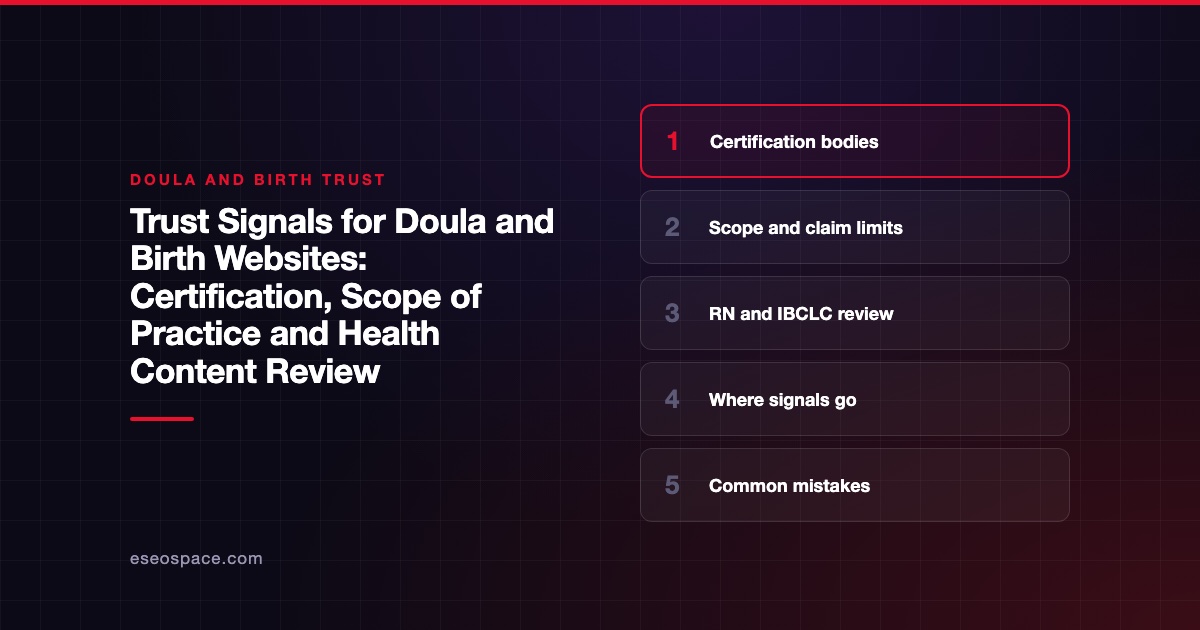
The trust signals that matter most on a doula or birth website are a current, checkable certification and a clear scope of practice statement. Careful claims and qualified review of health content come next. Families are making decisions about pregnancy and birth, so honesty about your role matters. This guide is part of our Trust Signals and E-E-A-T Guide.
Pregnancy content is YMYL (Your Money or Your Life), because it affects health. Google says E-E-A-T (experience, expertise, authoritativeness and trust) isn't a specific ranking factor, but it says its systems give more weight to strong E-E-A-T on health topics.
Doulas have a real advantage: first-hand experience. Google's E-E-A-T concept values it, and our post on experience in health content explains how to use it. The trick is to share experience without drifting into medical advice.
Key Takeaways
- Name your certifying body and exact credential, and only claim what you currently hold.
- DONA's standards say its doulas do not perform clinical tasks and will not diagnose or treat.
- Separate any added services, such as placenta encapsulation or massage, from your doula role.
- Avoid promising birth outcomes, and keep testimonials honest about what clients can expect.
- Have an RN, midwife, physician or IBCLC review health content within their field.
- Never add a "Reviewed by" line unless the named person actually reviewed that page.
The credentials that matter for doulas and birth workers
Doula certification comes from private organizations. Each has its own requirements and letters.
| Credential | Issued by | How families verify it |
|---|---|---|
| CD(DONA), PCD(DONA), AdvCD(DONA), AdvPCD(DONA) | DONA International | Find a DONA certified doula |
| CLD (labor doula), CPD (postpartum doula), CCCE (childbirth educator), CLE (lactation educator) | CAPPA | CAPPA's "Find Care" directory |
| IBCLC (lactation consultant) | IBLCE | IBLCE's "verify an IBCLC" option |
| RN | State nursing board | State license lookup |
| Certified nurse-midwife or licensed midwife | State board, by license type | State license lookup |
| Medi-Cal enrolled doula (California) | California DHCS | Ask your Medi-Cal plan or DHCS |
Other certifying groups exist. List any credential you hold, using the organization's exact name, and link to its directory where one exists.
"Trained" and "certified" are different. If you finished a workshop but not the certification process, say "DONA-trained" only if the organization permits that wording. Otherwise write "completed DONA birth doula workshop, certification in progress." If your certification lapses, update your site that day.
What the rules say about showing them
We did not find a federal rule requiring doulas to display a certificate. Doula rules differ by state and by payer, so check yours. A private certificate is also not the same as a state license, so do not write "licensed" unless a state actually issued you a license.
Scope of practice
Your scope statement may be the strongest trust signal on your site. DONA's published Limits to Practice say its standards and certification apply to emotional, physical and informational support only. The certified or member doula "does not perform clinical or medical tasks," such as taking blood pressure or temperature, fetal heart tone checks or vaginal exams. She or he "will not diagnose or treat in any modality."
The same standards address added services, such as aromatherapy, massage or placenta encapsulation. Doulas must make very clear that these fall outside the doula's scope. A health care provider also may not use the title "doula" while providing services outside that scope. So use separate pages or sections for separate services.
That post dates from 2015. Read the current Standards and Ethics page before you quote it.
California's benefit page uses similar language. DHCS describes doulas as "non-clinical, trained professionals" providing personal support, and says Medi-Cal doula services have been covered since 1 January 2023. Do not say Medicaid covers doulas everywhere. Coverage is state-specific, so name the state and program.
Health claims and testimonials
Avoid promises such as "fewer C-sections" or "a shorter labor" on your own pages. Even when research exists, you cannot promise that result to one family. The FTC's Health Products Compliance Guidance is written for product claims, but its test is useful. Health claims generally need competent and reliable scientific evidence.
Testimonials are powerful and need care. The FTC Endorsement Guides address endorsements that imply results consumers generally will not get. Those need proper substantiation and disclosure. The FTC review rule also bans fake testimonials and buying reviews with a required sentiment.
Good wording describes support, not outcomes:
| Do this | Not this |
|---|---|
| "I offer continuous emotional and physical support during labor." | "I'll help you avoid a C-section." |
| "We'll talk through questions to bring to your provider." | "I'll tell you which interventions to refuse." |
| "Ask your midwife or doctor about this symptom." | "This symptom is nothing to worry about." |
| "Certified CD(DONA) since [year]." | "Licensed birth expert." |
Rules vary by state; confirm with your certifying body or counsel.
Bylines and reviewers for birth content
Who should write. You. Your name, photo and real experience belong on the article. In our audit of 149 sites, 105 of 130 sites with articles had sampled articles credited to the company or to no one. A collective can name the doula who wrote each post.
Who should review. Match reviewers to the topic and their scope:
- RN or labor and delivery nurse: hospital birth, monitoring and postpartum warning signs.
- Certified nurse-midwife or physician: clinical topics such as induction or complications.
- IBCLC: feeding and lactation content.
- Mental health clinician: perinatal mood topics.
What the line should say.
"Written by [name, credential]. Reviewed by [name, RN or IBCLC] for clinical accuracy. Last reviewed [date]."
Never add a "Reviewed by" line unless the named person actually reviewed that page. A friend who is a nurse can be your reviewer only if they truly read and approved it, and agreed to be named. Our guide to hiring a content reviewer covers how to arrange this.
Keep it in your lane. Blog posts about what support looks like, packing a bag or preparing questions may need no clinical reviewer. Posts about symptoms, medication or induction do. When in doubt, send readers to their provider.
Where each signal goes on your site
| Signal | Where on the page | Schema property |
|---|---|---|
| Name, credential, certifying body | Home page, About page, byline | name, hasCredential |
| Directory link | About page, next to the credential | sameAs, hasCredential |
| Scope of practice statement | About and services pages | None; visible text only |
| Added services, labeled separately | Separate service pages | makesOffer |
| Service area and hospitals or birth settings | Services and contact pages | areaServed |
| Reviewer and date | Under the article title | reviewedBy, lastReviewed |
| Medical disclaimer | Health articles, kept short | None; visible text only |
| Medicaid or benefit status | Fees page, with state named | None; visible text only |
Schema describes the page to machines. It does not create trust alone or guarantee a rich result. Our license and credential schema guide has examples. To set up your bio, see About and author pages.
Common mistakes
- Writing "certified" before certification is complete, or after it has lapsed.
- Mixing doula support with herbal, massage or clinical services on one page.
- Promising outcomes such as fewer interventions or a shorter labor.
- Giving advice on symptoms instead of pointing readers to their provider.
- Saying "insurance covers doulas" without naming the state, plan or program.
- Using a nurse's name on articles she or he did not review.
Next step
Start with your About page: add your exact credential, directory link and scope statement. Then check every claim about outcomes. See our doula and birth website services, or get a free 20–30 page website audit within 24 hours.
Frequently asked questions
Do doulas need a license to advertise?
Doula certification is usually from a private organization, and state rules differ. Check your state and any payer program you work with. Do not use the word "licensed" unless a state actually issued you a license.
What should a scope of practice statement say?
Say what you provide, such as emotional, physical and informational support. Then say what you do not do, such as clinical tasks, diagnosis or treatment. Follow your certifying body's standards.
Can I share research on doula benefits?
Yes, if you cite the actual study and describe it accurately. Do not turn a study result into a promise for one family. Add that outcomes vary, and direct medical questions to the family's provider.
Who can review my breastfeeding articles?
An IBCLC is a natural fit, and IBLCE offers a way to verify the credential. Name the reviewer only when that person really reviewed the article. Keep a record of the date.
Can I use client birth stories?
Yes, with written permission and honest details. Leave out private information the family has not agreed to share. Do not use a story to imply that every client will have the same experience.