This article is part of our Trust Signals & E-E-A-T Guide: the bylines, reviewers, license numbers and schema that help Google, AI assistants and customers trust a business website. Want to know where your site stands? Get a free 20–30 page website audit within 24 hours.
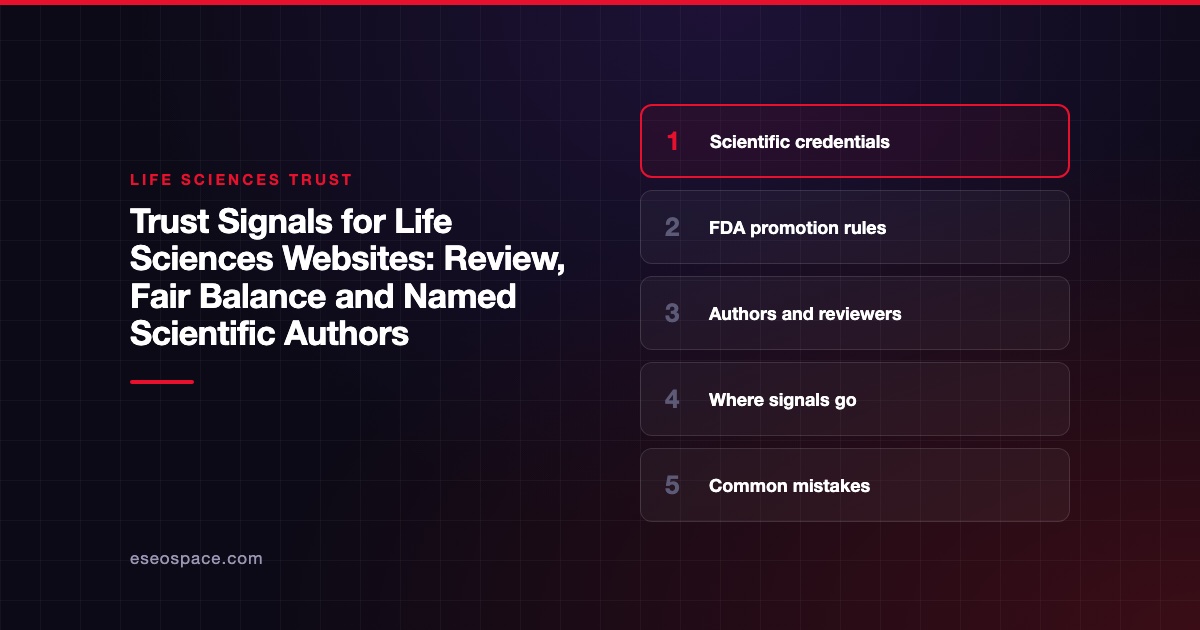
The trust signals that matter most on a life sciences website are documented review, balanced risk information and primary citations. Named scientific authors and clear conflict disclosures complete the list. These pages are YMYL (Your Money or Your Life), meaning errors can affect someone's health. This guide is part of our Trust Signals and E-E-A-T Guide.
Google says E-E-A-T (experience, expertise, authoritativeness and trust) is not a specific ranking factor. The same page says its systems give more weight to strong E-E-A-T on health topics. It also says YMYL content must be highly accurate and consistent with expert consensus.
For a life sciences company, regulators add a second layer. A sentence that reads well to marketing can still be a promotional claim. This article covers website signals, not regulatory advice. Rules depend on your product type, so confirm with your regulatory team or counsel.
Key Takeaways
- Prescription drug promotion must not be false or misleading, and it must balance efficacy and risk information.
- Investigational products cannot be promoted as safe or effective for the use under study.
- A device cleared through 510(k) is not "FDA approved," and implying official approval is misbranding under federal rules.
- Named scientific authors, with disclosed financial relationships, tell readers who stands behind the science.
- Never add a "Reviewed by" line unless the named person actually reviewed that page.
- Keep a sign-off record for every page so the visible review line matches what really happened.
The credentials that matter in life sciences
Life sciences readers look for evidence of who did the science. Show each person's real degree and role, then link to something they can check.
| Credential or record | Who it applies to | How readers verify it |
|---|---|---|
| Medical license | Physician authors and medical reviewers | The state medical board's license search |
| ABMS board certification | Physicians with a member board certificate | Certification Matters, run by the American Board of Medical Specialties |
| NPI | US health care providers | NPI Registry, which warns that an NPI does not validate a license or credential |
| ORCID iD | Researchers and scientific authors | ORCID, which identifies researchers and connects them to their contributions |
| Industry payments | Physicians and other covered recipients | CMS Open Payments, a public database of payments from drug and device companies |
An NPI is an identifier, not a qualification. Do not present it as proof of expertise. A PhD or PharmD is not a license to practice medicine. Describe each person's actual role, such as "Vice President, Clinical Development."
What the rules say about showing them
No FDA rule we opened tells a company to publish an author bio. The rules below limit what the page can say, and those limits shape your trust signals.
Prescription drugs: fair balance
FDA's Bad Ad Program page says prescription drug promotion must not be false or misleading. It must balance efficacy and risk information and reveal material facts. The same page says this covers internet promotion, including social media, made by or on behalf of the manufacturer, packer or distributor.
The advertising regulation, 21 CFR 202.1, defines the test. An ad fails if effectiveness is shown in greater scope, depth or detail than risk information without a fair balance. A correct statement elsewhere does not fix a misleading part or theme.
In practice, that affects page design:
- Keep risk information near benefit claims, not only behind a link.
- Give risk text a readable size and contrast.
- Check that charts and headlines do not overstate what the study showed.
- Apply the same review to blog posts, landing pages and social captions.
FDA also lists common issues, including omitted risk, overstated benefit, misrepresented study data and misleading comparisons. Use that list as a website review checklist.
FDA attention rose recently. In September 2025, FDA announced letters to drug companies and rulemaking on the "adequate provision" standard for broadcast ads. Check the current status with counsel, as of November 2026.
Investigational products
21 CFR 312.7 limits how sponsors, and anyone acting for them, describe an investigational drug. In a promotional context, they must not represent it as safe or effective for the use under study. The rule does not restrict the full exchange of scientific information. Keep pipeline pages factual and separate them from sales language.
Devices and other health products
The word "approved" has a narrow meaning for devices. 21 CFR 807.97 says implying official approval because of a premarket notification is misleading and constitutes misbranding. If your device was cleared, write "cleared."
For other health-related products, the FTC's Health Products Compliance Guidance says health benefit and safety claims generally need competent and reliable scientific evidence. Our related posts cover device compliance design in more detail.
Bylines and reviewers for life sciences content
Many companies route content through medical, legal and regulatory review, often called MLR. It is a company process, not a badge. Readers cannot see it unless you show the results.
Who should write. Use a named scientist, clinician or medical writer with real knowledge of the topic. A "Marketing Team" byline tells the reader nothing. In our 149-site audit, 105 of 130 sites with articles had sampled articles credited to the company or to no one.
Who should review. Match the reviewer to the claim. A physician may review clinical content. A statistician may check data descriptions. Regulatory and legal staff review promotional risk, though they do not need a public byline.
What the line should say. Write something like: "Reviewed by [full name, degree], [title]. Last reviewed [date]." Then link to a profile with their experience. See what "reviewed by" means for wording. Never add a "Reviewed by" line unless the named person actually reviewed that page.
How to disclose conflicts. The ICMJE recommendations say perceived conflicts can erode trust as much as actual ones. They name employment, consultancies, stock ownership, honoraria, patents and paid expert testimony as the most easily identified financial relationships. A short line works well: "Dr. Example is an employee of [Company] and holds company stock."
How often to review. Set a schedule based on risk, and also trigger a review when labeling, safety information or a cited study changes. Record the date, the reviewer and the page version. Our guide to research files for YMYL content shows how to store sources.
Citations. Link claims to the primary study, label or regulation, not to a press release. Show the source close to the claim, so a reader or an AI assistant can match them.
Where each signal goes on your site
| Signal | Where on the page | Schema property |
|---|---|---|
| Author name and degree | Byline, linked to profile | author (Person) |
| Medical or scientific reviewer | Below the byline | reviewedBy on WebPage |
| Last reviewed date | Next to the reviewer | lastReviewed on WebPage |
| Risk information | Close to benefit claims | None; visible text only |
| Citations | Inline and in a references list | citation |
| Conflict disclosure | End of article and author profile | None; visible text only |
| Review process | Editorial policy page, linked in footer | publishingPrinciples |
| Regulatory status wording | Product page, near the claim | None; visible text only |
reviewedBy and lastReviewed are schema.org properties, which describe a page to machines. They do not prove review, and they do not guarantee a rich result. Our author and reviewer schema guide has code examples.
Common mistakes
- Writing "FDA approved" for a product that was cleared through 510(k).
- Describing a pipeline candidate as safe or effective in marketing copy.
- Putting all risk information on a separate page or in small, low-contrast text.
- Crediting scientific articles to the company with no named person.
- Listing a medical advisor as a reviewer when that person never saw the page.
- Publishing an author bio that leaves out employment or stock ownership.
Next step
Start with your highest-risk pages: product, pipeline and clinical articles. Add named authors, review lines and disclosures, then record each sign-off. Learn how to find a qualified reviewer, see our life sciences marketing services, and get a free 20–30 page website audit within 24 hours.
Frequently asked questions
Do FDA fair balance rules apply to our blog?
They can. FDA says prescription drug promotion by or for the manufacturer, packer or distributor includes internet promotion. Whether a given post is promotional depends on its content and context, so have regulatory staff or counsel check it.
Can we say a device is "FDA approved"?
Only if FDA actually approved it, for example through premarket approval. A device cleared through 510(k) is cleared, not approved. Federal rules treat an impression of official approval from a 510(k) as misleading.
Should every article name a reviewer?
Name a reviewer on health and scientific content where review really took place. Skip the line where no qualified person checked the page. A false review line damages trust more than a missing one.
Does reviewedBy schema help us rank?
Google does not describe reviewedBy as a direct ranking signal. It is a way to describe the page in structured form. Its value depends on matching a real, visible review line.
What should a conflict disclosure include?
State the person's employer and any relevant financial ties, such as consulting fees, stock or patents. The ICMJE guidance names those examples. Keep it short, specific and close to the content.