This article is part of our Trust Signals & E-E-A-T Guide: the bylines, reviewers, license numbers and schema that help Google, AI assistants and customers trust a business website. Want to know where your site stands? Get a free 20–30 page website audit within 24 hours.
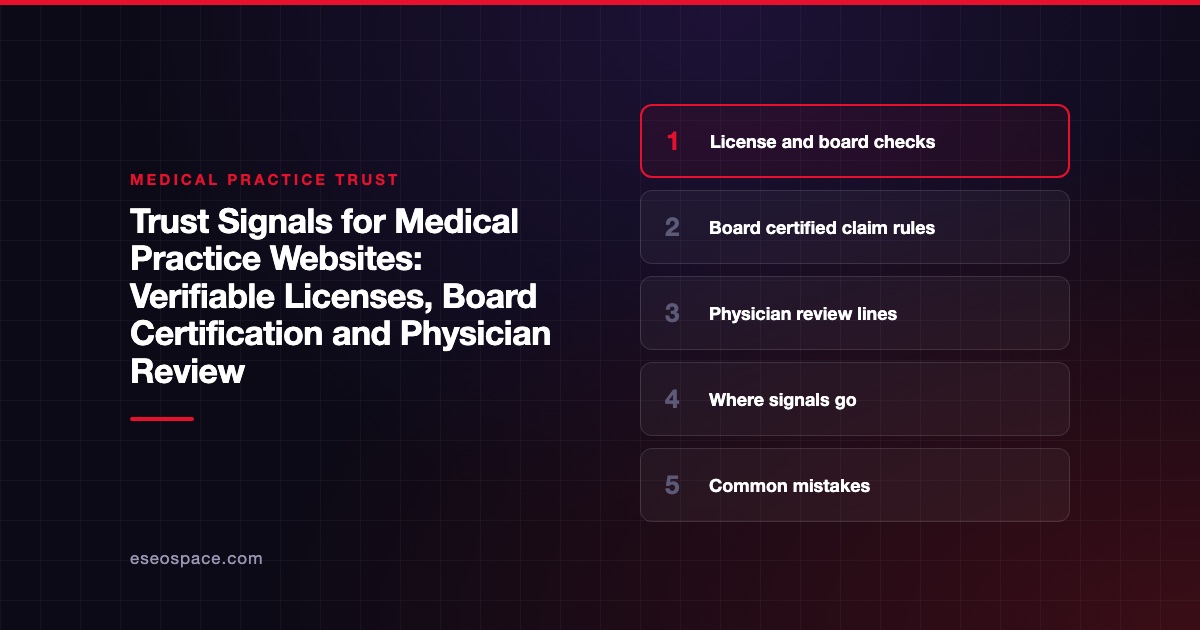
The trust signals that matter most on a medical practice website are verifiable licenses and accurately worded board certification. Named clinical reviewers and a visible review date come next. Patients can check most of these in minutes. This guide is part of our Trust Signals and E-E-A-T Guide.
Medical content is YMYL (Your Money or Your Life) because it can affect a person's health. Google says E-E-A-T (experience, expertise, authoritativeness and trust) isn't a specific ranking factor, yet its systems give more weight to strong E-E-A-T on health topics. It also asks whether content has a byline and whether that byline leads to more information about the author.
Our existing guide covers E-E-A-T for healthcare websites in general. This one focuses on proof: what can be verified, where to link it, and how claims should be worded.
Key Takeaways
- Link each clinician to the public license lookup run by their state board.
- Check board certification on Certification Matters before you publish the claim.
- An NPI identifies a provider, but it does not prove a license or credential.
- State rules can limit the words "board certified," so check yours before you use them.
- Never add a "Reviewed by" line unless the named person actually reviewed that page.
- Use each clinician's correct title, and never describe a nurse practitioner or physician assistant as a physician.
The credentials that matter in medical practices
Different records answer different questions. Show patients the record that matches the claim.
| Credential | What it tells a patient | Where to verify it |
|---|---|---|
| State medical license | The physician is licensed in that state | Your state board, such as the Medical Board of California license verification |
| ABMS board certification | Certification by a member board in a specialty | Certification Matters, from the American Board of Medical Specialties |
| NPI | A unique 10-digit provider identifier | NPI Registry |
| Member board details | Which boards and specialties exist | ABMS member boards |
| Nurse practitioner or RN license | The nurse's own state license | Your state nursing board |
| Physician assistant license | The PA's own state license | Your state's PA licensing authority |
ABMS says its 24 member boards certify in 38 specialties and 90 subspecialties. That list helps you name the certifying board correctly.
Be careful with the NPI. The registry says issuing an NPI "does not ensure or validate that the Health Care Provider is Licensed or Credentialed." You can list it for referring offices and payers. Do not present it as a qualification.
What the rules say about showing them
We did not find a general federal rule requiring a practice to print license numbers on its website. Some states have their own rules on advertising and titles, so check with your board.
California shows how specific these rules can be. Business and Professions Code section 651 covers public communications by healing arts licensees, and it names the internet. For example:
- "Board certified" (physicians). A physician may claim certification only from certain boards. These are ABMS member boards, boards with equivalent requirements approved before 1 January 2019, and boards with an ACGME-approved postgraduate training program in that specialty.
- Full board name. Where a physician uses "board certified," the full name of the certifying board must appear with comparable prominence. "Board Certified in Dermatology" alone falls short in California; name the board.
- Superiority claims. A claim of professional superiority needs to be relevant to the service and substantiated with objective scientific evidence.
- Scientific claims. These must be supported by reliable, peer-reviewed, published studies.
- Testimonials. A statement, endorsement or testimonial is covered if it misleads by leaving out material facts.
- Before and after images. The section requires naming the procedures performed, comparable presentation and a statement that the same results may not occur for all patients.
That is one state's law. Rules vary by state, so confirm yours with your licensing board or counsel.
Reviews have a federal layer too. The FTC rule on consumer reviews and testimonials, in effect since 21 October 2024, covers fake reviews, buying positive or negative reviews, insider reviews, and review suppression. Our reviews and testimonials guide explains how to apply it.
Bylines and reviewers for medical practice content
Patient education is often drafted by someone other than a physician. That is fine, provided the page says who did what.
Who should write. A clinician, or a health writer working from a clinician's input. In our audit of 149 sites, 105 of 130 sites with articles had sampled articles credited to the company or to no one.
Who should review. Choose a clinician whose training fits the topic. A cardiologist reviews a cardiology article, not a dermatology one. A nurse practitioner can be a suitable reviewer within their field. The line must then say "nurse practitioner," not "doctor" or "physician." In the audit, 40 of 50 health, legal and financial sites with articles showed no "Reviewed by" on any sampled article.
What the line should say.
"Medically reviewed by [full name, MD or DO], [specialty]. Last reviewed [date]."
Link the name to a profile with the license lookup and certifying board. Never add a "Reviewed by" line unless the named person actually reviewed that page. Keep a record of who reviewed which version and when.
How often. Set a cadence by risk, such as yearly for most condition pages. Review sooner when a guideline, drug label or practice service changes. Only change the date when someone truly rechecks the page.
Policy page. In the audit, 55 of 57 health, legal and financial sites had no editorial or review policy page. Explain your process publicly with our editorial policy template. For how privacy rules affect health content, see HIPAA, health content and E-E-A-T.
Where each signal goes on your site
| Signal | Where on the page | Schema property |
|---|---|---|
| Clinician name and title | Provider profile, byline | name, jobTitle |
| License number and state | Provider profile, with lookup link | hasCredential, identifier |
| Board certification and full board name | Provider profile, near the name | hasCredential |
| NPI | Provider profile | identifier |
| Specialty | Provider and service pages | medicalSpecialty |
| Reviewer line and date | Under the article title | reviewedBy, lastReviewed |
| Editorial policy | Footer and article pages | publishingPrinciples |
| Practice address and phone | Footer and contact page | address, telephone |
Schema.org defines reviewedBy as the people or organizations that checked a page for accuracy or completeness, and hasCredential as a credential awarded to a person or organization. Schema must match visible text, and it does not guarantee a rich result. Our license and credential schema guide has examples.
Put the proof in plain HTML text. Credentials shown only inside an image are harder for crawlers and screen readers to use. List the same details for every person on your provider roster.
Common mistakes
- Writing "board certified" without naming the board.
- Using a certificate from a course or society as if it were board certification.
- Calling all clinicians "our doctors" when the team includes nurse practitioners or physician assistants.
- Presenting an NPI as proof of a license.
- Adding a physician's name to articles they never read.
- Leaving a departed clinician on the site or on old review lines.
Next step
Open each provider profile and check every claim against the lookup pages above. Fix wording, add links, then add reviewer lines where review really happened. See our medical practice website services, or get a free 20–30 page website audit within 24 hours.
Frequently asked questions
Do we have to show a license number on our website?
It depends on your state and license type. We did not find a general federal requirement. Showing the number with a lookup link is a simple way to let patients verify it, so check your board's rule and consider adding it either way.
What is the difference between a license and board certification?
A state license is permission to practice in that state. Board certification is a separate credential in a specialty. ABMS member board certification can be checked on Certification Matters.
Is an NPI number a trust signal?
It is an identifier that helps people confirm they found the right provider. The NPI Registry itself warns that it does not validate a license or credential. List it if useful, but do not describe it as a qualification.
Can a nurse practitioner review our medical articles?
Yes, if the topic fits that person's training and they really review the page. Use the title "nurse practitioner" and include the correct credential. Do not call them a physician or write "medically reviewed by a doctor."
How often should we update the review date?
Update it only when a qualified person rechecks the page. Set a regular schedule by topic risk, and recheck sooner when guidelines or services change. Changing a date without a review is misleading.