

This article is part of our AI Agents for Business hub. Want help applying it? Talk to eSEOspace.
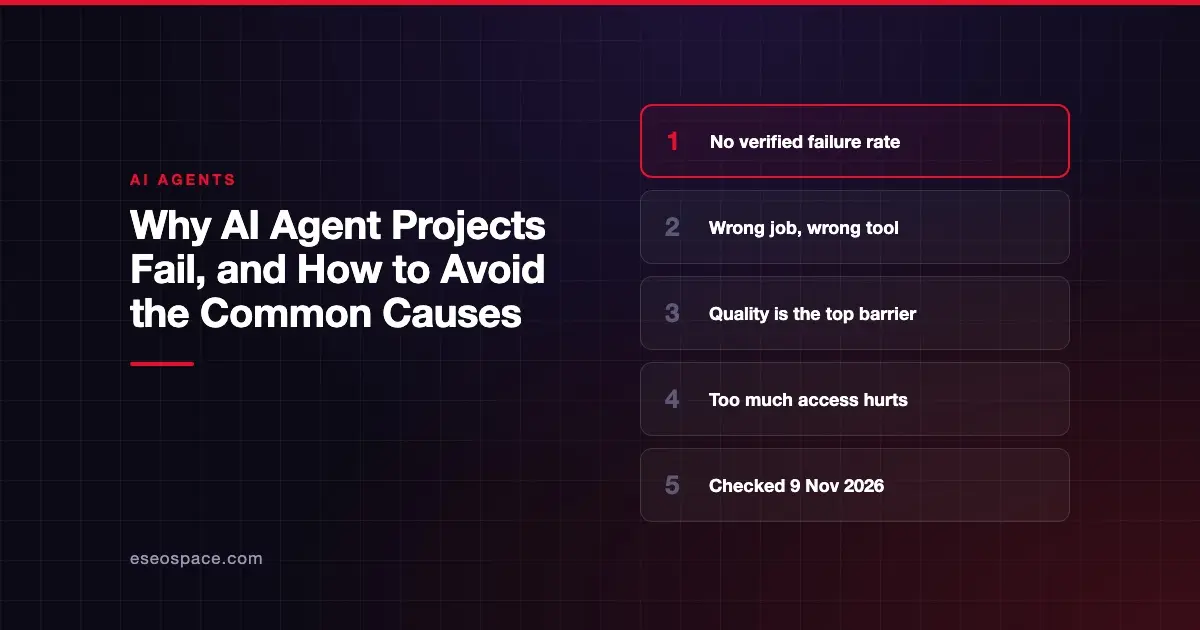
Common causes of AI agent project failure include picking the wrong job for an agent, not measuring quality, and giving the agent too much access. We found no verified field failure rate for AI agent projects in business, so be careful with anyone who gives you a percentage.
This guide is part of our AI agents for business hub. It sticks to causes we can support with sources we opened on 9 November 2026.
Key Takeaways
- We found no verified field failure rate for AI agent projects, and lab benchmarks are not failure rates.
- In one vendor survey of agent builders, quality was the top barrier to production.
- Anthropic says agents bring higher costs and the potential for compounding errors.
- OWASP's 2026 incident roundup shows exposed credentials and excess permissions widening the damage.
- The fixes are ordinary: a narrow job, tests from real cases, limited access and a named owner.
The number you will not see here
Percentages about failed AI projects get repeated widely in sales decks and articles. We tried to check the commonly quoted ones against primary sources, and we could not verify them. We will not repeat them.
Lab benchmarks do not fill the gap. A benchmark tells you how agents did on a defined test, and it says nothing about how many business projects were abandoned. Our guide on how often agents make mistakes covers what those tests do show.
So treat this article as a list of known causes, not a statistic. If a vendor quotes a failure rate, ask for the original study and its method.
Cause 1: The job did not need an agent
The first failure happens before anyone writes code. Anthropic, which sells AI models, says in its engineering guide: "When building applications with LLMs, we recommend finding the simplest solution possible, and only increasing complexity when needed."
If the steps never change, a plain automation will be cheaper and easier to run. Our guide on whether you need an agent at all gives you a quick test.
Fix: Start with one narrow job, and be willing to conclude that a simpler tool will do.
Cause 2: Nobody measured quality
In LangChain's State of Agent Engineering survey, quality was the top barrier. It says: "Quality remains the biggest barrier to production, consistent with last year's findings."
LangChain says that one third of respondents cited quality as their primary blocker. The same report's summary gives 32%. It describes quality as accuracy, relevance, consistency and the ability to hold the right tone and follow policy.
LangChain sells agent tools, and its 1,340 respondents are self-selected builders. It tells you what builders report, not what happens at a typical small business.
Fix: Build a small test set before launch. AI agent evals explains how to start with real cases.
Cause 3: Small errors compound
A chatbot that gets one answer wrong gives you one wrong answer. An agent can use a wrong result as the basis for its next step.
Anthropic says: "The autonomous nature of agents means higher costs, and the potential for compounding errors." It also says: "We recommend extensive testing in sandboxed environments, along with the appropriate guardrails."
Fix: Test away from live data, and put checks between steps on any job that changes records.
Cause 4: Too much access
Access decides how bad a mistake or an attack can get. OWASP's Q3 2026 exploit roundup says: "Exposed credentials and excessive permissions expanded the damage from individual workloads into connected systems."
The same roundup says: "Prompt-level instructions alone do not establish a secure boundary." Telling an agent "never do X" is a request, not a control.
Fix: OWASP's AI Agent Security Cheat Sheet says: "Grant agents the minimum tools required for their specific task." It also says: "Require explicit approval for high-impact or irreversible actions."
Cause 5: Nobody can see what happened
When an agent does something strange, you need to know why. OWASP's guidance says: "Log all agent decisions, tool calls, and outcomes."
Without that record, a problem turns into guesswork. Our guide to agent observability covers what to capture.
Fix: Turn on step-level logging from day one, and name who reads it.
Cause 6: The cost surprised someone
Agent costs depend on how much the agent does, and that is hard to predict. Microsoft's Copilot Studio billing page gives an illustrative example on its standard harness.
In it, one follow-up message from a customer used 141 Copilot Credits for reasoning, on top of feature rates. A plain generative answer is listed at 2 credits. Microsoft says the numbers are illustrative and that token counts depend on your agent.
The same page says enforcement begins at 125% of prepaid capacity. It adds: "A blocked agent stops responding, including in a conversation that's already in progress." Environments that bill overage to a pay-as-you-go plan are not blocked for running out of prepaid credits, and users with a Microsoft 365 Copilot license might not be blocked.
Fix: Set a budget, measure cost per task during testing and agree on what happens when the budget runs out.
Cause 7: The platform changed underneath you
Vendors retire products. OpenAI's deprecations page says: "Agent Builder is scheduled to shut down." It lists 30 November 2026 as the date, after a notice on 3 June 2026.
Anything built on a closed tool needs a plan for moving. We cover this one in our Agent Builder article.
Fix: Keep your prompts, test cases and process notes in files you own.
Cause 8: No one owns it after launch
Agents need upkeep. Models change, connected apps change and new kinds of requests show up.
This cause is our own observation from how software runs in general, and we have no statistic for it. But the risk is plain: nobody is watching a system that acts on your behalf.
Fix: Name one person who owns the agent's results, its budget and the decision to pause it.
A pre-launch checklist
| Question | If the answer is no |
|---|---|
| Can you name the single job it does? | Narrow the scope |
| Have you ruled out a simpler tool? | Try the simpler tool first |
| Do you have test cases from real work? | Build them before launch |
| Does it have only the access it needs? | Remove the extra access |
| Do risky actions need a person's approval? | Add human approval |
| Can you see each step of each run? | Turn on logging |
| Is there a budget limit? | Set one |
| Is one person responsible? | Name that person |
Next step
Score your project against the checklist, and fix every "no" before you add more features. If an agent you already run is unreliable or too expensive, you can talk to us through our AI agent development service.
Frequently asked questions
What percentage of AI agent projects fail?
No verified field failure rate exists that we could open and check. Percentages that circulate widely could not be confirmed against a primary source, and lab benchmarks measure something else. Ask for the method behind any number you are given.
What is the biggest reason AI agents fail?
In LangChain's survey of agent builders, quality was the biggest barrier to production. That survey covers a self-selected group, so read it as what builders report. Choosing the wrong job for an agent is also a common cause in our view.
Are failed agent projects a sign that AI does not work?
Not on their own. An agent can fail because of scope, data, access or ownership. Those are project problems, and they can be addressed separately from the question of what the model can do.
How do I know if my agent project is failing?
Look for rising correction work, staff bypassing the agent and costs nobody can explain. If you cannot tell whether it is working, you are missing measurement. That is a problem in itself.
Can a failing agent be fixed?
Often the scope can be narrowed and the access reduced. Sometimes the honest answer is to replace it with a simpler automation. Test the fix against real cases before you relaunch.









