This article is part of our AI Agents for Business hub. Want help applying it? Talk to eSEOspace.
You need an AI agent only when the steps of a job change from case to case and cannot be written down in advance. If the steps are the same each time, a plain automation is simpler and more predictable.
That is good news for a smaller budget. This guide is part of our AI agents for business hub. It gives you a short test, and it was checked against Anthropic, OWASP and Zapier documentation on 9 November 2026.
Key Takeaways
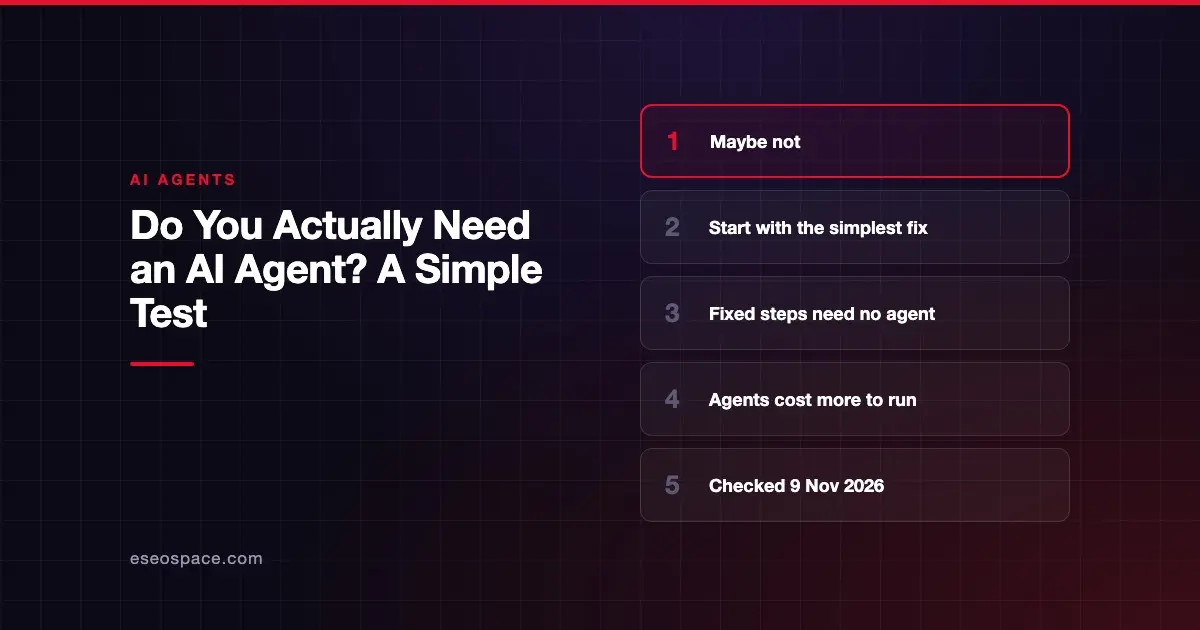
- Anthropic, which sells AI models, recommends the simplest solution possible and says this might mean no agent at all.
- There are four options to consider: a process fix, a plain automation, one AI step, or an agent.
- An agent suits open-ended work where the number of steps cannot be predicted.
- Agents bring higher costs and the potential for compounding errors.
- If the job can cause real harm, a person should approve the action, whichever tool you choose.
Four options before you buy
The word "agent" gets used for almost anything with AI in it. Here is a clearer ladder, starting from the simplest. The ladder is our own framing.
| Option | What it is | Good for |
|---|---|---|
| 1. Fix the process | Remove the step, or change the form | Work that should not exist |
| 2. Plain automation | Fixed rules that move data between apps | The same steps every time |
| 3. One AI step | A fixed process with AI doing one part | Reading messy text, then following rules |
| 4. An agent | AI chooses its steps and tools | Open-ended jobs with varied paths |
Anthropic's engineering guide makes the same argument. It says: "When building applications with LLMs, we recommend finding the simplest solution possible, and only increasing complexity when needed." The next sentence reads: "This might mean not building agentic systems at all."
A five-question test
Answer these for one specific job. Do not answer for your business in general.
- Could you write the steps on one page? If yes, you likely want an automation.
- Does the input arrive in a fixed format? If yes, rules will probably handle it.
- Does the path change based on what it finds? If yes, an agent may help.
- Is a wrong answer cheap to fix? If no, keep a person in the loop.
- Is the job frequent enough to justify setup? If no, leave it manual for now.
An agent makes sense when question 3 is a yes and question 1 is a no. The test is our own, but it follows Anthropic's definition.
What makes a job right for an agent
Anthropic says: "Agents can be used for open-ended problems where it's difficult or impossible to predict the required number of steps, and where you can't hardcode a fixed path." It adds a warning: "The LLM will potentially operate for many turns, and you must have some level of trust in its decision-making."
For a real business, that could be researching a problem across several systems, then preparing a recommendation. The path depends on what the agent finds.
Sending a thank-you email after every order is not that kind of job. It is a trigger and an action.
Why plain automation may be enough
Tools like Zapier show how simple this can be. Zapier's help center says: "A Zap is an automated workflow that connects your apps and services together." It also says: "A trigger is an event that starts a Zap."
A workflow like that does the same thing each time. It is easy to test, and it is easy to explain to your team.
Agents are metered differently, too. Zapier says of its agents: "An activity is any billable action that your agent takes."
Zapier's usage article counts each trigger, knowledge lookup, action run, web search and page browse as one activity. A single agent run can use several of them.
What an agent costs you beyond the price
Anthropic says: "Agentic systems often trade latency and cost for better task performance, and you should consider when this tradeoff makes sense."
It also says: "The autonomous nature of agents means higher costs, and the potential for compounding errors." A compounding error is one wrong step that the next steps build on.
Budget for the extra work as well. Someone must test the agent, watch what it does and own it after launch.
How much access is too much?
If you do use an agent, give it less than you first think it needs. OWASP's entry on Excessive Agency names three root causes: excessive functionality, excessive permissions and excessive autonomy.
It also gives a direct instruction: "Utilise human-in-the-loop control to require a human to approve high-impact actions before they are taken." Our guide on human-in-the-loop agents covers how to set that up.
Signs you probably do not need one
- A vendor can't name the specific job the agent will do.
- The problem is a messy process, not a lack of software.
- You have no one to review the output.
- The job happens a few times a month.
- The steps are the same every time.
Signs an agent may be worth testing
- The work involves reading varied text, then deciding what to do next.
- Your staff follow judgment, not a checklist, and the judgment is teachable.
- Mistakes are easy to catch and cheap to reverse.
- You can name a person who will own it.
- You have real past examples to test it on.
If you are leaning toward yes, compare building or buying next. Our AI readiness checklist can help you check the groundwork.
Next step
Pick one job and run the five questions on it, with the person who does the work today. If the answer points to an agent and you want it built, see our AI agent development service. If it points to a simple fix, make that fix first.
Frequently asked questions
What is the difference between an automation and an AI agent?
An automation follows steps set in advance. An agent chooses its own steps toward a goal. Anthropic's definition turns on whether the path is fixed in code or directed by the model.
Is an AI agent worth it for a small business?
It can be, for a job that varies and happens often enough. For fixed jobs, a plain automation does the work with less cost and less risk. Judge one job at a time.
Can I start with an automation and add AI later?
Yes, and it is a sensible path. Start with fixed rules, then add one AI step where the rules keep failing. Move to an agent only if the single step is not enough.
What if my vendor says I need an agent?
Ask what it would do that a fixed workflow cannot. Ask how they tested it, what it costs per task and what happens when it is wrong. A clear answer is a good sign.
How can I tell if a product is a real agent?
Ask whether the model picks its next step or whether the steps are fixed in advance. Some products sold as agents may run a fixed workflow, and that may be fine for your job.