This article is part of our AI Agents for Business hub. Want help applying it? Talk to eSEOspace.
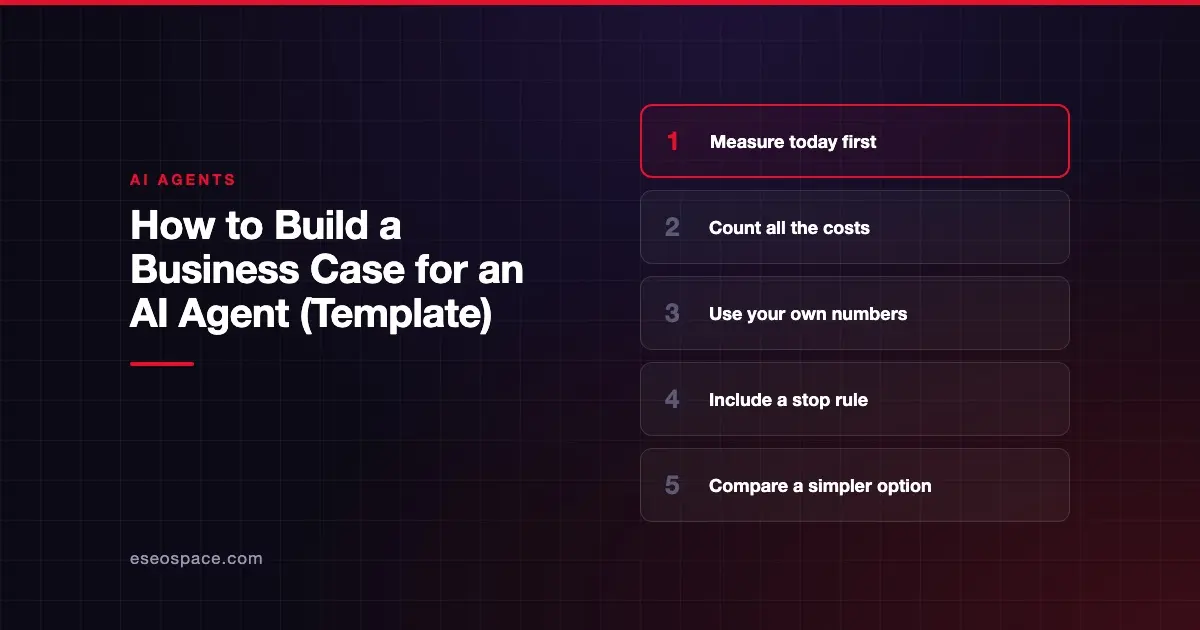
Build a business case for an AI agent by measuring the job as it runs today and counting all the costs. Estimate benefits from your own pilot data, compare the agent against a simpler option, and state what would make you stop. Showing the assumptions lets partners and boards test the case for themselves.
This template is part of our AI agents for business hub and was checked against primary sources on 9 November 2026. It is a planning template, not financial advice. We publish no ROI figure for AI agents, because we have found no verified one that would apply to your business.
Key Takeaways
- Your own baseline and pilot results are the only credible source for the numbers.
- Public surveys cover AI use in general and are self-reported, so they do not predict an agent's return.
- Count review time, testing, monitoring and migration as costs from the start.
- Always compare the agent with a simpler option and with doing nothing.
- Include a stop rule, so that approval is also approval to end it.
What the public numbers can and can't tell you
You will be tempted to quote a statistic. Be careful about what these actually measure.
| Source | What it found | What it does not show |
|---|---|---|
| US Census Bureau, March 2026 survey | "A quarter said AI saved them less than an hour and 31% said AI saved them one to two hours." | That is self-reported time from AI users in general, not agents |
| Same Census page | "Some (10%) said AI didn't save any time and 4% reported using AI required additional time to complete their work." | Why, or for what kind of task |
| NBER Working Paper 34836, revised October 2026 | Executives reported that AI raised annual labor productivity growth by 0.2% over the last 3 years | Agents specifically, or what your company can expect |
These figures help you set expectations, and they are useful in a board discussion. They should not go into your forecast as an expected return.
Claims that some percentage of AI projects fail are also widely repeated. We could not verify the ones we looked into, so we do not cite them.
The template
1. The problem
Describe the job in one paragraph, including who does it now and why it matters.
2. Today's baseline
Measure this before you buy anything.
| Measure | Your number |
|---|---|
| Monthly volume | |
| Minutes per task | |
| Loaded cost per hour of the staff who do it | |
| Error rate | |
| Cost per error | |
| Response or cycle time |
3. The options
Include at least three.
| Option | Description |
|---|---|
| A. Do nothing | The cost of the status quo |
| B. Simplest fix | A form, template, script or fixed workflow |
| C. AI agent | What it would do, and what it would not |
Anthropic's guide to building agents says: "When building applications with LLMs, we recommend finding the simplest solution possible, and only increasing complexity when needed." It also says: "The autonomous nature of agents means higher costs, and the potential for compounding errors." Anthropic sells AI models, so this is a vendor's own caution.
4. Full costs
Vendor prices change, so date every one. See the hidden costs guide for what people miss.
| Cost | Year one | Each later year |
|---|---|---|
| Build or setup | ||
| Licenses, seats and platform fees | ||
| Usage: tokens, credits, outcomes | ||
| Testing and monitoring tools | ||
| Staff time reviewing the agent's work | ||
| Staff time maintaining it | ||
| Security and legal review | ||
| Training | ||
| Migration reserve |
Our AI agent pricing guide and cost per task guide explain how usage is billed.
5. Benefits, in three scenarios
Take the numbers from your pilot and show low, expected and high. Include the benefits you cannot price in a separate list, such as faster responses. Do not assign them a dollar value unless you have a basis for it.
6. Risks and controls
| Risk | What could happen | Control | Owner |
|---|---|---|---|
| Wrong action | A customer is harmed | Approval for high-impact steps | |
| Data exposure | Private data leaks | Least privilege, log review | |
| Cost overrun | Usage exceeds budget | Quotas and alerts | |
| Vendor change | Product is withdrawn | Export rights, migration reserve | |
| Staff workaround | People stop reviewing | Sampling and spot checks |
OWASP's Unbounded Consumption entry describes how usage-based pricing can be abused and recommends rate limits and quotas. OpenAI's deprecations page shows vendor risk in practice, with Agent Builder scheduled to shut down on 30 November 2026.
7. Decision gates
Ask for approval in stages, tied to the pilot plan.
| Gate | Spend released | Pass condition |
|---|---|---|
| Pilot | Small fixed budget | Test set passes |
| Limited live | Next tranche | Rejection rate at target |
| Full rollout | Remainder | Benefit shown against baseline |
8. Stop rule
Write down what ends the project. For example, a cost per completed task above an agreed amount, or an unresolved privacy incident.
A worked example (hypothetical arithmetic)
Every number below is invented to show the math. None is a benchmark, an estimate of typical results, or a promise. Replace all of them with your own.
Assume a support team handles 2,000 routine requests a month, at 6 minutes each, at a loaded staff cost of $30 an hour.
- Current labor: 2,000 x 6 minutes = 12,000 minutes, or 200 hours.
- Current monthly cost: 200 x $30 = $6,000.
Assume the agent could fully complete 40% of those requests, with the other 60% staying with staff.
- Requests completed by the agent: 800.
- Labor released: 800 x 6 minutes = 80 hours, or $2,400.
Now take off the costs that are easy to forget.
| Monthly item (invented) | Amount |
|---|---|
| Labor released, gross | $2,400 |
| Usage: 800 x an assumed $1.00 per task | -$800 |
| Review: 10% of 800 tasks x 6 minutes = 8 hours at $30 | -$240 |
| Monitoring and upkeep, assumed flat | -$500 |
| Correcting errors, assumed | -$200 |
| Net monthly benefit (hypothetical) | $660 |
With an assumed $20,000 setup, simple payback would be $20,000 divided by $660, or about 30 months.
Now change one assumption. If the agent completes only 25% of requests:
- Requests completed: 500, and labor released: 50 hours, or $1,500.
- Usage: $500. Review: 5 hours, or $150. Upkeep stays at $500. Errors, assumed at $125.
- Net monthly benefit: $225, and payback stretches to about 89 months.
The arithmetic shows why a single point estimate misleads. In this invented case, a modest change in completion rate reduces the monthly benefit by about two-thirds.
Also note the word "released." Saved minutes only become savings if that time is redeployed or you hire less. NBER's executives reported essentially no net effect on employment from AI over three years, which is a reminder not to assume headcount savings.
Then run the same math for option B, the simpler fix. It may win.
How to present it
Keep it to one page plus the assumptions table. Lead with the problem and the ask, then show the three scenarios side by side and name the risks plainly.
Ask for the pilot, not the whole project. That is an easier decision, and it produces the numbers you were missing.
Next step
Measure your baseline for two weeks before writing anything else. If you want a fixed-scope quote to drop into the cost table, talk to our AI agent development team.
Frequently asked questions
What ROI should I expect from an AI agent?
We can't give you a figure, and we would be wary of anyone who does without seeing your job. Use your baseline and pilot data to calculate your own.
Can I cite industry statistics in my business case?
You can, if you say what they measure. Census figures on time saved are self-reported AI use in general. They are context and do not forecast your return.
Should I count time saved as money saved?
Only if the time is actually redeployed or a planned hire is avoided. Otherwise, report it separately as capacity gained.
What if the simpler option wins?
Then you've saved money, and the exercise worked. Anthropic's own guide recommends the simplest solution that meets the need.
How long should the payback period be?
That is for your partners or board to decide, based on your cost of capital. Agents can change quickly, so be cautious about any payback period that runs for years.