This profile is part of our MCP server directory, within The MCP Guide. Profiles are checked against each vendor's own documentation. Need a server built? See MCP development.

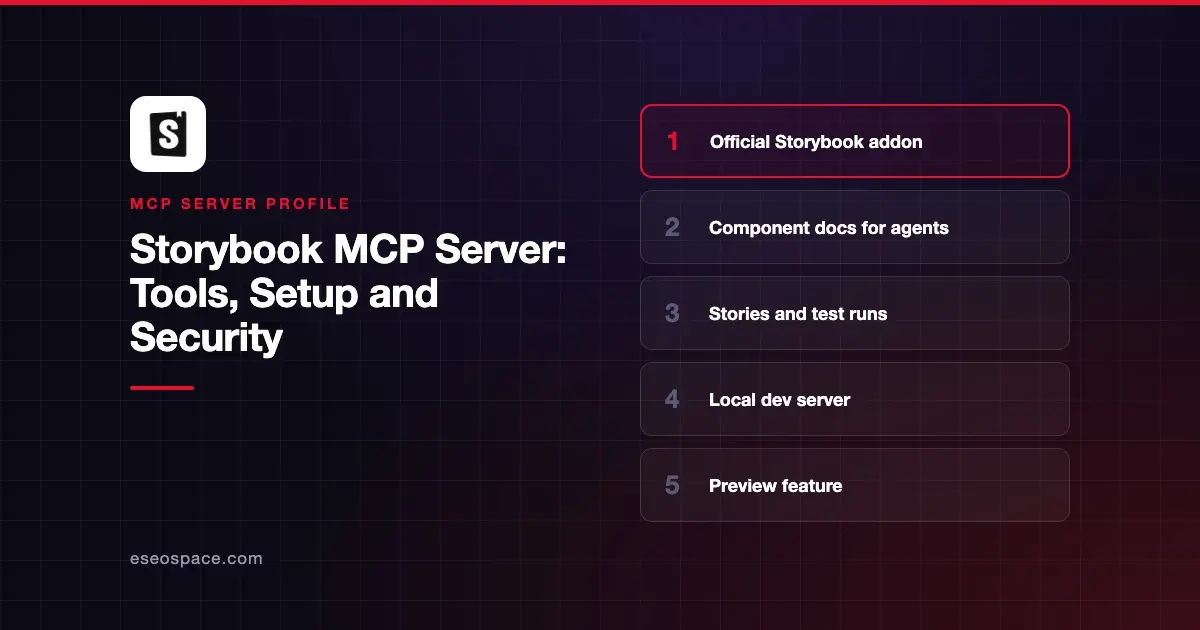
The Storybook MCP server connects your Storybook to coding agents, so they can look up your components, write stories and run tests. It runs inside your local Storybook dev server through the @storybook/addon-mcp addon, at http://localhost:6006/mcp by default.
Checked against: Storybook's MCP server docs (version 10.6) on 2 November 2026. eSEOspace did not install or test this server.
Key Takeaways
- Install it with
npx storybook add @storybook/addon-mcp. The server then runs with your Storybook dev server. - It has three toolsets: development, docs and testing. All are on by default.
- The docs toolset needs a components manifest, which today only React frameworks,
@storybook/angular-viteand@storybook/vue3-vitegenerate. - Storybook says its AI features are in preview and "The API may change in future releases."
- You can share the docs toolset with your team through Chromatic or self-host it with
@storybook/mcp.
At a glance
| Item | Detail |
|---|---|
| Publisher | Storybook (storybookjs) |
| Official? | Yes |
| Hosting | Local (inside the Storybook dev server); docs toolset can be published |
| Transport | HTTP at http://localhost:6006/mcp |
| Sign-in | None locally; Chromatic controls access to published servers |
| Read or write | Reads docs and runs tests; agents write story files |
| Price | Free; Chromatic publishing follows Chromatic's plans |
| Source code | storybookjs/storybook (the old storybookjs/mcp repo is archived) |
| Status | Preview |
What it can do
The overview page groups the tools into three toolsets.
Development:
get-storybook-story-instructionsreturns guidance on writing useful stories and interaction tests.stories-previewshows story previews in chat when the client supports MCP Apps, or returns links otherwise.stories-changedlists stories affected by local file changes.stories-find-by-componentmaps component files to the stories that render them.review-createpushes a review of current changes and returns its URL.
Docs:
docs-listreturns an index of components and docs entries.docs-showreturns a component's props, first three stories and extra docs.docs-show-storyreturns one full story whendocs-showis not enough.
Testing:
test-runruns tests for chosen stories, including accessibility checks if you set them up, and tells the agent to fix any issues.
Storybook describes a "self-healing loop": the agent builds UI from your components, writes stories, runs tests and fixes what fails. Tool names changed between releases, so check the docs for your Storybook version.
How to connect it
Install and register the addon:
npx storybook add @storybook/addon-mcpTo use the docs toolset, enable the manifest in .storybook/main.ts:
const config: StorybookConfig = {
  framework: '@storybook/your-framework',
  stories: ['../src/**/*.mdx', '../src/**/*.stories.@(js|jsx|mjs|ts|tsx)'],
  features: {
    componentsManifest: true,
  },
};
Then add the server to your agent. Storybook suggests the mcp-add tool:
npx mcp-add --type http --url "http://localhost:6006/mcp" --scope projectYou can also add the URL by hand in Claude Code, Codex, Cursor, Gemini CLI or VS Code. Storybook recommends a line in AGENTS.md or CLAUDE.md telling the agent to check docs-list and docs-show before using any component prop.
To switch off a toolset, pass options to the addon, for example toolsets: { dev: false }.
Security notes
The local server is part of your dev server, so Storybook's host validation applies. If an agent reaches Storybook through another hostname, such as a reverse proxy, you must list it in core.allowedHosts. Keep the dev server bound to your machine rather than opening it to a network. Our guide to exposed local MCP servers explains why.
If you publish the docs toolset through Chromatic, Storybook says a private Storybook gives a private MCP server, while a public Storybook gives a public one "accessible to anyone with the URL." Check your Chromatic project's visibility before sharing.
The testing toolset runs your test code, and the development toolset leads the agent to write files. Review diffs as you would any agent change. The MCP project's security best practices and our MCP Security Center cover the wider risks.
Alternatives
- Figma MCP server for design files and Dev Mode context.
- Chrome DevTools MCP server for checking rendered pages in a browser.
- Playwright MCP server for end-to-end browser tests.
Next step
Turn on the components manifest, then ask your agent to "list all documented components" to confirm it can see your design system. Our best MCP servers for design list covers related tools, and the MCP server directory has more profiles.
More in the MCP Guide
Free tools: MCP Server Risk Checklist · Tool Permission Planner
Latest research: State of MCP: October 2026
Frequently asked questions
Is the Storybook MCP server free?
Yes. The addon is part of Storybook's open-source project. Publishing through Chromatic follows Chromatic's own plans.
Which frameworks support the docs toolset?
React frameworks, @storybook/angular-vite and @storybook/vue3-vite, per Storybook's docs. Other frameworks still get the development and testing toolsets.
Which agents work with it?
Storybook says any MCP agent can connect, naming Claude Code, OpenAI Codex, Cursor, Gemini CLI and VS Code Copilot.
Where did the storybookjs/mcp repository go?
Its README says it moved into the main storybookjs/storybook repository as of Storybook v10.6.0. The old repository is archived on GitHub.