Text to Speech in 2026: How AI Voice Generation Is Becoming a Core Content and SEO Asset
Text to Speech in 2026: How AI Voice Generation Is Becoming a Core Content and SEO Asset
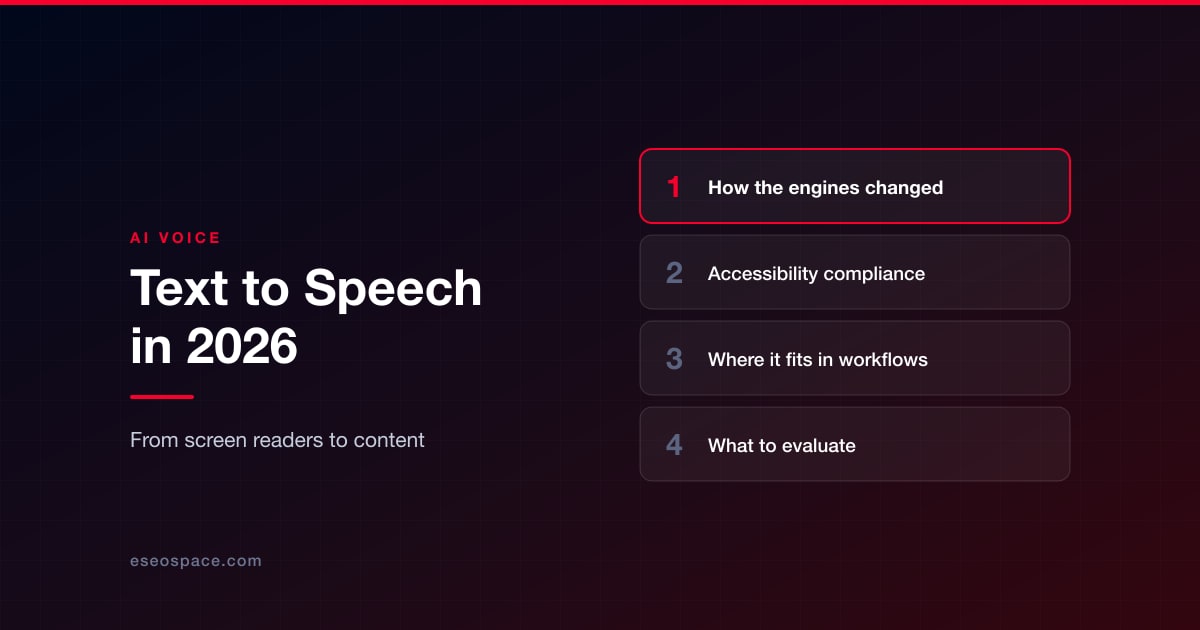
Text to Speech used to be shorthand for the flat, robotic narrator voice built into screen readers and phone menus. That reputation is quickly becoming outdated. Over the past few product cycles, the underlying models have improved enough that synthetic narration is now showing up in podcasts, product demos, e-learning courses, and even branded video content, often without listeners realizing a machine generated the voice.
Part of the reason is scale. GMI Insights values the global text-to-speech market at roughly USD 4.8 billion in 2025 and projects it will reach USD 35.3 billion by 2035, a trajectory the firm attributes largely to demand from content, customer service, and accessibility use cases rather than traditional assistive technology alone.
How Text to Speech Engines Have Evolved
Early systems concatenated pre-recorded phonemes, which is why older automated voiceovers sounded stiff and monotone. Neural TTS models changed the underlying approach, generating waveforms directly from text and learning natural pitch, pacing, and emphasis patterns from large voice datasets. The practical result is that a script read by an AI voiceover today can carry pauses, emotional inflection, and cross-lingual pronunciation that older engines simply could not produce.
This shift also lowered the bar for entry. Cloning a voice or generating a new one for a project no longer requires a studio session; some Text to Speech platforms can now produce a usable voice model from a short sample and apply it across dozens of languages, which is reshaping how quickly teams can localize content.
Text to Speech and Web Accessibility Compliance
Accessibility is one of the more concrete drivers behind this growth. The WebAIM Million report found that 95.9% of the top one million home pages had detected WCAG 2 failures in 2026, up from 94.8% the year before, and because only automatically detectable failures are counted, the real rate is higher still. Audio alternatives to text are one of the more direct ways organizations can close part of that gap without redesigning an entire site.
Audio is an addition, not a substitute. It does not fix contrast, focus order, link text or form labels, and a site that reads itself aloud can still be unusable with a keyboard. The ADA Title II rule for government websites is worth reading on where the actual obligations fall, and our WCAG accessibility services cover the rest of the work.
For publishers and government or nonprofit sites in particular, offering an audio version of an article or policy page is becoming less of a nice-to-have and more of a baseline expectation, especially as more jurisdictions formalize digital accessibility requirements into law.
Where AI Voice Generation Fits Into Content and SEO Workflows
Beyond compliance, voice synthesis technology is increasingly treated as a distribution channel in its own right. Common applications include:
- Turning long-form blog posts into audio versions for readers who prefer listening
- Producing multilingual voiceovers for product videos without rebooking talent per market
- Generating draft narration for internal training and onboarding content
- Powering IVR and customer support scripts that need frequent updates
Because these outputs can be generated and updated in minutes rather than days, teams are folding an AI voice generator into the same workflows they already use for content production and localization, rather than treating it as a separate specialist task. It is the same economics that make repurposing blog posts into video worth doing: the research is already paid for, and another format costs a fraction of the original.
What to Evaluate in a Text-to-Speech Platform
Not all engines are equal, and the differences show up quickly once a script includes numbers, brand names, or emotional cues. When comparing options, it is worth checking naturalness and prosody on longer passages rather than short demo clips, how much control is offered over pacing and tone, whether the platform supports the specific languages a project needs, and how pricing scales once usage moves beyond a free tier.
Latency also matters for anything interactive, such as voice agents or live captioning, where a noticeable delay between text input and audio output breaks the experience.
One thing synthetic narration will not do by itself is earn you search visibility. Audio is not indexed the way text is, so the transcript, the page it sits on and the schema around it still carry the ranking work — the same lesson as our video SEO guide.
Conclusion
Text to speech is no longer a narrow accessibility feature bolted onto a website. It has become a content, localization, and SEO tool that touches how organizations produce audio, reach international audiences, and meet compliance requirements, and that shift is likely to accelerate as the underlying models keep improving.
Put this into action with eSEOspace
We help businesses grow with website development that actually performs. Explore the services behind this guide:
Get a FREE Audit
We'll perform a comprehensive SEO, AEO, GEO & CRO audit of your website — completely free — and show you exactly how to outrank your competitors.
Don't have a site yet? Get in touch →
Get a FREE GEO/AEO/SEO Audit
We'll analyze your site's SEO, GEO, AEO & CRO — completely free — and show you exactly how to get found across Google and AI answers.
Don't have a site yet? Get in touch →
Great — your audit is on the way!
We'll send your free SEO/GEO/AEO/CRO audit within the next few hours. Where should we send it?
You're all set! ✓
Your free audit is being prepared — check your inbox in the next few hours. Talk soon!