This profile is part of our MCP server directory, within The MCP Guide. Profiles are checked against each vendor's own documentation. Need a server built? See MCP development.
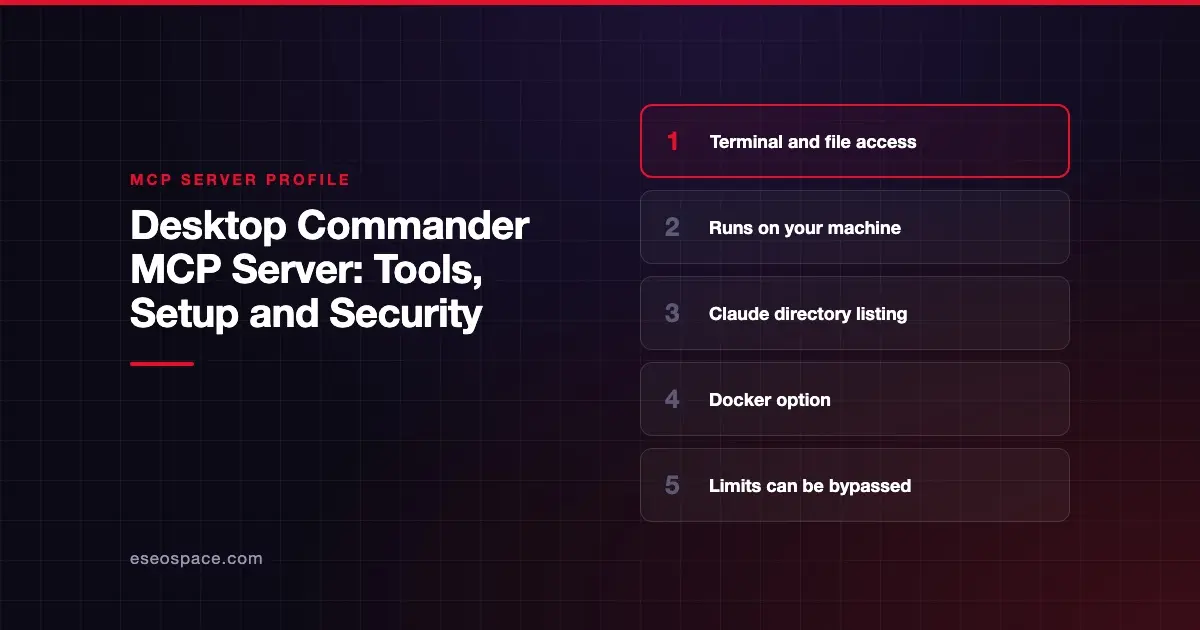
Desktop Commander is an MCP server that gives an AI app your computer's terminal and file system. It can run long commands, manage processes, search and edit files, and read Excel files and PDFs. It is open source and listed in Claude's connector directory.
Checked against: the Desktop Commander README on GitHub and Claude's Desktop Commander listing on 2 November 2026. eSEOspace did not install or test this server.
Key Takeaways
- Desktop Commander runs locally and acts with your user account's permissions.
- Its README warns that directory limits and command blocking "can be bypassed" through symlinks, command substitution and absolute paths.
allowedDirectorieslimits file tools only. Terminal commands can still reach other folders.- For stronger isolation, the project recommends its Docker install.
- A "Remote" mode lets ChatGPT and Claude on the web reach your machine while the remote device runs.
At a glance
| Item | Detail |
|---|---|
| Publisher | Desktop Commander Team |
| Official? | Yes (the project's own server) |
| Hosting | Local (npx, Docker or desktop extension); optional remote relay |
| Transport | stdio locally |
| Sign-in | None locally; OAuth for Remote mode |
| Read or write | Read-write, including shell commands |
| Price | Not stated in the README |
| Source code | wonderwhy-er/DesktopCommanderMCP (MIT) |
| Status | Active; listed in Claude's directory since July 2026 |
What it can do
The README's tool table covers six areas:
- Terminal:
start_process,interact_with_process,read_process_output,force_terminate,list_sessions,list_processesandkill_process. - Files:
read_file(including URLs, Excel and PDFs),read_multiple_files,write_file,write_pdf,create_directory,list_directory,move_fileandget_file_info. - Search:
start_search,get_more_search_results,stop_searchandlist_searches. - Editing:
edit_blockfor targeted text replacements or Excel cell ranges. - Configuration:
get_configandset_config_value. - History:
get_usage_stats,get_recent_tool_callsand a feedback tool.
Claude's listing shows 26 tools from the same set.
How to connect it
The README's quickest path for Claude Desktop needs Node.js:
npx @wonderwhy-er/desktop-commander@latest setupFor Claude Code:
claude mcp add --scope user desktop-commander -- npx -y @wonderwhy-er/desktop-commander@latestFor Codex CLI:
codex mcp add desktop-commander -- npx -y @wonderwhy-er/desktop-commander@latestThe README also covers Cursor, JetBrains, Qwen Code and a Docker install that mounts only the folders you choose. The npx and Docker options auto-update when you restart Claude. To remove it, run npx @wonderwhy-er/desktop-commander@latest remove.
For ChatGPT or Claude on the web, start the remote device:
npx @wonderwhy-er/desktop-commander@latest remoteThe README says the remote device "only accepts commands while it is running" and uses OAuth.
Security notes
This server can do anything your user account can do. The README is direct about the limits of its own guardrails:
- Bypassable limits. Directory restrictions and command blocking "can be bypassed" through symlinks, command substitution, absolute paths or code execution.
- Terminal reach.
allowedDirectories"currently only restricts filesystem operations, not terminal commands." - Self-editing config. The README says Claude may try to change settings such as
allowedDirectorieswhen blocked, and advises changing config in a separate chat. - Isolation. "For production security," it points to the Docker install.
Logging matters too. Every tool call is written to a local claude_tool_call.log with arguments that are "not redacted or sanitized," so commands and paths may appear there. The Remote service briefly stores tool arguments and results to route calls, then sweeps them. Optional telemetry excludes file contents, paths and command arguments, and you can turn it off with "telemetryEnabled": false.
Read sandboxing local MCP servers and command injection, and plan permissions with the MCP tool permission planner. The MCP project's security best practices cover local server compromise.
Alternatives
- MCP filesystem server, the reference server, for file access without a shell.
- MCP Git server for repository actions only.
- JetBrains MCP server for IDE-controlled edits and runs.
Next step
If you try it, start in Docker with one mounted project folder and keep approval prompts on. Compare other local tools in our best MCP servers for Claude Code list or the MCP server directory.
More in the MCP Guide
Free tools: MCP Server Risk Checklist · Tool Permission Planner
Latest research: State of MCP: October 2026
Frequently asked questions
Is Desktop Commander safe to use?
It is as safe as giving an AI your terminal. The project says its own limits can be bypassed, so use Docker isolation, a separate user account or a test machine for anything sensitive.
Does Desktop Commander work with ChatGPT?
Yes, through its Remote mode. You run the remote device on your computer, and ChatGPT or Claude on the web sends commands to it while it runs.
Is it in Claude's connector directory?
Yes. Claude's directory lists Desktop Commander, published by the Desktop Commander Team, added in July 2026.
Does it collect data?
It collects optional, pseudonymous telemetry that excludes file contents, paths and command arguments. It also keeps local tool-call logs that may include sensitive arguments.