This profile is part of our MCP server directory, within The MCP Guide. Profiles are checked against each vendor's own documentation. Need a server built? See MCP development.

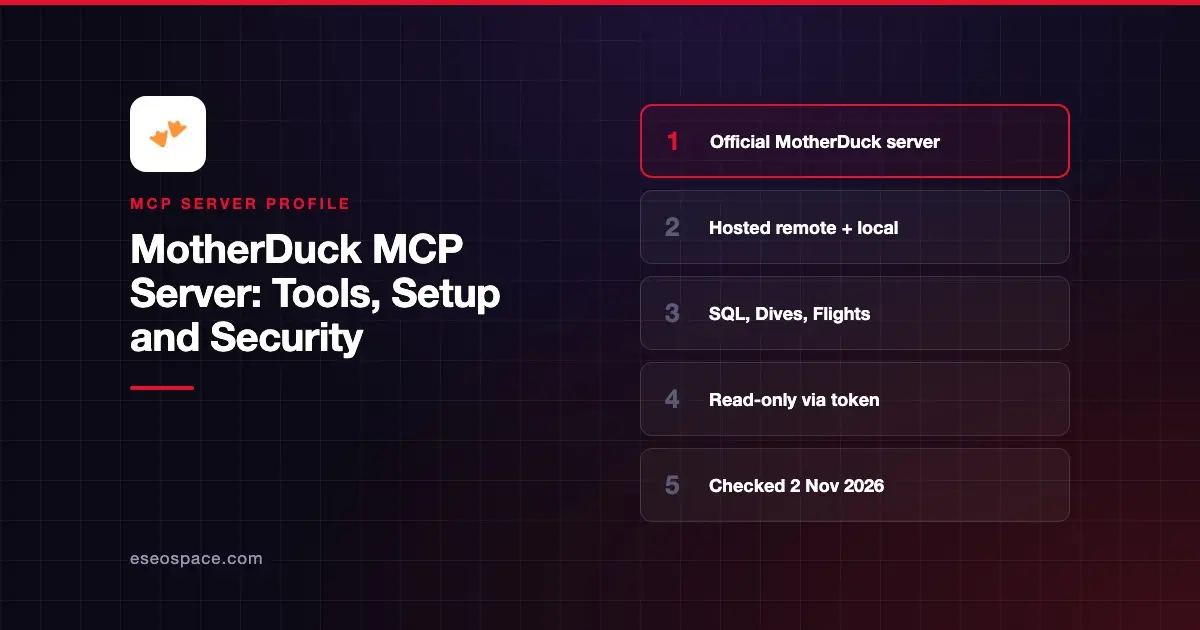
The MotherDuck MCP server lets an AI app query your MotherDuck data warehouse in plain English. MotherDuck hosts a remote, read-write server, and it also publishes an open-source local server that works with plain DuckDB files, in-memory databases, S3 and MotherDuck.
Checked against: MotherDuck's MCP reference, its MCP setup guide, its read-only access guide, the MotherDuck page in Claude's connector directory and the local server README (v1.1.0 on PyPI), checked on 2 November 2026. eSEOspace did not install or test this server.
Key Takeaways
- The remote server lives at
https://api.motherduck.com/mcpand most clients sign in with OAuth. - MotherDuck calls the remote server "fully managed, read-write," with both read-only and read-write tools.
- The write tool is
query_rw; MotherDuck's main read-only advice is to block it in your client. - For read-only enforced by the server, use a read scaling token instead of OAuth.
- The local server is read-only by default, but MotherDuck warns that read-only mode alone is not enough for third-party access.
At a glance
| Item | Detail |
|---|---|
| Publisher | MotherDuck |
| Official? | Yes (listed as Anthropic verified in Claude's directory) |
| Hosting | Remote (hosted by MotherDuck) or local/self-hosted |
| Transport | HTTP for remote; stdio or HTTP for local |
| Sign-in | OAuth, or Authorization: Bearer with a MotherDuck token |
| Read or write | Remote is read-write; local is read-only unless you pass --read-write |
| Price | No MCP-specific price listed; MotherDuck sign-up is free |
| Source code | Remote closed; local server open source (MIT) |
| Status | Listed in Claude's directory since January 2026 |
What it can do
MotherDuck groups the remote tools into core tools (run SQL, explore schemas and shares, ask documentation questions), Dive tools for interactive data visualizations, Flight tools for scheduled Python jobs on MotherDuck compute, and Guide tools.
Claude's directory page lists 15 tools: list_databases, list_shares, list_tables, list_columns, search_catalog, query, ask_docs_question, query_rw, get_dive_guide, save_dive, read_dive, update_dive, delete_dive, list_dives and share_dive_data. The MotherDuck docs also describe Flight tools that this list does not show, so your client may receive more.
The local server has five tools: execute_query, list_databases, list_tables, list_columns and switch_database_connection. The last one only appears with --allow-switch-databases. Results cap at 1,024 rows or 50,000 characters by default.
How to connect it
For Claude Code, MotherDuck documents:
claude mcp add --transport http MotherDuck https://api.motherduck.com/mcpAdd --scope user after add to make it available in every project. For Cursor, the guide gives this entry; Windsurf, Zed and other clients use the same entry under mcpServers:
{
  "MotherDuck": {
    "url": "https://api.motherduck.com/mcp",
    "type": "http"
  }
}
In Claude on the web or desktop, open Customize > Connectors, click +, find MotherDuck and click Connect. On Claude Team and Enterprise, an owner must enable it first. In ChatGPT, MotherDuck says to install it from Plugins, then type @ and pick MotherDuck in a chat.
For the local server, which also reads local DuckDB files, the README gives this read-only config:
{
  "mcpServers": {
    "DuckDB (read-only)": {
      "command": "uvx",
      "args": ["mcp-server-motherduck", "--db-path", "/absolute/path/to/your.duckdb"]
    }
  }
}
Use --db-path md: with a motherduck_token environment variable to point it at MotherDuck instead. If you see spawn uvx ENOENT, the README says to use the full path to uvx. Our MCP config generator can help with other clients.
Security notes
MotherDuck gives three ways to limit the remote server:
- Block
query_rwin the client. Claude, Cursor, ChatGPT Enterprise/Edu, Copilot Studio and Claude Code all support this. In Claude Code, add{ "permissions": { "deny": ["mcp__MotherDuck__query_rw"] } }to your settings file. This is per user, not enforced by the server. - Use a read scaling token. The server then rejects writes. It needs manual setup, does not work with OAuth connectors, and results can lag a few minutes.
- Filter tools in a proxy for custom backends, enforcing the same list when calls are dispatched.
MotherDuck also says to "review Guide, Dive, Flight, sharing, and delete tools separately," since tools like delete_dive change data too. Query results pass through the remote server, which matters if you have data residency rules.
For the local server, MotherDuck warns that read-only mode still allows filesystem access and DuckDB setting changes. For third-party access it recommends the remote server, or a service account with read scaling tokens, or --init-sql with DuckDB's security settings. Map tools to roles with our tool permission planner and see the MCP Security Center.
Alternatives
- Snowflake MCP Server for a warehouse with a managed server inside your account.
- Google BigQuery MCP Server for BigQuery data.
- ClickHouse MCP Server for another fast analytics database.
Next step
Connect the remote server, block query_rw, and ask it to list your databases. Compare other analytics options in our best MCP servers for databases roundup.
More in the MCP Guide
Free tools: MCP Server Risk Checklist · Tool Permission Planner
Latest research: State of MCP: October 2026
Frequently asked questions
Does the MotherDuck MCP server cost extra?
MotherDuck's MCP pages do not list a separate price. You need a MotherDuck account, and the setup guide says sign-up is free. Check MotherDuck's own pricing for the compute your queries use.
How do I make it read-only?
Block query_rw in your client for a quick per-user limit. For server-side enforcement, connect with a read scaling token, ideally for a service account, and still block query_rw so the model does not try it.
What is the difference between the remote and local servers?
The remote server is hosted by MotherDuck with OAuth and extra tools for Dives and Flights. The local server runs on your machine, can read local DuckDB files and S3, and is read-only unless you add --read-write.
Can I use it with plain DuckDB without MotherDuck?
Yes, with the local server. Point --db-path at a DuckDB file or :memory:. The remote server is for MotherDuck accounts.