Google's Link Spam Policy Explained for Link Builders
Google's Link Spam Policy Explained for Link Builders
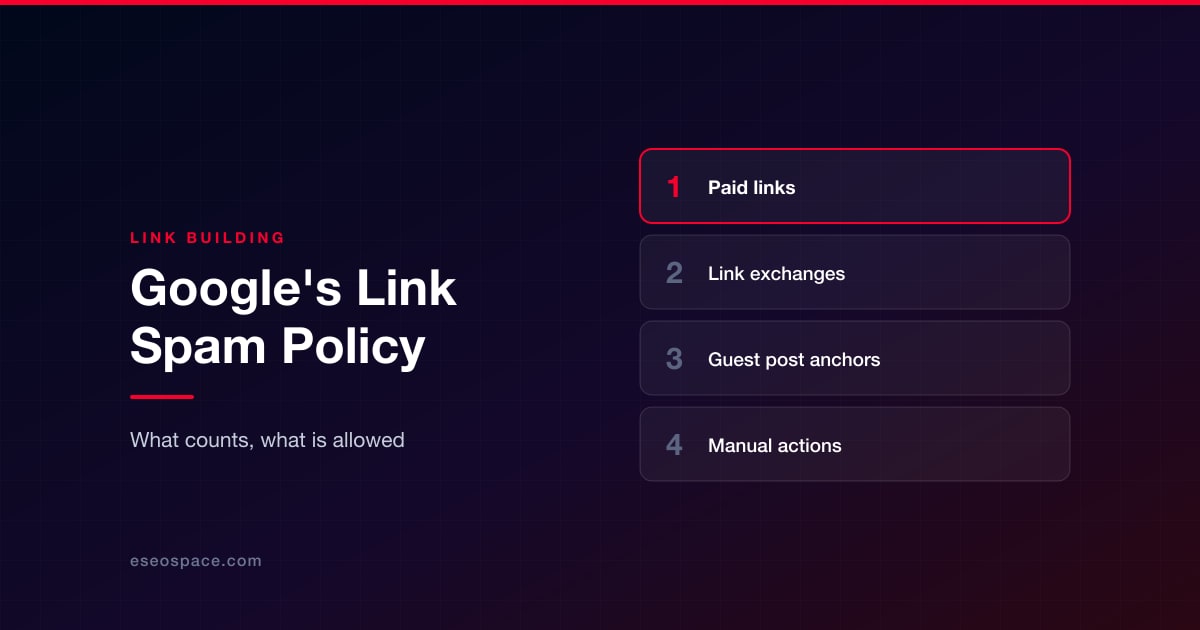
Google's link spam policy prohibits creating links to or from a site primarily to manipulate search rankings, which covers buying or selling links that pass ranking credit, excessive link exchanges, automated link building and keyword-optimized links in guest posts or press releases. Paid and sponsored links are allowed as long as they carry rel="sponsored" or rel="nofollow", and links that editors give freely are exactly what Google wants to count.
Below we walk through the policy as Google publishes it today, how Google enforces it, where the site reputation policy fits, and what link builders should change in their day-to-day work.
Key Takeaways
- Link spam is defined by purpose: links created primarily to manipulate rankings, whether you build them to your site or sell them from it.
- Paying for a link is not itself a violation; passing ranking credit through a paid link is, so qualify it with
sponsoredornofollow. - Google mostly neutralizes spammy links automatically with SpamBrain, and the lost value does not come back after cleanup.
- Manual actions for unnatural links appear in Search Console and need a cleanup plus a reconsideration request.
- The safest link building is work an editor would link to anyway: useful content, real relationships and honest attribution.
What Google means by link spam
Google used to publish this guidance as "link schemes." It now sits in the Google Search spam policies under the heading "Link spam," defined as "the practice of creating links to or from a site primarily for the purpose of manipulating search rankings."
Two parts of that definition matter for link builders. First, "to or from": selling links from a site you own is covered just as much as buying links to a client site. Second, "primarily for the purpose": the policy is about intent and pattern. A single sponsored post is not the problem. A campaign designed to push ranking credit to target pages is.
What counts as link spam
Google's list of examples, paraphrased closely, includes:
- Buying or selling links for ranking purposes. This includes exchanging money for links or for posts that contain links, exchanging goods or services for links, and sending someone a product in exchange for writing about it with a link.
- Excessive link exchanges ("link to me and I'll link to you") or partner pages built only for cross-linking.
- Automated programs or services that create links to your site.
- Required links in terms of service, contracts or similar arrangements where the other site owner can't qualify the outbound link.
- Text ads or text links that don't block ranking credit.
- Advertorials or native advertising where payment is received for articles with links that pass ranking credit, and links with optimized anchor text in articles, guest posts or press releases distributed on other sites.
- Low-quality directory or bookmark site links.
- Keyword-rich, hidden or low-quality links in widgets distributed across many sites.
- Widely distributed links in footers or templates of various sites.
- Forum comments with optimized links in the post or signature.
- Low-value content created mainly to manipulate linking and ranking signals.
Notice how many of these are about anchors and scale rather than the mere existence of a link. Guest posting is not banned; guest posts distributed to carry optimized anchor text back to a money page are. Our guide to guest posting that still works covers how to keep contributed content editorial, and our piece on anchor text strategy in 2026 explains why chasing an anchor ratio misses the point.
What is allowed
Google is explicit that commercial links are fine when they are labeled: "buying and selling links is a normal part of the economy of the web for advertising and sponsorship purposes. It's not a violation of our policies to have such links as long as they are qualified with a rel="nofollow" or rel="sponsored" attribute value."
So the following are all within policy:
- A sponsored article or paid placement where the link carries
rel="sponsored". - Affiliate links marked
sponsoredornofollow. - User comments and forum links marked
ugcornofollow. - Links editors give because your content, data, tool or expertise is worth citing.
- Normal business relationships, such as a supplier listing its stockists, when they aren't built as a cross-linking scheme.
If you are unsure which value belongs on which link, our explainer on rel="sponsored" vs nofollow vs ugc goes through each case with HTML examples.
How Google enforces it
| Mechanism | What happens | Will you be told? |
|---|---|---|
| Automated systems (SpamBrain) | Unnatural links are detected and neutralized, so they pass no value. | No notification. You may only see rankings change. |
| Link spam updates | Periodic improvements to detection, announced on Google's Search Status Dashboard. | Announced publicly, not per site. |
| Manual action | A human reviewer finds a pattern of unnatural links to or from your site. | Yes, in Search Console's Manual actions report. |
SpamBrain and link spam updates
SpamBrain is Google's AI-based spam-prevention system. In the December 2022 link spam update, Google said it was using SpamBrain to detect both sites buying links and sites used to pass outgoing links, and to "neutralize the impact of unnatural links."
The practical consequence is spelled out on Google's spam updates page: after a link spam update, "making changes might not generate an improvement," because the ranking benefit those links provided is gone. Cleanup protects you going forward; it doesn't restore value that was never legitimate.
Manual actions
When a reviewer finds a pattern of manipulative links, Search Console shows a manual action. "Unnatural links to your site" means Google detected artificial or manipulative links pointing at you. "Unnatural links from your site" means your outbound links look sold or exchanged. Google's manual actions documentation describes the fix: download your links from Search Console, identify the ones that violate the policy, get them removed or qualified, disavow what you can't remove, then select Request Review. Google says reviews can take several days or weeks.
Where site reputation abuse fits
Google's site reputation policy is separate from link spam but hits many of the same vendors. It applies when third-party content is published on a host site "mainly because of that host's already-established ranking signals," so the content ranks better than it could on its own. Think of coupon, casino or product-review sections rented out on news or university sites.
For link builders, the lesson is that a placement on a strong domain inside a section that exists only to host paid third-party content is risky twice over: the link can be neutralized, and the section itself can be demoted or hit with a manual action. Google notes that enforcement works differently in the EEA, so check the current policy text for the market you work in.
Google's spam policies also now state that Google may act against practices meant to manipulate generative AI responses in Search. Seeding inauthentic brand mentions to influence AI answers is no safer than seeding links.
What link builders should change in practice
1. Audit what you are actually buying
If any money, product, service or favor changes hands for a placement, the link needs sponsored or nofollow. That includes "content fees," "editorial fees" and free products. Write it into your agreements and check it on every live link.
2. Retire keyword-optimized anchors in placed content
Use the brand name, the page title or a natural description in contributed articles and press releases. If a campaign only works when the anchor is the exact commercial keyword, it is the kind of campaign the policy describes.
3. Stop the quiet exchanges
"Three-way" swaps and partner networks are still exchanges. Occasional, relevant reciprocal links between businesses that genuinely work together are normal. A standing arrangement to trade links across client sites is not.
4. Vet every vendor and partner
Resold or outsourced links carry the same risk as links you build yourself. If you work with a fulfillment partner, our guide to white-label link building without risking client sites covers the contract clauses and QA checks we use. When you are comparing link building services, ask each one how they handle paid placements and attributes before you ask about price.
5. Invest in things editors want to cite
Original data, clear explanations, calculators, expert quotes and useful resource pages earn links that need no disguise. They are slower, and they are the only kind the policy never touches.
Cleaning up a risky link profile
If you inherit a client with a history of bought links, don't panic and don't disavow everything. Google's systems already ignore much of the obvious spam. Start by reading what a healthy backlink profile actually looks like, then compare.
- Export linking sites from Search Console's Links report and your usual third-party tool.
- Flag links that match the policy's examples: paid followed placements, exchanges, widget and footer links, optimized anchors on low-quality sites.
- Ask for removal or for
sponsored/nofollowwhere you have contact with the site owner. - Use the disavow tool only in the case Google describes: a considerable number of spammy or artificial links that have caused, or are likely to cause, a manual action. Google says "most sites will not need to use this tool."
- Document everything, especially if you will file a reconsideration request.
Our post on toxic backlinks explains why third-party "toxicity" scores are not Google's judgment and how to decide what really needs action.
If you'd rather have a team that builds within these rules from the start, our link building team qualifies every paid placement and reports each link's attribute alongside the result.
Frequently Asked Questions
Is buying links against Google's rules?
Buying links that pass ranking credit is. Buying advertising or sponsorship that includes a link is fine when the link carries rel="sponsored" or rel="nofollow". The attribute is what separates an ad from link spam.
Is guest posting considered link spam?
Not by itself. Google's examples target links with optimized anchor text in guest posts distributed on other sites, and paid articles with links that pass ranking credit. An editorially reviewed guest article with a natural, relevant link is not what the policy describes.
Will Google tell me if my links were neutralized?
Usually not. Algorithmic neutralization happens without a notice. You only get a message in Search Console when a human reviewer applies a manual action.
Can a competitor hurt my site by building spam links to it?
Google's disavow documentation says that "in most cases, Google can assess which links to trust without additional guidance." If you see a manual action for unnatural links you did not build, document the situation, remove or disavow what you can, and explain it in the reconsideration request.
Put this into action with eSEOspace
We help businesses grow with website development that actually performs. Explore the services behind this guide:
Get a FREE Audit
We'll perform a comprehensive SEO, AEO, GEO & CRO audit of your website — completely free — and show you exactly how to outrank your competitors.
Don't have a site yet? Get in touch →
Get a FREE GEO/AEO/SEO Audit
We'll analyze your site's SEO, GEO, AEO & CRO — completely free — and show you exactly how to get found across Google and AI answers.
Don't have a site yet? Get in touch →
Great — your audit is on the way!
We'll send your free SEO/GEO/AEO/CRO audit within the next few hours. Where should we send it?
You're all set! ✓
Your free audit is being prepared — check your inbox in the next few hours. Talk soon!