Link Prospecting: A Step-by-Step Workflow for Finding Sites Worth Pitching
Link Prospecting: A Step-by-Step Workflow for Finding Sites Worth Pitching
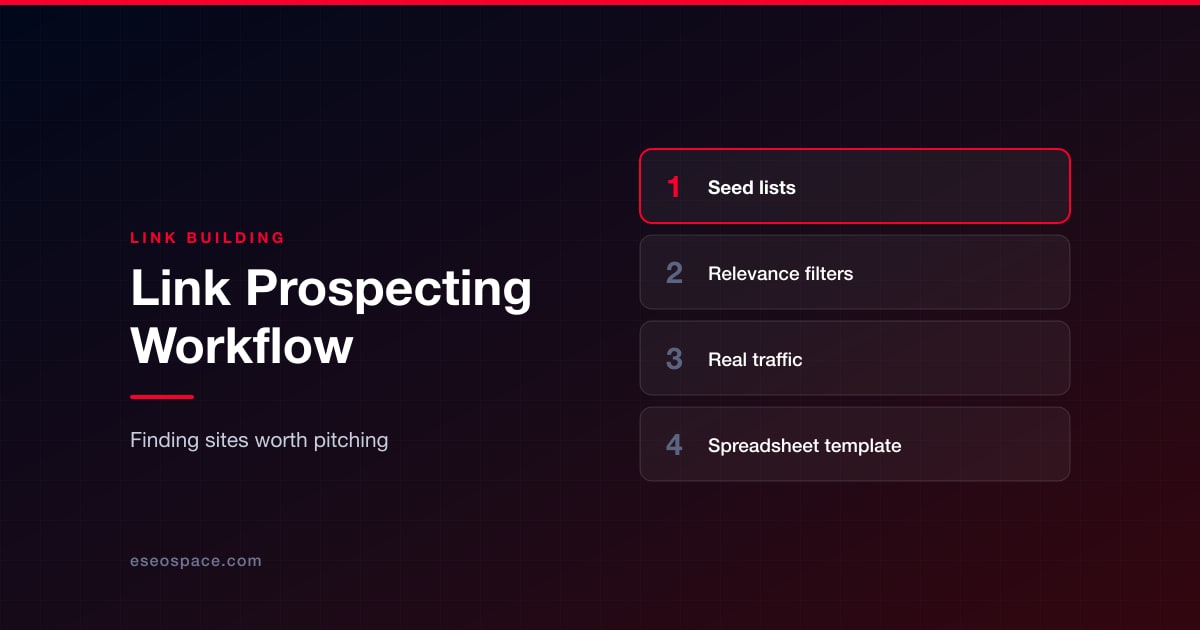
Link prospecting is the work of finding specific websites that have a real reason to link to a specific page of yours, then qualifying them and finding the person who can add the link. Done well, it decides most of the outcome of a campaign before a single email goes out, because a relevant site with a clear reason to link needs far less persuasion than a random one.
This is the workflow our team uses: start from the page and the reason, build seed lists from five sources, filter hard, find the right contact, and keep every decision in one spreadsheet. It works the same whether you run links in-house or manage a vendor.
Key Takeaways
- Prospecting starts with a target page and a reason to link, not with a list of high-metric domains.
- The strongest seed lists come from competitor backlinks, resource pages, unlinked mentions, broken links and targeted search operators.
- Qualify every site on topical relevance, real organic traffic, editorial standards, outbound link patterns and indexation before anyone writes a pitch.
- DR, DA and similar scores are third-party estimates, useful for sorting but never a reason to include a site on their own.
- One shared spreadsheet with fixed columns keeps prospecting consistent, auditable and easy to hand off to outreach.
Step 1: Define the target page and the reason someone would link
Every prospect list should be built for one page, or one tight group of pages. "Links for the domain" is not a brief. Pick the page, then write one sentence that answers: why would an editor who has never heard of us link to this?
Good reasons are concrete:
- It fills a gap on their page. A resource list that covers every step but one, and your guide covers that step.
- It replaces something broken. They link to a tool or study that no longer exists.
- It supports a claim they make. Your original data, calculator or checklist backs up a point in their article.
- They already mention you. The brand or product is named but not linked.
If you cannot write that sentence, the page is not ready for outreach. Improve the asset first. Our note on the types of backlinks that matter for AI search visibility is a useful check on whether the links you are chasing are the kind that build real authority, not just a count.
Step 2: Build seed lists from five sources
A seed list is raw and unfiltered. Aim for volume here and be ruthless in Step 3. Keep a "source" column so you can see later which method produced the links that actually landed.
Competitor backlinks
Pull the referring domains of two to five pages that rank for your target query or cover the same topic. Any backlink tool will do this: Ahrefs, Semrush, Moz and Majestic all export referring domains with the linking URL and anchor text. Filter for editorial links in body content and ignore sitewide footers, directories and scraper sites. Sites that link to several competitors but not to you are the warmest prospects on the list. Our walkthrough on competitor backlink analysis covers the export, the dedupe and the gap comparison in detail.
Also open your own Search Console Links report. It shows which sites already link to you and which pages they link to, which tells you who has linked once and might link again.
Search operators
Google documents a few operators, including site: and filetype:, and notes on its search operators page that they are bound by indexing and retrieval limits. Treat results as a sample, not a census. Quoted phrases and intitle: still work well in practice for finding resource and roundup pages:
"your topic" intitle:resources
"your topic" inurl:links
"your topic" "useful links"
"your topic" "further reading"
"your topic" intitle:"roundup" OR intitle:"weekly links"
Resource pages
Curated resource pages exist to link out, so they are the most natural fit for a genuinely useful guide or tool. Prioritize pages maintained by organizations such as universities, associations, libraries and local governments, and check the page has been updated in the last year or two. A resource page last touched in 2017 is unlikely to have an editor watching it.
Unlinked mentions
Set up brand monitoring for your company name, product names, founders and any proprietary data or frameworks you publish. Mentions without a link are the easiest ask in link building because the editor has already decided you are worth naming.
Broken links
Find dead pages in your niche that still have backlinks, then list every site linking to them. If you have a page that serves the same purpose, those sites are prospects with a built-in reason to update. The full method, including how to find dead pages and check the replacement fit, is in our guide to broken link building, step by step.
Step 3: Qualify every prospect with hard filters
This is where most lists go wrong. A long list of unqualified domains wastes outreach time and, worse, can point you at sites that sell links or exist only to host them. We run five checks, in this order, and drop a prospect at the first failure.
Topical relevance
Would a reader of that page plausibly want to click through to yours? Check the specific page, not only the homepage. A general business blog can be a fit for one article and irrelevant for the next.
Real organic traffic
Use a traffic estimate from your SEO tool as a sanity check. You are not looking for a minimum number, you are looking for a trend and a shape. A site whose estimated traffic collapsed after a core or spam update, or whose traffic comes from keywords unrelated to its topic, is a warning sign. Remember that DR, DA, Trust Flow and Authority Score are third-party metrics built by tool vendors. They are not Google signals, and a high score on a site with no real audience is meaningless.
Editorial standards
Read two or three recent posts. Is there a named author? Are claims sourced? Does the site publish on a coherent set of topics, or on everything from crypto to casinos to dentistry? A site that accepts anything is a site that will not help you.
Outbound link patterns
Look at where the site links out. Patterns that signal a link farm or a paid-post shop include:
- Recent posts that each contain one or two exact-match commercial anchors pointing to unrelated businesses.
- A "write for us" page listing prices, turnaround times or "do-follow guaranteed".
- Many posts tagged "sponsored" or "partner" but with no
rel="sponsored"on the links. - Outbound links heavily weighted toward gambling, loans, CBD or essay-writing services unrelated to the site's topic.
Google's spam policies on link spam name buying and selling links that pass ranking credit, excessive link exchanges and large-scale guest posting with keyword-rich anchors. A site built around those practices is a liability, not a prospect.
Indexation
Search site:theirdomain.com and search a distinctive sentence from one of their recent posts in quotes. If the site barely appears, or recent posts are not indexed, a link from it is unlikely to carry much value. This is a rough check, since operator results are incomplete, but a site that is missing almost entirely is worth dropping.
Step 4: Find the right contact
A generic info@ address is a last resort. For each qualified prospect, find the person who owns the page:
- The named author of the specific article, if they still write for the site.
- The editor or content lead for that section, often listed on a masthead or team page.
- For resource pages on institutional sites, the department or librarian named on the page.
- For small sites, the owner, usually named on the About page.
Email finder tools such as Hunter can suggest and verify addresses from a name and a domain. Always verify before sending, because bounces hurt your sender reputation. If the site has a contact form or a clear pitch process, use it. Respecting how a site asks to be contacted is part of being a credible sender.
Step 5: Organize everything in one spreadsheet
A spreadsheet beats a pile of exports because it forces a decision on every row and leaves an audit trail. This is the column layout we use. Keep it identical across campaigns so reports and handoffs are consistent.
| Column | What goes in it | Example |
|---|---|---|
| Target page | The URL on your site this prospect is for | /blog/roof-replacement-cost/ |
| Prospect URL | The exact page where the link would go | example.org/homeowner-resources/ |
| Domain | Root domain, for dedupe | example.org |
| Source | How you found it | Competitor backlinks / resource page / broken link |
| Reason to link | One sentence, specific to this page | Lists five cost guides; the one for metal roofs is 404 |
| Relevance (1 to 3) | Fit between their page and yours | 3 |
| Traffic check | Pass or fail, with a short note | Pass, stable trend |
| Editorial check | Pass or fail, with a short note | Pass, named authors, sourced |
| Outbound link check | Pass or fail, red flags seen | Pass |
| Indexed | Yes or no | Yes |
| Third-party metric | DR/DA/TF for sorting only | DR 41 |
| Contact name and role | Who owns the page | J. Rivera, content editor |
| Email and verification | Address and verifier result | Valid |
| Status | Qualified, pitched, followed up, replied, won, declined | Pitched |
| Dates | Pitch and follow-up dates | 2026-09-29 / 2026-10-06 |
| Live link and rel | Final URL, anchor and rel attribute | Anchor "metal roof costs", no rel |
Two rules keep the sheet useful. First, one row per prospect page, not per domain, because different pages on the same site can have different contacts and reasons. Second, never delete a rejected row. Mark it as dropped with the reason, so nobody re-qualifies the same bad site next quarter.
Step 6: Hand off to outreach with the reason attached
The "reason to link" column is the first line of the pitch. When the outreach writer can see exactly why this page fits, the email writes itself and stays short. Our set of link building outreach email templates is built around that idea, with a template for each prospect source above.
Before you send at volume, make sure the sending setup can take it. A well-qualified list still fails if messages land in spam or burn your main domain's reputation. Our guide to outreach email deliverability for link builders covers authentication, sending domains and volume limits.
Common prospecting mistakes
- Sorting by metric first. High-DR sites with no topical fit produce low reply rates and weak links. Filter for relevance, then sort.
- Prospecting for the homepage. Editors link to useful pages, rarely to a company homepage.
- Buying lists. Pre-built "guest post site lists" are usually collections of sites that sell links. Google treats paid links that pass ranking credit as link spam unless they are qualified with
rel="sponsored"orrel="nofollow". - Skipping the dedupe. Pitching the same editor twice from two team members is the fastest way to get ignored.
- No feedback loop. If you never check which sources produced live links, you keep spending time on the ones that do not.
When to do it yourself and when to hand it off
Prospecting is learnable and worth doing in-house if you have a few hours a week and a narrow niche. It gets harder to sustain across many clients or topics, which is where most agencies either build a dedicated role or bring in outside help. If you are comparing link building agencies, ask each one to show you a sample of their prospect sheet and the filters they apply. How a vendor qualifies sites tells you more than any link count they quote.
If you would rather have the whole workflow run for you, from prospecting to live, qualified links, talk to our link building team. We work to Google's link policies, report every link with its rel attribute, and do not promise rankings, because no one can.
Frequently Asked Questions
How many prospects do I need per link?
It depends heavily on the niche, the asset and the tactic, so we do not quote a fixed ratio. Track your own numbers in the Status column. After one or two campaigns you will know how many qualified prospects your team needs per live link for each source.
Is a high Domain Rating enough to qualify a site?
No. DR, DA and similar scores are third-party estimates from tool vendors, not Google metrics. Use them to sort a list that has already passed relevance, traffic, editorial and outbound-link checks.
Should I prospect for guest posts?
Only on sites with real editorial standards, where you would write a genuinely useful article for their readers. Large-scale guest posting with keyword-rich anchor links is named as link spam in Google's policies, so keep it rare, relevant and editorially earned.
How often should I refresh a prospect list?
Re-check qualification before each campaign. Sites change owners, start selling links or lose traffic after updates, so a site that passed six months ago may not pass today.
Put this into action with eSEOspace
We help businesses grow with website development that actually performs. Explore the services behind this guide:
Get a FREE Audit
We'll perform a comprehensive SEO, AEO, GEO & CRO audit of your website — completely free — and show you exactly how to outrank your competitors.
Don't have a site yet? Get in touch →
Get a FREE GEO/AEO/SEO Audit
We'll analyze your site's SEO, GEO, AEO & CRO — completely free — and show you exactly how to get found across Google and AI answers.
Don't have a site yet? Get in touch →
Great — your audit is on the way!
We'll send your free SEO/GEO/AEO/CRO audit within the next few hours. Where should we send it?
You're all set! ✓
Your free audit is being prepared — check your inbox in the next few hours. Talk soon!


On this page
- Key Takeaways
- Step 1: Define the target page and the reason someone would link
- Step 2: Build seed lists from five sources
- Step 3: Qualify every prospect with hard filters
- Step 4: Find the right contact
- Step 5: Organize everything in one spreadsheet
- Step 6: Hand off to outreach with the reason attached
- Common prospecting mistakes
- When to do it yourself and when to hand it off
- Frequently Asked Questions