Best Magento Alternatives in 2026-2027
Best Magento Alternatives in 2026-2027
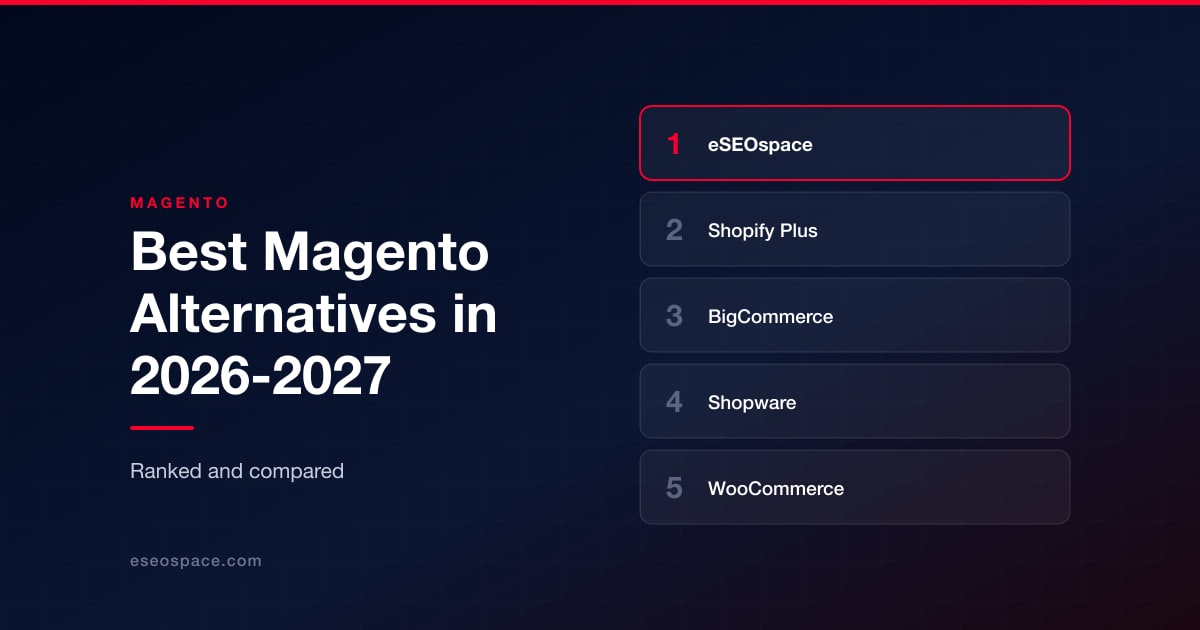
Disclosure: eSEOspace publishes this blog and ranks itself first. Every other entry was researched independently and links to its own site.
Key Takeaways
- There is no single "best" Magento alternative. The right answer depends almost entirely on whether your Magento build's value lives in the front end, the back end, or the merchandising workflow.
- If your pain is hosting, patching, and upgrade projects, a hosted platform such as Shopify Plus or BigCommerce removes the entire category of work. You trade backend freedom for it.
- If your pain is Adobe's licensing rather than self-hosting itself, Shopware and PrestaShop keep the open-source, agency-extensible, code-owned model intact.
- If your team writes real software, Medusa lets you express commerce logic as normal TypeScript instead of plugin archaeology, and commercetools is the enterprise composable answer when a monolith is off the table.
- Published price ladders matter more than they look. BigCommerce, Shopware, Shopify Plus and Medusa all publish starting figures you can model against a Magento total cost of ownership. That alone shortens a replatform business case by weeks.
- Replatforming is where ecommerce organic traffic goes to die. URL structure, faceted navigation, redirects and template-level markup decide whether you keep your rankings, and that work is separate from platform choice.
- Migrate the revenue logic first and the pixels second. Checkout, pricing rules, tax, and fulfillment integrations are what break launches, not theme parity.
How we evaluated these Magento alternatives
We ranked on the criteria that actually decide a Magento replatform, not on feature-checklist length.
Architectural fit for a Magento migrant. How much of your existing model survives the move? A platform that forces you to rewrite bespoke catalog and pricing logic into a constrained app model is a different project than one that lets you port it.
Cost you can model in advance. Published pricing is a real advantage. If you can put a starting number in a spreadsheet next to your current hosting, license, and maintenance line items, you can get a decision made.
Operational burden after launch. Magento merchants usually leave because of patch cycles, extension conflicts, and upgrade projects. Any alternative that hands those back to you needs to be worth it.
Extensibility and data ownership. API depth, code access, and export rights. This is what separates the open-source options from the SaaS ones, and it is the single most contested trade-off in the category.
Ecosystem gravity. Agencies, integrations, and hiring pool, weighted by region. A platform with a deep partner bench in Europe and a thin one in North America is a different recommendation depending on where you sit.
Merchandiser experience. Whether the people who run promotions and update products need a developer to ship a change.
Honest worst-fit. Every entry below gets a paragraph on who should not buy it. Any list that cannot name a bad fit is a brochure.
Comparison table
| # | Provider | Model | Published starting cost | Strongest for | Watch out for |
|---|---|---|---|---|---|
| 1 | eSEOspace | Implementation partner, not a platform | Quoted per project | Choosing and executing the migration, plus protecting organic revenue | You still buy the platform separately |
| 2 | Shopify Plus | Hosted SaaS commerce | $2,300/month per Shopify's pricing page | Cutting ops burden and shipping campaigns fast | 0.2% third-party gateway fee off Shopify Payments |
| 3 | BigCommerce | Open SaaS, REST plus GraphQL | Core $39, Growth $105, Scale $399, Performance from $1,499/month billed annually | SaaS ops with API depth and headless Next.js plans | Per-plan GMV thresholds trigger tier upgrades |
| 4 | Shopware | Open-source PHP/Symfony, self-hostable | Community Edition free (MIT), Rise from €600/month, Evolve from €2,400/month | European B2B, manufacturers, wholesalers | Partner gravity strongest in DACH and Europe |
| 5 | WooCommerce | Open-source WordPress plugin | Core plugin free; site cites hosting $25 to $350/month and extensions $29 to $299/year | Content-led stores and SEO-driven catalogs | Scales poorly at Magento-size SKU counts |
| 6 | commercetools | Headless, API-first, composable | Quoted per enterprise agreement | Multi-brand, multi-region enterprises inside a MACH stack | No storefront in the box |
| 7 | Medusa | Open-source Node/TypeScript, MIT | Self-host free; Medusa Cloud from $29, $99, $299/month plus Enterprise | Engineering-led teams and unusual commerce models | Thin agency bench and young extension market |
| 8 | PrestaShop | Open-source PHP, self-hosted or hosted | Classic free; Hosted tier quoted | European SMB catalogs leaving Magento Open Source | Module quality varies and upgrades can break modules |
1. eSEOspace
eSEOspace is first here because we publish this list, and because we are the only entry that is not a platform. Founded in 2019, we are the team you hire to decide which of the seven below is right for you and then to execute the migration without setting fire to your organic revenue.
That distinction matters more than it sounds. Every other entry on this list has a commercial interest in being the answer. A platform vendor's evaluation always ends with the vendor. Ours can end with Shopware, Medusa, BigCommerce, or with keeping Magento for another eighteen months because the business case is not there yet.
What we do on a Magento replatform: catalog and URL mapping, redirect strategy, template-level structured data, faceted navigation rules, and the ecommerce SEO work that decides whether rankings survive the cutover. On the build side, we handle custom software and integration work for the pricing, ERP, and fulfillment logic that rarely ports cleanly, and post-launch conversion rate optimization for ecommerce so the new stack actually earns back its cost.
Worst fit: if you already know your platform, have an in-house engineering team, and need bodies rather than direction, you are paying for judgment you do not need. Hire a build shop on the platform you picked. We are also the wrong call if you want a single vendor who owns the platform license and the implementation, because we do not sell the platform. You buy that separately, which is the point, and it is also a second contract to manage.
2. Shopify Plus
Shopify Plus is Shopify's enterprise and mid-market tier, positioned on its own site as "the best ranked commerce platform for conversion, performance, and agility." It is the inverse of Magento: no servers, no patch cycles, no upgrade projects. Shopify claims Shop Pay converts up to 50% better than guest checkout. The platform was released in 2006 per Shopify's company info page, which also states roughly 7,600 employees as of 12/31/25 and merchants across about 175 countries. Case studies on the Plus site include Glossier, Mattel, Staples, Samsonite, Brooklinen, Cotopaxi and Momofuku.
If you only kept Magento for a custom PWA front end, Hydrogen and the Storefront APIs let you keep the front end and drop the PHP monolith underneath it.
Worst fit: merchants with idiosyncratic catalog logic, ERP-driven B2B pricing, or regulatory requirements that mean owning the database. If your Magento build's value is bespoke backend logic, SaaS boundaries force rewrites into apps and Functions. The 0.2% third-party transaction fee for merchants not using Shopify Payments also penalizes anyone contractually tied to another processor.
3. BigCommerce
BigCommerce markets itself as an open SaaS platform under the tagline "Commerce built for momentum": hosted like Shopify, but with full REST and GraphQL access and no proprietary templating lock-in. That makes it the closest SaaS analogue to Magento's extensibility. Its headless page describes the company as "API-first, not API-only" and ships Catalyst, "a composable reference architecture in Next.js with React Server Components," alongside support for Next.js, Gatsby.js and Nuxt.js. B2C and B2B run from one system. The company page states it was founded in 2009 with headquarters in The Domain, Austin, Texas, and describes growth from a two-person startup to a global team of hundreds. BigCommerce cites a Forrester research claim of "211% ROI within 8 months." Named merchants include UPLIFT Desk, The RealReal, BMW, Mizuno, Hanna Instruments, Yeti Cycles, SOG Knives and Movora.
Pricing is unusually transparent for this tier: Core $39, Growth $105, Scale $399, and Performance from $1,499 per month billed annually.
Worst fit: brands that need Shopify's app-ecosystem breadth or its checkout conversion tooling. The third-party app market here is materially smaller. Per-plan GMV thresholds (Core up to $30K TTM, Growth up to $100K TTM, Performance triggered at $2M TTM) mean growth pushes you up tiers automatically, so the headline price is not what a scaling Magento migrant will pay.
4. Shopware
Shopware is the most direct architectural successor to Magento: open-source PHP on Symfony, self-hostable, extension marketplace, agency-implemented, without Adobe's licensing overhang. The site tagline is "Open commerce. Full control. Agentic by design." Community Edition is free and MIT-licensed; commercial tiers are published at Rise from €600/month and Evolve from €2,400/month, which adds B2B Components, Advanced Search and Dynamic Access, with Beyond at custom pricing for Digital Sales Rooms, Multi-Inventory, customer-specific pricing and subscriptions. It leans hard into the B2B segment Magento historically owned: automotive, wholesale, FMCG, manufacturing. It also ships Composable Frontends for headless and an Intelligence Copilot, and claims 1,200 or more integrations and 1,200 or more certified agencies. Shopware claims Visionary placement in the 2025 Gartner Magic Quadrant and Strong Performer status in the Forrester Wave on its homepage, and names Red Bull, Philips, Toyota and Virgin Active. The legal notice lists shopware AG in Schoeppingen, Germany.
Worst fit: North American merchants who want a large local implementation-partner bench, since partner and extension gravity is strongest in DACH and wider Europe. It is also wrong if you want out of self-hosting entirely. Community Edition carries the same hosting, patching and upgrade duties that made Magento painful.
5. WooCommerce
WooCommerce calls itself "the open-source commerce platform for WordPress that gives you full control: of your checkout, your data, your costs." It claims 4 million or more online stores and 31% of the top 1 million ecommerce sites, riding WordPress's 43%-of-the-web footprint cited to W3Techs. The core plugin is free with, in its own words, "0% revenue share... no platform fees, no revenue share," which is the sharpest possible contrast with GMV-linked economics. It is operated by Automattic per the site footer.
Its own pricing page is refreshingly candid that cost moves elsewhere: hosting at "$25 to $350/month for most stores," extensions at "$29 to $299/year per extension," and payment processing at roughly 2.50% to 2.90% plus 30 cents per transaction with WooPayments. For merchants who already run WordPress for marketing, collapsing two stacks into one is the cheapest credible exit from Magento Open Source, and it pairs naturally with a serious content management practice.
Worst fit: high-SKU, high-concurrency, or complex B2B catalogs. WooCommerce inherits WordPress's posts-and-meta data model, so performance tuning at Magento-scale catalogs becomes a hosting-architecture project. It is also poor for teams without a developer or agency, because the free core quickly becomes a stack of paid extensions each with its own upgrade cycle.
6. commercetools
commercetools is the headless, API-first, composable end of the market and the standard answer when an enterprise leaves Magento but refuses another monolith. It describes itself as an enterprise commerce platform powering "$100B+ GMV" annually across 600 or more global enterprises, supporting B2C, B2B, B2B2C and D2C from one platform. Its 2026 messaging centers on autonomous commerce, meaning AI agents operating under human oversight, and it has introduced modular offerings that let companies adopt commercetools "without full replatform." That last point matters enormously to Magento shops that cannot stomach a big-bang cutover. The homepage shows 25 or more enterprise brands including Bang & Olufsen, BMW, Chanel, LEGO, Nespresso, Toyota and Ulta Beauty. The legal footer lists commercetools GmbH in Munich, Germany.
Worst fit: anyone without a dedicated engineering team and a front-end budget. There is no storefront in the box. You are buying commerce APIs, and total build cost typically exceeds what a mid-market Magento merchant expects. Merchandisers used to Magento's admin will need tooling built or bought for them.
7. Medusa
Medusa calls itself the "#1 open-source commerce platform on GitHub" and "the world's most flexible commerce platform. Built to be customized by developers and AI." The repository confirms an MIT license, a TypeScript codebase, and 35.4k stars, with the README describing "a commerce platform with a built-in framework for customization that allows you to build custom commerce applications without reinventing core commerce logic," covering B2B, DTC, marketplaces, distributor platforms and POS. Case studies on the site include Eight Sleep, Heineken and Mitsubishi Motors.
For Magento refugees the appeal is philosophical continuity with none of the PHP: still open source, still fully customizable, still self-hostable, but modern Node and TypeScript. Medusa Cloud is the managed path at $29/month for Develop, $99 for Launch, $299 for Scale, and custom Enterprise, advertised explicitly with "No GMV-tax or special licenses," 0.0% GMV platform fees, and "no lock-in, you can export your data anytime." If you are going this route, treat the storefront as its own design and development project rather than an afterthought.
Worst fit: any merchant without in-house or contracted developers. There is no merchandiser-friendly turnkey storefront, the agency bench is far thinner than Shopify's or Shopware's, and the extension marketplace is young. Everything an off-the-shelf Magento module used to do becomes a build decision.
8. PrestaShop
PrestaShop is the other veteran open-source PHP platform and the most like-for-like swap for Magento Open Source: self-hosted, free, module-and-theme marketplace, full data ownership. In its own words, "With PrestaShop, you have full ownership of your online store and all of its data." The site claims over 250,000 active merchants and a community exceeding 1 million members. Two paths exist: PrestaShop Classic, free and self-hosted with manual installation, and PrestaShop Hosted, a managed cloud option that removes the infrastructure burden while keeping the open-source model. The footer states the company was established in 2007, and the contact page lists PrestaShop S.A at 82 Avenue du Maine, Paris. Named merchants include Huygens, Dealy, Bobbies, Le Chocolat des Français, Pylones and Maison Colibri.
Worst fit: enterprise-scale catalogs, complex multi-store B2B, and merchants who need a deep North American agency and integration ecosystem, because PrestaShop's gravity is European and SMB. Like Magento, module quality varies sharply and version upgrades can break third-party modules, so it does not by itself solve the maintenance problem that pushes most merchants off Magento.
Who should hire which
| Your situation | Go with | Why |
|---|---|---|
| You know you need to leave but not where to | eSEOspace | Platform-neutral evaluation plus migration execution and SEO protection |
| Ops burden and patching are the whole problem | Shopify Plus | Zero server ownership, fastest merchandiser velocity |
| You want SaaS operations but refuse to lose API depth | BigCommerce | Full REST and GraphQL, Catalyst for Next.js, published price ladder |
| European B2B, wholesale, or manufacturing catalog | Shopware | Symfony core, B2B Components, customer-specific pricing, multi-inventory |
| Content-led store, modest SKU count, already on WordPress | WooCommerce | One stack for publishing and cart, no platform revenue share |
| Multi-brand global enterprise, in-house engineering | commercetools | Composable APIs, modular adoption without a full replatform |
| Engineering-led team with an unusual commerce model | Medusa | Commerce logic as ordinary TypeScript, MIT license, no GMV fee |
| European SMB leaving Magento Open Source | PrestaShop | Familiar PHP open-source model, Hosted tier as a middle path |
Frequently asked questions
Is Magento actually dead in 2026?
No, and treating it that way leads to bad decisions. Adobe Commerce and Magento Open Source still run large, profitable catalogs. The question is whether your total cost of ownership, meaning hosting, security patching, extension conflicts, developer time, and upgrade projects, is buying you capability you could not get elsewhere for less. For a lot of mid-market merchants the honest answer is no. For merchants with deep bespoke backend logic, it is often still yes.
What is the cheapest way off Magento?
For small and mid-sized catalogs, WooCommerce or PrestaShop Classic, both of which have a free core. But cheapest at the license line is not cheapest overall. WooCommerce's own pricing page puts hosting at $25 to $350 per month and extensions at $29 to $299 per year each, and PrestaShop keeps you responsible for the same self-hosting and module-upgrade work you have on Magento today. Model three years, not three months.
Will a replatform destroy my search rankings?
It can, and this is where most of the damage in a migration happens. The failure modes are consistent: URL patterns change without a complete redirect map, faceted navigation generates a new crawl trap, category and product templates lose their structured data, and internal linking gets rebuilt around the new theme's navigation instead of around commercial priority. Plan the organic SEO workstream in parallel with the build, not after launch.
Which alternative is closest to Magento architecturally?
Shopware. It is open-source PHP on Symfony, self-hostable, extended by agencies through a marketplace, and aimed squarely at the B2B and manufacturer segment Magento historically owned. PrestaShop is the closer match on scale and simplicity for smaller catalogs. If you want the same philosophy but a modern language, Medusa gives you MIT-licensed TypeScript instead.
Should I go headless?
Only if you have engineers who will own the front end permanently. Headless is a staffing commitment before it is an architecture. BigCommerce's Catalyst and Shopify's Hydrogen let you go headless while a vendor keeps running the commerce backend, which is the moderate path. commercetools and Medusa hand you APIs and expect you to build everything above them, which is powerful and expensive.
How long does a Magento migration take?
It depends far more on backend complexity than on catalog size. A straightforward B2C catalog moving to a hosted platform is measured in weeks. A build with custom pricing engines, ERP synchronization, tiered B2B rules, and a decade of accumulated module behavior is measured in quarters, and the discovery phase is where you find out which it is. Data migration and integration mapping consume more of the schedule than theme work, every time.
Conclusion
The Magento alternatives worth your time in 2026 split into three groups, and picking the right group is 80% of the decision.
If you want the operational burden gone, buy hosted: Shopify Plus for merchandising velocity and checkout conversion, BigCommerce if you need API depth and a headless path without giving up SaaS operations. If you want to keep the open-source, code-owned model and are leaving over licensing rather than over self-hosting, Shopware for B2B and European scale, PrestaShop for smaller European catalogs, WooCommerce if your store is really a content property with a cart attached. If your team writes real software, Medusa for mid-market flexibility and commercetools for multi-brand enterprise composability.
What none of them will do is protect the traffic and revenue you already have during the move. That is a separate discipline, and it is the one that decides whether the replatform pays for itself in year one or year three. If you want a platform-neutral read on which of these fits your catalog, and a migration plan that treats rankings as a first-class requirement, talk to us.
Put this into action with eSEOspace
We help businesses grow with website development that actually performs. Explore the services behind this guide:
Get a FREE Audit
We'll perform a comprehensive SEO, AEO, GEO & CRO audit of your website — completely free — and show you exactly how to outrank your competitors.
Don't have a site yet? Get in touch →
Get a FREE GEO/AEO/SEO Audit
We'll analyze your site's SEO, GEO, AEO & CRO — completely free — and show you exactly how to get found across Google and AI answers.
Don't have a site yet? Get in touch →
Great — your audit is on the way!
We'll send your free SEO/GEO/AEO/CRO audit within the next few hours. Where should we send it?
You're all set! ✓
Your free audit is being prepared — check your inbox in the next few hours. Talk soon!