




Blog
Key Takeaways
- Website migrations are a search engine communication event, so any change to URLs, structure, or rendering forces engines to reassess crawling and indexing.
- Traffic drops usually stem from incomplete redirect maps, misconfigured canonicals, lost internal link equity, accidentally indexed staging, or missing baseline crawl data.
- A complete pre-migration baseline of indexable URLs, status codes, canonicals, and link depth is the foundation for measuring success after launch.
- Strategic redirect planning maps every valuable URL to a direct 301 without chains, prioritizing pages by crawl depth and log frequency.
- Rigorous staging validation and real-time log file monitoring during launch catch noindex directives, redirect errors, and crawl budget waste before they cause losses.
- Redirect maps are incomplete or inaccurate
- Crawl budget is redirected toward low-priority pages
- Important URLs lose internal link equity
- Canonical tags are misconfigured
- Staging environments accidentally get indexed
- No baseline crawl data exists for comparison
- Log files are not analyzed during rollout
- JavaScript rendering differs between old and new versions
- XML sitemaps are outdated or inconsistent
- Indexation signals conflict across the site
Phase 1: Building a Complete Pre-Migration Baseline
Every successful website migration process begins with understanding exactly what exists today. Before any changes are made, SEO and development teams must document the full technical state of the site. JetOctopus enables this by delivering a comprehensive crawl and log-based audit that includes:- A full inventory of indexable URLs
- Status code distribution analysis
- Canonical relationship mapping
- Internal linking depth visualization
- Identification of orphan pages
- JavaScript-rendered content validation
- Crawl budget allocation insights
- Sitemap-to-URL consistency checks
- Duplicate content clustering
- Response time benchmarking
Phase 2: Strategic Redirect Planning & URL Mapping
Redirect logic is one of the most critical components of any website migration checklist SEO strategy. Each valuable URL must transition cleanly to a new equivalent location - ideally through direct 301 redirects without chains or loops. JetOctopus supports this phase by:- Exporting structured URL datasets
- Segmenting pages by crawl depth and importance
- Highlighting high-priority URLs based on log frequency
- Detecting parameterized or duplicate URLs
- Identifying thin or redundant pages for consolidation
- Allowing redirect validation via recrawling
- Comparing legacy and updated URL structures
Phase 3: Staging Environment & Pre-Launch Validation
Before going live, the new environment must undergo rigorous technical review. Many website migration failures happen because teams assume the staging setup mirrors production reality - only to discover hidden errors after launch. Using a robust seo crawler, teams can:- Crawl the staging domain in full
- Detect accidental noindex or nofollow directives
- Validate canonical tag accuracy
- Review hreflang consistency
- Confirm robots.txt logic
- Compare metadata between old and new versions
- Test internal linking alignment
- Analyze structural depth changes
- Review XML sitemap generation
- Identify redirect misconfigurations
Phase 4: Monitoring Crawl Behavior During Launch
The first days after launch are decisive in any website migration project plan. Search engines begin testing the new structure immediately and unexpected technical issues often surface quickly.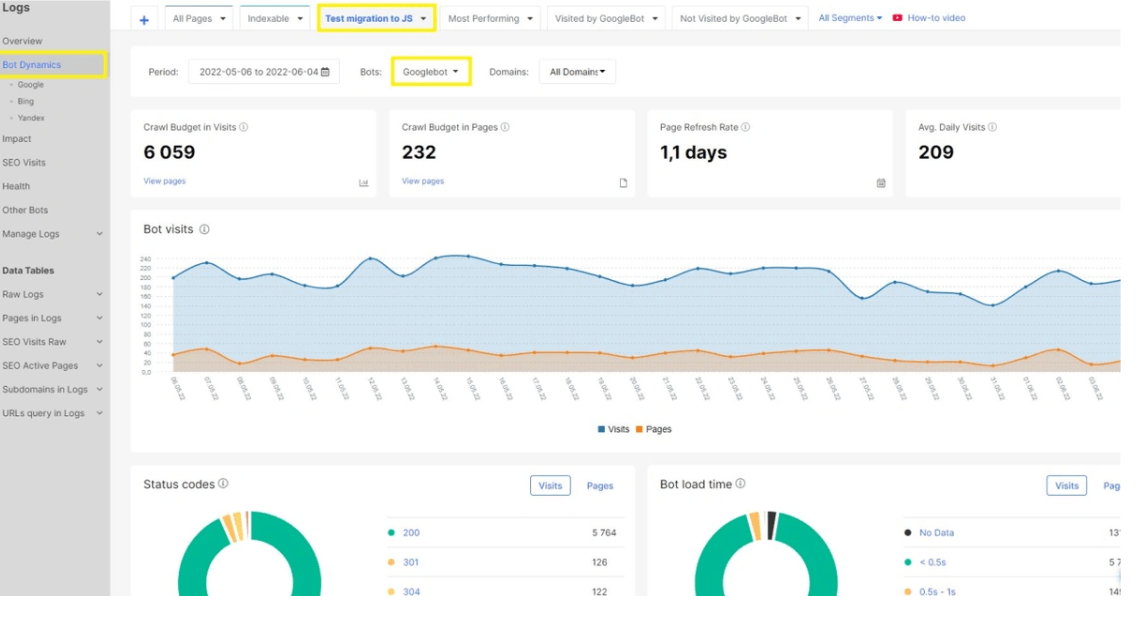 JetOctopus log file analysis provides real-time insights into:
- Which URLs Googlebot crawls first
- How frequently legacy URLs are requested
- Whether redirects are discovered and processed
- If crawl budget shifts toward low-value pages
- Spikes in 404 or 500 errors
- Redirect chain inefficiencies
- Server response time changes
- Crawl anomalies caused by architecture shifts
- Indexation-related signals
Phase 5: Post-Migration Validation & Long-Term Stability
Launching a site does not complete a website migration project. True SEO stability requires ongoing comparison between pre- and post-migration performance. JetOctopus assists with:- Full recrawls of the live site
- Detection of broken internal links
- Monitoring indexable vs non-indexable ratios
- Evaluating crawl depth redistribution
- Analyzing canonical cluster changes
- Identifying newly created orphan pages
- Verifying redirect persistence
- Reviewing sitemap accuracy
- Measuring crawl budget reallocation
Structured Website Migration Checklist
Below is a practical checklist for website migration inspired by the Zero Traffic Loss framework:Pre-Migration Preparation
- Perform a full crawl of the existing website.
- Export all indexable and canonical URLs.
- Benchmark metadata and structured data.
- Identify high-value, high-traffic pages.
- Audit internal linking depth and structure.
- Analyze crawl budget distribution via logs.
- Validate XML sitemap coverage.
- Identify duplicate content clusters.
- Detect orphaned URLs.
- Document response time performance.
Migration Planning & Implementation
- Build a comprehensive redirect mapping file.
- Consolidate redundant or low-quality URLs.
- Validate new URL structure logic.
- Prepare updated canonical configurations.
- Update robots.txt directives.
- Generate accurate XML sitemaps.
- Align SEO and development documentation.
- Define measurable KPIs for success.
- Schedule validation crawls for staging.
- Prepare rollback contingencies if needed.
Post-Launch Execution
- Crawl the live site immediately after deployment.
- Validate all redirect responses.
- Monitor 404, 500 and redirect chains.
- Review canonical and hreflang signals.
- Analyze crawl depth changes.
- Compare old vs new URL inventory.
- Review log-based crawl activity.
- Validate sitemap submissions.
- Monitor indexation trends.
- Track organic traffic stability.
Common Website Migration Mistakes to Avoid
Even with a detailed website migration guide, teams often encounter preventable issues. The most frequent mistakes include:- Skipping a complete pre-migration crawl.
- Launching without redirect validation.
- Allowing staging URLs to become indexable.
- Failing to monitor Googlebot logs during launch.
- Breaking internal linking hierarchies.
- Forgetting to update canonical references.
- Removing strong-performing content without mapping alternatives.
- Changing CMS, design and domain simultaneously without phased testing.
- Ignoring JavaScript rendering discrepancies.
- Publishing inaccurate XML sitemaps.
- Creating redirect chains instead of direct mappings.
- Neglecting post-launch crawl comparisons.
How JetOctopus Reduces Migration Risk
For SEO professionals and developers handling complex website migration projects, visibility is everything. JetOctopus combines large-scale crawling with real log data to provide:- High-speed crawling for enterprise-scale websites
- Advanced URL segmentation and filtering
- Log file analysis showing real search engine behavior
- JavaScript rendering validation
- Crawl comparison reporting
- Crawl budget distribution insights
- Internal link structure visualization
- Canonical cluster analysis
- Real-time issue detection
- Scalable infrastructure for large migration website checklist needs
Turning Website Migration Into an Opportunity
While website migrations carry risk, they also present an opportunity to improve technical SEO foundations. When executed correctly, migrations can:- Optimize site architecture
- Strengthen internal linking pathways
- Improve crawl efficiency
- Consolidate duplicate content
- Enhance page performance
- Improve indexation clarity
- Increase long-term scalability
Get a FREE Audit
We'll perform a comprehensive SEO, AEO, GEO & CRO audit of your website — completely free — and show you exactly how to outrank your competitors.
Don't have a site yet? Get in touch →
Conclusion
A successful website migration is not the result of luck - it’s the result of rigorous planning and deep technical visibility. The Zero Traffic Loss Migration Checklist demonstrates that an effective website migration SEO checklist must integrate crawling, log analysis and ongoing comparison across every stage of the website migration process. For SEO specialists and developers managing a website migration project plan, replacing assumptions with crawl-based intelligence dramatically reduces risk. By aligning structured validation with real-time search engine behavior insights, teams can execute a site migration plan that preserves authority, maintains crawl efficiency and protects organic performance long after launch.Frequently Asked Questions
Why do website migrations so often cause traffic loss?
Migrations change URLs, site structure, internal linking, or rendering logic, forcing search engines to reassess how the site is crawled and indexed. Traffic drops when redirect maps are incomplete, canonical tags are misconfigured, important URLs lose link equity, staging gets indexed, or no baseline crawl data exists to compare against after launch.
What is a pre-migration baseline and why does it matter?
A pre-migration baseline is a complete crawl and log-based audit documenting the site's current technical state: indexable URLs, status codes, canonical relationships, internal link depth, orphan pages, and crawl budget. It matters because without this snapshot there is no reliable way to measure migration success or identify post-launch discrepancies against the previous version.
How should redirects be planned during a migration?
Each valuable URL should transition cleanly to its new equivalent through direct 301 redirects, avoiding chains and loops. Rather than mapping blindly, teams segment pages by crawl depth and importance, prioritize high-frequency URLs from log data, detect duplicate or thin pages for consolidation, and validate redirects by recrawling before and after launch.
Why is staging environment validation important before launch?
Many migration failures happen because teams assume staging mirrors production, then discover hidden errors after going live. Validating staging lets you detect accidental noindex or nofollow directives, confirm canonical and hreflang accuracy, check robots.txt logic, compare metadata, and catch redirect misconfigurations before search engines encounter them, reducing launch-day uncertainty.
What should teams monitor immediately after a migration launches?
The first days after launch are decisive because search engines begin testing the new structure right away. Log file analysis reveals which URLs Googlebot crawls first, how often legacy URLs are requested, whether redirects are being discovered and processed, if crawl budget shifts to low-value pages, and any spikes in 404 or 500 errors.
Put this into action with eSEOspace
We help businesses grow with website development that actually performs. Explore the services behind this guide:
Get a FREE GEO/AEO/SEO Audit
We'll analyze your site's SEO, GEO, AEO & CRO — completely free — and show you exactly how to get found across Google and AI answers.
Don't have a site yet? Get in touch →
Great — your audit is on the way!
We'll send your free SEO/GEO/AEO/CRO audit within the next few hours. Where should we send it?
You're all set! ✓
Your free audit is being prepared — check your inbox in the next few hours. Talk soon!


On this page
- Key Takeaways
- Phase 1: Building a Complete Pre-Migration Baseline
- Phase 2: Strategic Redirect Planning & URL Mapping
- Phase 3: Staging Environment & Pre-Launch Validation
- Phase 4: Monitoring Crawl Behavior During Launch
- Phase 5: Post-Migration Validation & Long-Term Stability
- Structured Website Migration Checklist
- Common Website Migration Mistakes to Avoid
- How JetOctopus Reduces Migration Risk
- Turning Website Migration Into an Opportunity
- Conclusion
- Frequently Asked Questions






